Women As Leaders in the Church

From Miriam to Joan of Arc

Written by Robert Jones

robertcjones@mindspring.com

Click here to see other courses that I've written

Click here to go to the Christian History & Theology home page


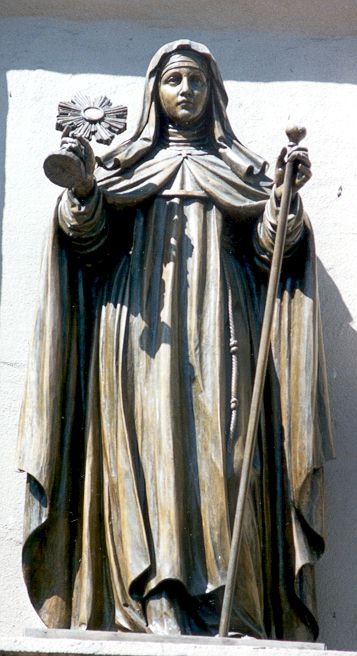
St. Clare at Mission Santa Clara, CA (photo by Robert Jones)


This material may be reprinted free of charge for use by non-profit church groups, as long as the author and copyright information is retained. 


Would you like to teach this course? 

$20.00 - You can purchase a Teacher's Pack, containing:


Click here to order via post

OR

(Note: Clicking on the "PayPal Buy Now" button allows you to order via MasterCard or Visa. You do not have to have a PayPal account.)


Copyright 2000 by Robert C. Jones

I'd love to hear about anyone that uses this material in their Sunday School classes!

robertcjones@mindspring.com

  "Scripture taken from the HOLY BIBLE, NEW INTERNATIONAL VERSION.  Copyright Ó 1973, 1978, 1984 by International Bible Society.  Used by permission of Zondervan Publishing House."


Table of Contents

Table of Contents

Introduction

Defining “leader”

Women as leaders in the church quiz

Old Testament era

Miriam (c. 13th century B.C.)

Deborah (c. 12th century B.C.)

Huldah (c. 7th century B.C.)

Esther  (5th century B.C.)

Judith  (c. 5th century B.C.)

New Testament

The Gospels

The Primitive Church

The Early Church

Patrons

Prophets

Church officials

Monastery and monastic order founders

Middle Ages

Hilda of Whitby (614-680 A .D.)

St. Clare of Assisi (1194-1293)

St. Bridget of Sweden (c. 1303 – 1373)

St. Catherine of Sienna (c.1347 – 1380)

Joan of Arc (1412 – 1431)

Margaretha Sattler (d. 1527)

And in our time…

Sources

Other Christian History & Theology courses

 Introduction

"There is neither Jew nor Greek, slave nor free, male nor female, for you are all one in Christ Jesus." (Gal 3: 26-28, NIV)

This course is intended to portray women who have taken strong leadership positions in the church, from Biblical times to the Middle Ages.  Some of the women discussed, such as Deborah the Judge or Hilda of Whitby are well known and well-recognized.  Others, such as Junias (the apostle?) are less recognized, and may be the object of some controversy.

I should also point out what this study is not about.  It is not a study of all major women in the Bible (just the ones that I somewhat arbitrarily assign “leadership” characteristics to – see list below).  It is also not a study of how attitudes toward women have changed over the years in the Christian Church, although we may touch on some of those attitudes as we go from section to section.  And finally, this is not a polemic for or against women priests, pastors, elders etc. – it’s presented in a “just the facts, ma’am” style.  To be fair, though, I should point out that the denominations in my religious background (Schwenkfelder, Presbyterian, Methodist) all allow women in any leadership position in the church.

One final note – the descriptions of the various women leaders are not meant to be complete biographies, but rather focus on the evidence of their leadership.

Defining “leader”

I will cheerfully admit that my definition of leader is somewhat arbitray.  Below is a list of leadership characteristics that I’ve defined in this study, and some examples of women who have exhibited those characteristics in Church history.


Attribute

Example(s)

Abbesses

Melanie the Younger, St. Brigid of Ireland Hilda of Whitby

Apostle (NT)

Junias (?)

Bishops

St. Brigid of Ireland (?)

Church reformers

St. Catherine of Sienna, St. Bridget of Sweden

Deacons

§         NT: Phoebe

§         St. Olympias

Founders of orders/churches or monasteries

§         NT: Priscilla, Nympha

§         St. Olympias, Melanie the Younger, St. Paula, St. Brigid of Ireland, St. Clare of Assisi

Judges (OT)

Deborah

Military leaders

Deborah, Joan of Arc

Patrons

§         NT: Mary Magdalene, Joanna the wife of Cuza, the manager of Herod's household, Susanna

§         St. Olympias, Melania the Elder

Prophets/visionaries

§         NT/OT: Miriam, Deborah, Huldah, Anna, Daughters of Philip

§         St. Catherine of Sienna, St. Bridget of Sweden, Joan of Arc

Risk themselves to save others

§         OT: Esther, Judith

§         Joan of Arc

Theologians/Scholars

St. Paula, St. Catherine of Sienna

Women as leaders in the church quiz

1.      T/F  There is no example in the Old Testament of a woman being the highest political leader of the Jews

2.      T/F  Women are mentioned in both the Old Testament and the News Testament as being prophets (or having the gift of prophecy)

3.      T/F  No woman is referred to by name in the New Testament as having been a deacon

4.      T/F  The Apostle Paul acknowledged no women as church leaders

5.      T/F  The first person to be given the charter to spread the word of the resurrection of Jesus was Mary Magdalene

6.      T/F  The Bible identifies Mary Magdalene as having been a former prostitute

7.      T/F  There have been no women honored with the title “Doctor of the Church” by the Roman Catholic Church

8.      T/F  During the Middle Ages, there were monastic establishments containing both men and women, ruled over by an abbess

9.      T/F  Only men were allowed to found religious orders during the Middle Ages

10.  T/F  After the Reformation, most Protestant denominations moved quickly to accept women as pastors and priests

Old Testament era

The Old Testament (including the Apocrypha) doesn’t discuss many women in leadership positions, but the ones that it does discuss tend to be described in vivid terms.  We’ll focus on the five listed below.


Name

Leadership Position

Key Bible Books

Miriam

Prophetess, leader

Exodus

Deborah

Judge, prophetess, military leader

Judges

Huldah

Prophetess

2 Kings, 2 Chronicles

Esther

Jewish Queen of Persia

Esther

Judith

Saved Jewish city

Judith

Miriam (c. 13th century B.C.)

The first woman in the Bible to be given the appellation prophetess was Miriam, the sister of Moses and Aaron.  The title appears in Exodus when Miriam leads the women of the Israelites in a victory chant after the destruction of pharaoh’s army in the Red Sea:

20Then Miriam the prophetess, Aaron’s sister, took a tambourine in her hand, and all the women followed her, with tambourines and dancing.  [emphasis added]

21Miriam sang to them:
       
“Sing to the LORD,
       
for he is highly exalted.
       
The horse and its rider
       
he has hurled into the sea.” (Exodus 15:20/21, NIV)

In Numbers 12:2, Miriam identifies herself as a prophet.

An even stronger claim is made for Miriam’s leadership position when she is identified by Micah as being part of the leadership triumvirate of Moses, Aaron and Miriam:

4          I brought you up out of Egypt
       
and redeemed you from the land of slavery.
       
I sent Moses to lead you,
       
also Aaron and Miriam. (Micah 6:4, NIV)

Deborah (c. 12th century B.C.)

Perhaps the most powerful woman depicted in the Old Testament is Deborah the Judge.  She is variously described as a judge, the leader of Israel, a prophetess, and a military leader.  After Moses, only Samuel and Deborah combined all these qualities.  The following verses in Judges attest to the first three aforementioned attributes:

“4Deborah, a prophetess, the wife of Lappidoth, was leading Israel at that time. 5She held court under the Palm of Deborah between Ramah and Bethel in the hill country of Ephraim, and the Israelites came to her to have their disputes decided.”  (Judges 4:4/5, NIV)

Her talents as a military commander are described in the following verses in Judges 4, when she rallies the Israelites to defeat an army of a Canaanite King named Jabin.  First she delivers a prophecy to her selected commander Barak:

“The LORD, the God of Israel, commands you: ‘Go, take with you ten thousand men of Naphtali and Zebulun and lead the way to Mount Tabor. 7I will lure Sisera, the commander of Jabin’s army, with his chariots and his troops to the Kishon River and give him into your hands.’”  (Judges 4:6-7)

 Barak agrees, but only after Deborah agrees to go with him.  Deborah notes before the battle:

“But because of the way you are going about this, the honor will not be yours, for the LORD will hand Sisera [the Canaanite commander] over to a woman.” (Judges 4:9, NIV)

Deborah goes on to order the 10,000 man attack, and the Israelites are successful, killing all of their enemies.

Huldah (c. 7th century B.C.)

Huldah the prophetess is probably the first person to declare a written document (probably the Book of Deuteronomy) to be Holy Scripture (c. 621 B.C.).  The story is described in 2 Kings 22 and 2 Chronicles 34.  It takes place during the reign of King Josiah, when workmen repairing the Temple of Solomon discover an old scroll.  The High Priest Hilkiah knows an important find has been made, exclaiming:

“8Hilkiah the high priest said to Shaphan the secretary, “I have found the Book of the Law in the temple of the LORD.””  (2 Kings 22:8, NIV)

After the book is shared with King Josiah, Josiah charters his high priest and chief of state to find out more about the book, and its contents:

“Go and inquire of the LORD for me and for the people and for all Judah about what is written in this book that has been found.” (2 Kings 22:8, NIV)

The officers (including High Priest Hilkiah) choose to go to the home of Huldah the prophetess for further elucidation:

 “14Hilkiah the priest, Ahikam, Acbor, Shaphan and Asaiah went to speak to the prophetess Huldah, who was the wife of Shallum son of Tikvah, the son of Harhas, keeper of the wardrobe. She lived in Jerusalem, in the Second District.” (2 Kings 22:14, NIV)

The choice of Huldah as the authority to whom the chief priest goes is especially interesting in light of the fact that the prophets Jeremiah, Zephaniah, and Nahum all lived in the same area at the time.  Yet Huldah was chosen.

Immediately after the King’s entourage arrived at Huldah’s house, she began to prophesize:

“15She said to them, “This is what the LORD, the God of Israel, says: Tell the man who sent you to me, 16‘This is what the LORD says: I am going to bring disaster on this place and its people, according to everything written in the book the king of Judah has read. 17Because they have forsaken me and burned incense to other gods and provoked me to anger by all the idols their hands have made, my anger will burn against this place and will not be quenched.’ 18Tell the king of Judah, who sent you to inquire of the LORD, ‘This is what the LORD, the God of Israel, says concerning the words you heard: 19Because your heart was responsive and you humbled yourself before the LORD when you heard what I have spoken against this place and its people, that they would become accursed and laid waste, and because you tore your robes and wept in my presence, I have heard you, declares the LORD. 20Therefore I will gather you to your fathers, and you will be buried in peace. Your eyes will not see all the disaster I am going to bring on this place.’” (2 Kings 22:15-20, NIV)

According to Jewish tradition, Huldah was the head of an academy in Jerusalem.

Interestingly enough, the great Reformer John Calvin (somewhat grudgingly) used Huldah and Deborah as examples of why female leaders might, at times, be legitimate:

“Two years ago, John Knox in a private conversation, asked my opinion respecting female government. I frankly answered that because it was a deviation from the primitive and established order of nature, it ought to be held as a judgment on man for his dereliction of his rights just like slavery — that nevertheless certain women had sometimes been so gifted that the singular blessing of God was conspicuous in them, and made it manifest that they had been raised up by the providence of God, either because he willed by such examples to condemn the supineness of men, or thus show more distinctly his own glory. I here instanced Huldah and Deborah.” (Letter to William Cecil, 1559)

Esther  (5th century B.C.)

Esther was the Jewish Queen of Persian King Xerxes I (5th century).  She is in this collection because she risked her life to save Jews who had been targeted for genocide by the evil Chief Minister of King Xerxes, Haman.

Esther knows that the only way to save the Jews is to petition the King – but to petition the King carries the risk of death:

“11“All the king’s officials and the people of the royal provinces know that for any man or woman who approaches the king in the inner court without being summoned the king has but one law: that he be put to death. The only exception to this is for the king to extend the gold scepter to him and spare his life. But thirty days have passed since I was called to go to the king.”  (Esther 4:11)

In the Old Testament version of Esther, the King receives Esther without incident because he seems glad to see her.  The version in the Apocrypha (from the Septuagint) describes a more touch and go situation:

“7Lifting his face, flushed with splendor, he looked at her in fierce anger. The queen faltered, and turned pale and faint, and collapsed on the head of the maid who went in front of her. 8Then God changed the spirit of the king to gentleness, and in alarm he sprang from his throne and took her in his arms until she came to herself. He comforted her with soothing words, and said to her, 9“What is it, Esther? I am your husband. Take courage; 10You shall not die, for our law applies only to our subjects. Come near.””  (Esther (Gk) 15:7-10, NRSV)

In time, Queen Esther persuades the King to send out a decree allowing the Jews to protect themselves – and Haman is executed.  Esther’s courage is remembered in the Feast of Purim.

Judith  (c. 5th century B.C.)

The Apocryphal Book of Judith is the story of a beautiful young widow who saves a Jewish town from the massed troops of King Nebuchadnezzar.  Next to Deborah, the namesake of the Book of Judith is perhaps the strongest woman depicted in the Old Testament or the Apocrypha – and perhaps the most praised.  It should be noted that some observers (including Martin Luther) believe that Judith is a folk tale, and is not to be taken as describing an actual historical event.

Judith’s town (the otherwise unknown Bethulia) is besieged by almost 200,000 troops under army commander Holefernes.  Holefernes gives orders to cut off the water supply of Bethulia, and in a short time, the city is completely without water.  In despair, the citizens consider surrendering, but Judith gives a passionate speech to the elders of the town, and convinces them to let her try to save them.  Judith becomes a spy in the camp of Holefernes, who falls in love with her.  Eventually Judith is able to assassinate him by cutting off his head.

Judith returns to Bethulia in triumph, and the besieging army eventually withdrawals in disarray.  The Elder Uzziah says of Judith:

18Then Uzziah said to her, ‘O daughter, you are blessed by the Most High God above all other women on earth; and blessed be the Lord God, who created the heavens and the earth, who has guided you to cut off the head of the leader of our enemies. 19Your praise will never depart from the hearts of those who remember the power of God. 20May God grant this to be a perpetual honor to you, and may he reward you with blessings, because you risked your own life when our nation was brought low, and you averted our ruin, walking in the straight path before our God.’ And all the people said, ‘Amen. Amen.’”  (Judith 13:18-20, NRSV)

The story of Judith of Bethulia was made into a silent film by D.W. Griffith in 1913/14. 

New Testament

There are a number of interesting descriptions of women as leaders in the New Testament, including several prophets (Elizabeth, Anna, four daughters of Philip), a deacon (Phoebe), and, perhaps, even an apostle (Junias).  We’ll discuss the Gospels first.

The Gospels

Elizabeth

The story of Elizabeth, the mother of John the Baptist, is described in the first chapter of Luke.  She appears in our study here because, at least once, she is granted the gift of prophecy.  The incident occurs when her kinsman Mary, who is pregnant with the baby Jesus, visits her:

“39At that time Mary got ready and hurried to a town in the hill country of Judea, 40where she entered Zechariah’s home and greeted Elizabeth. 41When Elizabeth heard Mary’s greeting, the baby leaped in her womb, and Elizabeth was filled with the Holy Spirit. 42In a loud voice she exclaimed: “Blessed are you among women, and blessed is the child you will bear! 43But why am I so favored, that the mother of my Lord should come to me? 44As soon as the sound of your greeting reached my ears, the baby in my womb leaped for joy. 45Blessed is she who has believed that what the Lord has said to her will be accomplished!””  (Luke 1:39-45, NIV)

Anna

Anna, an 84-year-old Temple attendant, is another example of a prophetess in the New Testament, and is one of the first people to proclaim that Jesus is the Messiah.  The description occurs in Luke 2:

“36There was also a prophetess, Anna, the daughter of Phanuel, of the tribe of Asher. She was very old; she had lived with her husband seven years after her marriage, 37and then was a widow until she was eighty-four.  She never left the temple but worshiped night and day, fasting and praying. 38Coming up to them [Mary, Joseph, and the baby Jesus] at that very moment, she gave thanks to God and spoke about the child to all who were looking forward to the redemption of Jerusalem.”  (Luke 2:36-38, NIV, emphasis added)

Mary Magdalene

Mary Magdalene was a follower of Jesus, and a supporter (patron) of his ministry, as in Luke 8:1-4:

“1After this, Jesus traveled about from one town and village to another, proclaiming the good news of the kingdom of God. The Twelve were with him, 2and also some women who had been cured of evil spirits and diseases: Mary (called Magdalene) from whom seven demons had come out; 3Joanna the wife of Cuza, the manager of Herod’s household; Susanna; and many others. These women were helping to support them out of their own means.”  (Luke 8:1-4, NIV)

Mary is an important part of the Passion story in the New Testament.  She is present at the cross with Jesus when the other disciples have fled (John 19:25).  She is among first to see the empty tomb (Luke 24:10) of Jesus, and is the first person to see and speak to the resurrected Christ (John 20:10/18).  More significantly, she is the first to be given the charter to spread the message of the resurrected Christ:

“17Jesus said, “Do not hold on to me, for I have not yet returned to the Father. Go instead to my brothers and tell them, ‘I am returning to my Father and your Father, to my God and your God.’” 18Mary Magdalene went to the disciples with the news: “I have seen the Lord!” And she told them that he had said these things to her.”  (John 20:17/18, NIV)

Out of all the figures in the New Testament, Mary Magdalene has probably had the worst public relations.  Most people today when asked about Mary’s profession would answer “former prostitute” -  yet there is no place in the New Testament where this is stated. 

In some non-canonical sources, Mary is described as having an even larger role in the ministry of Jesus.  The Gospel of Peter, for example, explicitly describes her as a disciple:

"And at dawn upon the Lord's day Mary Magdalene, a disciple of the Lord...took her friends with her and came to the sepulcher where he was laid." (Gospel of Peter 1:12, trans. from Lost books of the Bible, p. 285)

Some Gnostic gospels describe Mary as being on the same level as the Apostles.

Mary Mother of Jesus

We don’t normally think of Mary, mother of Jesus as having a leadership position, but the following points could be made: 

“14They [the apostles, minus Judas] all joined together constantly in prayer, along with the women and Mary the mother of Jesus, and with his brothers.”  (Acts 1:14, NIV)

The Primitive Church

There are many strong women mentioned in the New Testament as having been leaders in the primitive church.  Some started churches, at least one served as a deacon; several are described as having the gift of prophecy.   Key references are summarized below.  We’ll explicitly discuss Phoebe, Priscilla, Junias, and the daughters of Philip.


Woman

Reference

Comment

Phoebe

Romans 16:1-2

"a deaconess of the church"

Priscilla (or Prisca)

Rom 16:3-5, 1 Cor 16:19

Founded at least two home churches with her husband Aquila

Junias

Rom 16:7

"outstanding among the apostles"

Nympha

Col 4:15

Started church in her house

Mary, Mother of Jesus

Acts 1:14

Present at first meetings of church

Euodia, Syntyche

Phil 4:2-3

"these women who have contended at my side in the cause of the gospel"

Four daughters of Philip

Acts 21:8/9

Prophetesses

Phoebe

Phoebe is mentioned by Paul in Romans 16:1-2.  The NIV translates it as follows:

“1I commend to you our sister Phoebe, a servant of the church in Cenchrea. 2I ask you to receive her in the Lord in a way worthy of the saints and to give her any help she may need from you, for she has been a great help to many people, including me.”  (Roamns 16:1-2, NIV)

The word that the NIV (and KJV) translates as “servant” is actually from the Greek word diakonos, which, according to Thayer’s Greek Definitions means:

“1b) a deacon, one who, by virtue of the office assigned to him by the church, cares for the poor and has charge of and distributes the money collected for their use”

We can thus assume that Phoebe held the office of deacon in her church (the NIV has a note which gives an alternative translation of diakonos as “deaconess”).

Priscilla (Prisca)

Priscilla and her husband Aquila (tentmakers by trade) are mentioned 6 times in the New Testament.  Interestingly, Priscilla is mentioned before her husband four of those six times (Acts 18:18,26, Rom 16:3, 2 Tim 4:19) – an unusual practice in New Testament times.  An article in Bible Review states:

"The public acknowledgment of Prisca's prominent role in the Church, implicit in the reversal of the secular form of naming the husband before his wife, underlies how radically egalitarian the Pauline communities were."  (Prisca and Aquila, Bible Review, 12/92, p. 42)

John Calvin in his Commentary on Romans says about Priscilla:

“It is a singular honor which he ascribes here to Prisca and Aquila, especially with regard to a woman. The modesty of the holy man does on this account more clearly shine forth; for he disdained not to have a woman as his associate in the work of the Lord; nor was he ashamed to confess this…”

The two of them founded at least two churches in their home (Rom 16:3-5, 1 Cor 16:19).

Junias

The most controversial possible reference to a woman leader in the New Testament is in Romans 16:7:

“7Greet Andronicus and Junias, my relatives who have been in prison with me. They are outstanding among the apostles, and they were in Christ before I was.”

Why is this seemingly innocent passage controversial?  Because one way of reading it is to view that Paul was saying that Andronicus and Junias were outstanding apostles – and Junias is the feminine form of a Greek name.  If this is the correct interpretation, then we have a female apostle. 

The Revised Standard Version muddies the waters by stating “they are men of note among the apostles”.  However, Junias (Iounias)is clearly of the feminine form, as Thayer’s Greek Definitions states:

“1) a Christian woman at Rome, mentioned by Paul as one of his kinsfolk and fellow prisoner
Part of Speech: noun proper feminine”

St. John Chrysostom (c. 345-407), Patriarch of Constantinople, referred to Junias as a female apostle in one of his sermons:

“And indeed to be apostles at all is a great thing. But to be even amongst these of note, just consider what a great encomium this is! But they were of note owing to their works, to their achievements. Oh! how great is the devotion of this woman, that she should be even counted worthy of the appellation of apostle!” (Homily 31, Homilies of St. John Chrysostom Archbishop of Constantinople on the Epistle of St. Paul the Apostle to the Romans)

So, there is some evidence that there was a female apostle – not in the sense of being one of the 12, but in the post-ascension sense (Acts 14:14, 1 Cor 15:7).

Daughters of Philip

Acts 2:17 explicitly states that women have the ability to prophesize: 

17“‘In the last days, God says,
I will pour out my Spirit on all people.
Your sons and daughters will prophesy,
your young men will see visions,
your old men will dream dreams.  (Acts 2:17, NIV)

Four women who are mentioned explicitly in Acts as having the ability to prophesize are the daughters of Philip (probably the Deacon):

“8Leaving the next day, we reached Caesarea and stayed at the house of Philip the evangelist, one of the Seven. 9He had four unmarried daughters who prophesied.” (Acts 21:8-9, NIV)

The Early Church

The post-Apostolic period, or the period after the death of John the Apostle, is not traditionally viewed as a period of active female leadership in the church.  However, there are some glimpses of female leadership that can be seen through the vale of time.  Certainly, there were female patrons of Church Fathers (Origen), as well as evidence of female prophets (Apostolic Constitutions).  Women founded monasteries and monastic orders (St. Olympias, Melania the Younger, Paula, St. Brigid of Ireland).  And there is clear evidence of women being ordained as deaconesses during this period (St. Olympias) – and possibly some early evidence that there might have been women priests and bishops.  We’ll examine each of these in turn.

Patrons

One role in which many wealthy women acted during the Early Church period was that of a patron of a high-church official or theologian.  Eusbius, in his Ecclesiastical History, tells of a “woman of great wealth” that is the patron of the young Origen (185 - 253 A.D.), whose family had been placed into poverty following the martyrdom of his father:

“These and other things like them are related to Origen when a boy. But when his father ended his life in martyrdom, he was left with his mother and six younger brothers when he was not quite seventeen years old. And the poverty of his father being confiscated to the royal treasury, he and his family were in want of the necessaries of life. But he was deemed worthy of Divine care. And he found welcome and rest with a woman of great wealth, and distinguished in her manner of life and in other respects”. (Eusebius 6.2)

St. Olympias, who will be discussed in further detail in a later section, was an immensely wealthy widow who was a patron of St. John Chrysostom, Patriarch of Constantinople.

Prophets

Although not as prominent and well known as women prophets of the Middle Ages (St. Catherine of Sienna, St. Bridget of Sweden), there is some evidence that there were women with the gift of prophecy in the Early Church.  The 3rd or 4th century Apostolic Constitutions, sort of a guidebook for church liturgy and practice, hints at the existence of women prophets during that period:

“Now women prophesied also. Of old, Miriam the sister of Moses and Aaron, and after her Deborah, and after these Huldah and Judith” — the former under Josiah, the latter under Darius. The mother of the Lord did also prophesy, and her kinswoman Elisabeth, and Anna; and in our time the daughters of Philip: yet were not these elated against their husbands, but preserved their own measures. Wherefore if among you also there be a man or a woman, and such a one obtains any gift let him be humble that God may be pleased with him. For says He: Upon whom will I look, but upon him that is humble and quiet, and trembles at my words?” (Apostolic Constitutions, 8.1.11)

Church officials

According to the Catholic Encyclopedia, St. Olympias was consecrated deaconess by Nectarius, Bishop of Constantinople.  Further proof that women were deacons during this period is provided in the aforementioned Apostolic Constitutions, which include a ceremony for the ordination of deaconesses.  Among the duties of the deaconess – to assist in the ceremony of baptism.  The following quotes are all from Apostolic Constitutions:

“Let also the deaconess be honored by you in the place of the Holy Ghost…” (2.4)

 “Ordain also a deaconess who is faithful and holy, for the ministrations towards women. For sometimes he cannot send a deacon, who is a man, to the women, on account of unbelievers. Thou shalt therefore send a woman, a deaconess, on account of the imaginations of the bad. For we stand in need of a woman, a deaconess, for many necessities; and first in the baptism of women, the deacon shall anoint only their forehead with the holy oil, and after him the deaconess shall anoint them…” (3.2)

"And let the deaconess be diligent in taking care of the women; but both of them [deacons and deaconesses] ready to carry messages, to travel about, to minister, and to serve, as spake Isaiah concerning the Lord, saying: “To justify the righteous, who serves many faithfully.” (3.2)

CONCERNING THE SACRED INITIATION OF HOLY BAPTISM

“Thou therefore, O bishop, according to that type, shalt anoint the head of those that are to be baptized, whether they be men or women, with the holy oil, for a type of the spiritual baptism. After that, either thou, O bishop, or a presbyter that is under thee, shall in the solemn form name over them the Father, and Son, and Holy Spirit, and shall dip them in the water; and let a deacon receive the man, and a deaconess the woman, that so the conferring of this inviolable seal may take place with a becoming decency. And after that, let the bishop anoint those that are baptized with ointment”. (3.2)

THE FORM OF PRAYER FOR THE ORDINATION OF A DEACONESS

“O Eternal God, the Father of our Lord Jesus Christ, the Creator of man and of woman, who didst replenish with the Spirit Miriam, and Deborah, and Anna, and Huldah; who didst not disdain that Thy only begotten Son should be born of a woman; who also in the tabernacle of the testimony, and in the temple, didst ordain women to be keepers of Thy holy gates, — do Thou now also look down upon this Thy servant, who is to be ordained to the office of a deaconess, and grant her Thy Holy Spirit, and “cleanse her from all filthiness of flesh and spirit,” that she may worthily discharge the work which is committed to her to Thy glory, and the praise of Thy Christ, with whom glory and adoration be to Thee and the Holy Spirit for ever. Amen.” (8.3)

So clearly there were deaconesses during this period.  But what about priests or bishops?  Karen Jo Torjesen, in her book When Women Were Priests, offers some archaeological and historical evidence that there were indeed early female priests and bishops.  I summarize her evidence below:

There is also some evidence that St. Brigid of Ireland (c. 451/452 – 525) may have held a position similar to bishop while she was abbess of Kildare.

Monastery and monastic order founders

There are several examples of women who founded monasteries or monastic orders during the Early Church and post-Nicene periods.  Some well-known examples are St. Olympias, Melania the Younger (and her grandmother), St. Paula, and St. Brigid of Ireland.  We’ll examine each one briefly, focusing on evidence of their leadership.

St. Paula (347 - 404)

St. Paula was a scholar and compatriot of St. Jerome, under whom she studied in both Rome and Jerusalem.  (Jerome once said of her that she knew the Scriptures by memory).  In Bethlehem, she financed construction of a monastery, a nunnery, and a hospice.

St. Olympias (c. 360/5 – 408)

Olympias of Constantinople was a wealthy disciple and patron of St. John of Chrysostom, Patriarch of Constantinople (398).  She was ordained a deaconess by Bishop Nectarius of Constantinople, and later built a convent in Constantinople.

She remained a staunch supporter of St. John during his exile from Constantinople.

Melania the Younger (c. 383 – 439)

Melania the Younger was an acquaintance of both St. Augustine and St. Jerome.  She built several monasteries and nunneries, in both Africa and in Jerusalem (one on the Mount of Olives).  She served as the abbess of at least one of the nunneries that she built.

Her grandmother, Melania the Elder, was a patron of Rufinus, who translated Origen's writings into Latin.  The Elder founded a monastery on Mt. of Olives.

St. Brigid of Ireland (c. 451/452 – 525)

St. Brigid founded the famous Convent of Cill-Dara, or Kildare, which grew into a cathedral city during her tenure as abbess.  Points of interest regarding St. Brigid include:

Middle Ages


The Middle Ages was a time when prominent women served as abbesses, theologians, founders of religious orders, and prophets.  We’ll look at some of the more prominent ones, including Hilda of Whitby, St. Catherine of Sienna, St. Clare of Assisi and St. Bridget of Sweden.  To finish off this study, we will look a Protestant church leader in the 16th century, Margaretha Sattler.

Hilda of Whitby (614-680 A .D.)


11th century remains of Whitby Abbey, founded in the 7th century by Hilda of Whitby. (Photo by Robert Jones)

St. Hilda founded Whitby Abbey in England, and, in 663, hosted the Synod of Whitby that decided against the Celtic calendar and tonsure, ensuring that Celtic monasticism in the future would have a more Roman flavor.  During her reign as abbess, five future bishops trained in her “double monastery” (male and female) community.

“Double monasteries” were not uncommon in England during this period, and included Whitby, Ely, Much Wenlock, Bardney, Barking, Coldingham, Repton and Wimborne. About these monasteries Medieval Monasteries of Great Britain says "England became renowned for the devoutness and scholarship of its double monasteries for men and women, each under the rule of an abbess..." (Medieval Monasteries of Great Britain, p. 22)

St. Clare of Assisi (1194-1293)

St. Clare of Assisi, a disciple of St. Francis of Assisi, founded the Order of Poor Ladies, later known as the Poor Clares.  She served as the abbess of the first community of the Poor Clares at San Damiano, in the Diocese of Assisi, for 40 years.  Like her mentor St. Francis, she believed that those consecrated to Christ should live in complete poverty. 

The Order spread quickly throughout Europe.  In Spain, 47 convents were founded in the 13th century alone.  The order still exists today:

“Today, the Poor Clares form a worldwide order of more than 17,000 nuns in a thousand monasteries, some thirty of which are located in the United States.”  (http://pages.prodigy.net/abrgreenville/page2.html)

St. Bridget of Sweden (c. 1303 – 1373)

St. Bridget of Sweden founded the Established Order of the Most Holy Savior, better known as the Brigittines.  The order was made up of dual (male and female) monasteries, ruled by an abbess.  The order dissipated during the 19th century, but was revived on a much smaller scale in 1976 (today they are renowned for their fudge).

During hew lifetime, Bridget was renowned for her visionary qualities, and writings about her revelations were revered during the Middle Ages.  Like St. Catherine of Sienna, St. Bridget called for Pope's return to Rome from Avignon, and worked tirelessly for church reforms.  In a letter to Pope Gregory XI she said, "In thy curia arrogant pride rules, insatiable cupidity and execrable luxury." (Christian Women Writers of the Medieval World, p. 23)

St. Catherine of Sienna (c.1347 – 1380)

During her brief life, the remarkable St. Catherine of Sienna was a prophet/visionary, advisor to two popes, a church reformer, a noted theologian, and a papal negotiator.  She was made a Doctor of Theology by the Roman Catholic Church in 1970, one of only three women, and one of only thirty-three people who have received that honor in the last 2000 years.  Some highlights of her life are noted below:

Joan of Arc (1412 – 1431)

(Photo by Robert Jones)

Joan of Arc, the “Maid of Orleans”, was renowned for being a visionary and a military leader.  Joan was born in Domremy, France in 1412.  From age 13 onwards, she had a series of visions from the Archangel Michael, and the Saints Catherine and Margaret.  In 1429, believing that she had received instructions to liberate France from the English, she rode 300 miles through enemy territory to see the dauphin, Charles VII.  Eventually, Charles, convinced that her powers did indeed come from heaven, put Joan in charge of his army.  

In 1429, Joan achieved her greatest military victory when she led 4000 troops to relieve the besieged town of Orleans.  After liberating Orleans, Joan defeated the English in several other battles, and liberated several other French towns.

In 1430, during an attack to liberate Paris, Joan was captured by the Burgundians, and sold to the British.  She was tried by the French Inquisition for sorcery and heresy, and burned at the stake in 1431.  In 1456, the results of the inquisitorial trial were reversed by Pope Calixtus III – a rare example of the Inquisition being overridden by a pope.  Pope Benedict XV canonized Joan of Arc in 1920.

Margaretha Sattler (d. 1527)

We end our historical discussion of women leaders in the church with a quick look at a female Protestant reformer – Margaretha Sattler. 

Margaretha belonged to a lay order of nuns called the Beguines.  In 1523, she left the order to marry Michael Sattler, an ex-Benedictine prior.  Together, they joined the early Anabaptist movement (of which the Mennonites and Amish are modern day descendents), and quickly emerged as leaders.

On February 24, 1527, she and her husband Michael brought a group of Anabaptists together in the small German town of Schleitheim, to form the first “Confession” or “Articles of Faith” of the Anabaptist movement.  It become known as the Schleitheim Confession.

Soon after the meeting, Margaretha and Michael were captured by the Catholics, and put on trial in Rottenburg for heresy.  Michael was burned at the stake on May 17, 1527, and, according to Martyr’s Mirror:

“His wife, also, after being subjected to many entreaties, admonitions and threats, under which she remained steadfast, was drowned a few days afterwards.”  (Martyr’s Mirror, 1660)

And in our time…

Other then the aforementioned example of Margaretha Sattler and the Anabaptists, it was a long time before most Protestant denominations accepted women as priests/pastors and elders. 

The Presbyterian Church (U.S.A.) for example, didn’t recognize women pastors and elders until the 1950s/60s:

“The first ordination of women as elders in this denomination [Presbyterian Church (U.S.A.)] actually occurred in 1962. As ministers, women were ordained beginning 1965.”  (http://www.pcusa.org/pcusa/info/women.htm)

The United Methodist Church took a similar path:

“Full clergy rights for women were finally granted in 1956, but it took a decade more before the number of women in seminaries and pulpits began to grow significantly. When Methodists and the Evangelical United Brethren united in 1968, the right of women to full clergy status was included in the plan of union.”

(http://www.umc.org/churchlibrary/discipline/history/movement_toward_union.htm)

The Lutheran (1970s), Episcopal (1976) and Anglican (1992) denominations took even longer to ordain women pastors/priests.

The Southern Baptist Convention, on the other hand, recently upheld its long-standing prohibition on female pastors:

“A New Testament church of the Lord Jesus Christ is an autonomous local congregation of baptized believers, associated by covenant in the faith and fellowship of the gospel…Its scriptural officers are pastors and deacons.  While both men and women are gifted for service in the church, the office of pastor is limited to men as qualified by Scripture.”  (Adopted by the Southern Baptist Convention June 14, 2000) http://www.utm.edu/martinarea/fbc/bfm/6.html

In 1976, the Declaration of the Sacred Congregation for the Doctrine of the Faith on the question of the admission of women to the ministerial priesthood upheld the long-standing doctrine of the Roman Catholic Church to not allow women priests.  Among the arguments:

“The whole sacramental economy is in fact based upon natural signs, on symbols imprinted upon the human psychology: ‘Sacramental signs,’ says Saint Thomas, ‘represent what they signify by natural resemblance. The same natural resemblance is required for persons as for things: when Christ’s role in the Eucharist is to be expressed sacramentally, there would not be this ‘natural resemblance’ which must exist between Christ and his minister if the role of Christ were not taken by a man: in such a case it would be difficult to see in the minister the image of Christ. For Christ himself was and remains a man.” (emphasis added) http://www.womenpriests.org/church/interlet.htm

Sources

Title

Author

Publisher

Date

A Woman Was the First to Declare Scripture Holy

William E. Phipps

Bible Review

4/90

Art Explosion 600,000


Nova Dev.

1999

Catherine of Siena

Caroline T. Marshall