Basic Christian
Theology
Written by Robert Jones
Click here to see other courses that I've written
Click here to go to the Christian History & Theology home page
Acworth, Georgia
|
|
|
|
|
|
Copyright 2002 by Robert C. Jones
This material may be reprinted free of charge for use by non-profit church groups, as long as the author and copyright information is retained.
Would you like to teach this course?
$20.00 - You can purchase a Teacher's Pack, containing:
OR
(Note: Clicking on the "PayPal Buy Now" button allows you to order via MasterCard or Visa. You do not have to have a PayPal account.)
I'd love to hear about anyone that uses this material in their Sunday School classes!
"Scripture taken from the HOLY BIBLE, NEW
INTERNATIONAL VERSION. Copyright 1973,
1978, 1984 by International Bible Society. Used by
permission of Zondervan Publishing House."
Reformation
(Protestant) theology
Evidence
for the Historical Jesus
Other Christian History & Theology courses
This survey study of Basic Christian Theology is taken from a series of sermons and Sunday School courses that I’ve written over the last 10 years. The purpose of this course is to answer the questions What do Christians believe?” and “What do Protestants believe” (and how are Protestant beliefs different from Roman Catholic beliefs). This course was written to be taught in three-to-four 60-90 minutes sections – it is not meant to be an in depth study.
Specifically, we’ll cover these topics:
The Apostles Creed and the Nicene Creed (two Creeds accepted by almost all Christians, Catholic and Protestant)
Basic Reformation (Protestant) theology
Evidence for the historical Jesus
Some may question why the third topic above is in a course on basic theology, but I actually consider it to be key, because Christianity, more than any other religion, is based on the belief that a series of historical events actually occurred (the death and resurrection of Jesus Christ). Paul goes so far as to say that if these events didn’t actually occur, our faith has no basis:
"But if it is preached that Christ has been raised from the dead, how can some of you say that there is no resurrection of the dead? If there is no resurrection of the dead, then not even Christ has been raised. And if Christ has not been raised, our preaching is useless and so is your faith. More than that, we are then found to be false witnesses about God, for we have testified about God that he raised Christ from the dead. But he did not raise him if in fact the dead are not raised. For if the dead are not raised, then Christ has not been raised either. And if Christ has not been raised, your faith is futile; you are still in your sins. Then those also who have fallen asleep in Christ are lost. If only for this life we have hope in Christ, we are to be pitied more than all men." (NIV, I Corinthians 15:12-19, emphasis added)
"Christian
truth could not possibly be put into a shorter and clearer statement." –
Martin Luther
The Apostles Creed (along with the Nicene Creed) is a basic
statement of Christian belief. It
defines the set of beliefs that makes a Christian a Christian.
The Creed was originally written partially as an affirmation of
basic Christian beliefs, and partly as a refutation of Gnostic beliefs.
The Apostles Creed is recited in many churches every Sunday
during worship. Why do Christians
make such a weekly public proclamation? The
need to express one’s belief publicly is explained in Romans 10: 9-10:
"That if you confess with your mouth, "Jesus is Lord," and believe in your heart that God raised him from the dead, you will be saved. For it is with your heart that you believe and are justified, and it is with your mouth that you confess and are saved." (NIV, Romans 10: 9-10)
"I call it
the Apostles' Creed, though I am by no means solicitous as to its
authorship." – John Calvin
Although the Apostles Creed has long born the identifier
“apostle”, it was probably NOT written by the Apostles – there is no
reference to it in the New Testament, nor did any of the apostles ever claim to
have written it (although there are non-canonical sources that claim that each
Apostle (Matthias replacing Judas) added one of the original 12 statements (or
"articles")).
Although the apostles did not write the Creed, it is still
ancient in origin - it dates back to at least the mid-2nd century.
It was probably originally used as a creed spoken during (adult) baptism
ceremonies, as a basic statement of Christian faith.
The Apostles Creed was a Western church creed, as the Nicene Creed was a
product of the Eastern Church.
The version we use today was fairly intact by the 7/8th
centuries. There are slight variations in the Catholic and Protestant versions
(and between Protestant denominations) used today.
The Creed is divided into three main sections - belief in the Father, the Son, and the Holy Ghost (Spirit), thus underscoring the Trinitarian beliefs of Christians – belief in the three-in-one God. A phrase-by-phrase look at the Creed follows.
We put our faith in an omnipotent, omnipresent God that created everything in the universe, both material and spiritual. This God has ultimate and complete control over everything in the universe. This is in stark contrast to some Gnostic and Eastern religions that believe that there are two Gods in the universe of equal strength - one that created the heaven and the spiritual realm, one that created earth and the material realm. One of the reasons the Apostles Creed was originally written was to refute these “dualist” views
Jesus is the Son of God - not just a prophet or teacher.
While Jesus was a human being, there was something special about his birth and parentage - He comes from God. (Protestants generally view that Mary was the mother of the human part of Jesus, and not "Mary, Mother of God"). A key point is that Jesus was NOT just a spirit, as some early Gnostics claimed (docetism), but was an incarnate human being.
Some people may wonder why a sacred creed of the Christian
Church contains a reference to an obscure Roman governor of 2000 years ago. The
reason for the reference is this - Christianity is a religion that is based on
the belief in the occurrence of certain historical events, one of which is the
crucifixion and death of Jesus Christ. The
reference to Pilate (whom archeology has proved to have been a real person)
places Jesus in an historical place in an historical time.
Jesus interacted with historical figures, and died a horrible death
This part of the Creed is the most controversial, and
difficult to understand statement in the Creed. It was not in the early baptismal versions, and isn’t
present in some Protestant versions of the Creed (Mennonite, Methodist).
There are various interpretations:
Some view that it means the same as "buried", or "tomb"
It may mean that Jesus descended to the "abode of the dead" (the meaning of "hades" - "hell" is an Anglo-Saxon word), and was separated from God during that period (in Revelation, the “Second Death" is isolation from God). (See also the curious passages at 1 Peter 3:18-20)
"But after explaining what Christ endured in the sight of man, the Creed appropriately adds the invisible and incomprehensible judgment which he endured before God, to teach us that not only was the body of Christ given up as the price of redemption, but that there was a greater and more excellent price — that he bore in his soul the tortures of condemned and ruined man...Thus by engaging with the power of the devil, the fear of death, and the pains of hell, he gained the victory, and achieved a triumph, so that we now fear not in death those things which our Prince has destroyed." (John Calvin, Christian Institutes)
The key moment in Christianity is the resurrection of
Christ. Paul in I Corinthians
15:12-19 believed that this event was so important, that Christianity had little
meaning without out – “And if Christ has not been raised, our preaching is
useless and so is your faith."
This part of the Creed also demonstrates that Jesus has a special place in heaven - at the side of the Father (see also Revelation Chapters 4&5).
Jesus is the final arbiter of humanity - all will be judged whether living or dead. This final judgment is described in Revelation 20:12-15:
"Then I saw a great white throne and him who was seated on it. Earth and sky fled from his presence, and there was no place for them. And I saw the dead, great and small, standing before the throne, and books were opened. Another book was opened, which is the book of life. The dead were judged according to what they had done as recorded in the books. The sea gave up the dead that were in it, and death and Hades gave up the dead that were in them, and each person was judged according to what he had done. Then death and Hades were thrown into the lake of fire. The lake of fire is the second death. If anyone's name was not found written in the book of life, he was thrown into the lake of fire." (NIV, Rev 20:12-15)
The third part of the triune God - the Holy Ghost (Spirit), our counselor and comforter.
"Catholic" in this context means, simply, "universal" - it is NOT referring to the Roman Catholic Church. Thus, it is still included in many Protestant versions of the Creed. However, some Protestant versions substitute other verbiage - the Anabaptist (Mennonite) version, for example, says "a holy general Christian church"; Luther said, simply "holy Christian Church"
In this case, "church" does not refer to a building, organization, or denomination - it is the sum of all believers, living, dead, or to be born. It transcends denominational boundaries. The universal church is made up of the assembly or congregation of Christians (or "saints", as the Apostle Paul uses the term) - us!
One of the key reasons that Christ became incarnate - to
redeem our sins. All humans are
sinners (including all Christians) - but Christians are forgiven of their sins,
by the sacrifice of Christ on the cross.
The death of the body is not the end of the line for
Believers. We will have everlasting
life with God. The phrase
"resurrection of the body" evokes an image of Halloween creatures in a
graveyard. However, we do not know
exactly what form this resurrection will take.
As Paul says in I Corinthians 15:51-52:
"Listen, I tell you a mystery: We will not all sleep, but we will all be changed--in a flash, in the twinkling of an eye, at the last trumpet. For the trumpet will sound, the dead will be raised imperishable, and we will be changed."
So be it!
In 312 A.D., an amazing event occurred – perhaps the most amazing event in church history since the time of the apostles. A general in the Roman Empire named Constantine marched on Rome, in an attempt to take over control of the Western Empire. Arrayed against him were the forces of Maxentius, four times as strong. At a key point in the battle, Constantine had a vision, which is described by Ecclesiastical Historian Eusebius:
“He
said that about noon, when the day was already beginning to decline, he saw with
his own eyes the trophy of a cross of light in the heavens, above the sun, and
bearing the inscription, CONQUER
BY THIS.
At this sight he himself was struck with
amazement, and his whole army also, which followed him on this
expedition, and witnessed the miracle.”
Constantine went on to win the battle against Maxentius,
take over control of the Western Empire, and convert to Christianity – the
first Roman Emperor to do so. By
324 A.D., Constantine had taken over the Eastern Empire as well, and had
established Christianity as the preferred religion in his realm.
While Constantine was primarily focused on political and
military issues, his bishops were in the midst of a great debate, started by the
Presbyter of Alexandria Arius (c. 250 - 336 A.D.).
Arius believed that Jesus, the Son was on a lower level than the Father.
Specifically:
“The Father existed before the Son. There was a time when the Son did not exist. Therefore, the Son was created by the Father. Therefore, although the Son was the highest of all creatures, he was not of the essence of God.”
Arius viewed that Christ was an intermediary distinct from the Father (or that there was a difference of substance (homoiousia), or essential being between the Father and the Son.).
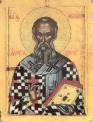
Arguing strenuously against the views of Arius was Athanasius, (c. 296-373 A.D.), later Bishop of Alexandria. Athanasius argued that the Word (John 1:1-18) became man - the Word did not come into a man. Thus, Christ is fully God and fully man.
High Noon occurred in 325 A.D. when Constantine, emperor of the Roman Empire ordered that the debate be settled once and for all. A great church council was ordered, and it took place at Nicea (in Bithynia). Over 300 bishops attended the council, most from the Eastern part of the Empire. Arius lost the debate, and the view of Athanasius became the view of the church. The doctrine of homoousios was affirmed – that Christ was of one (or the same) substance with the Father.
While the earlier Apostle’s Creed tended to focus on the nature of the incarnate Christ, the Nicene Creed tended to focus on the relationship of Christ to the Father (and, later, the Holy Ghost).

St.
Athanasius, who argued successfully against the views of Arius
God created everything in the universe – including physical things (refuting the views of the Gnostics, which viewed that there were two gods in the universe, one that created the pure heavenly and spiritual realms, and one that created the impure physical realms.)
The centerpiece of the Creed – the relation of Christ to the Father. As noted above, Christ was NOT a created being, but rather “God of God” and “True God of True God”. This matches well with scripture readings such as Colossians:
“He is the image of the invisible God, the firstborn over all creation. For by him all things were created: things in heaven and on earth, visible and invisible, whether thrones or powers or rulers or authorities; all things were created by him and for him. He is before all things, and in him all things hold together.” (NIV, Col 1:15-17 )
The key phrase in the Nicene Creed is “being of one substance with the Father”. Arius viewed that Christ was of “like” or “similar” essence with the Father. This is NOT a sufficient explanation – a pulpit is made of wood, and so is the rocking chair in my living room, so they are of “like” substance – but not very connected. The Creed says of the ONE substance (or essence), thus putting Christ, “by whom all things were made”, on the same level as the Father.
Quite similar in verbiage to the Apostles Creed – and making the same point. Christ actually became a living, breathing human being – he was a historical figure, who lived, died on the cross, and rose again. He was not just a spirit, as some Gnostics believed.
There will be a Second Coming, and a final day of reckoning – Judgment Day, where the living and the dead will be judged by Christ himself (see Revelation 20:11-15)
This passage confirms
the Trinitarian nature of the godhead – Father, Son and Holy Ghost.
This is also the section that helped cause the schism between the Roman
Church, and the Eastern (Orthodox) Church in the 11th century (and
also, the only significant difference in the Creed between the Eastern and
Western churches). The Eastern
Church says that the Holy Spirit proceeds from the Father – the Western Church
(including the Protestant churches) say that the Spirit proceeds from the Father
and the Son.
There is one universal church, founded and descendent from the apostles.
The death of the body is not the end of the line for
Believers. We will have everlasting
life with God. The Creed also
supports the idea of one baptism being sufficient for the remission of sins.
The 16th-century Protestant reformers (such as Martin Luther, John Calvin, Ulrich Zwingli and Menno Simon) disagreed on some key issues, which led to the proliferation of Protestant denominations that we know today. Among the areas of disagreement:
Infant vs. adult baptism
Relationship between church and state
The meaning of the Eucharist (Communion)
And in later times (1600s on) - predestination vs. free will
However,
there was a key theology that ALL of the reformers agreed on, that forms the
basis for almost all Protestant denominations today.
Martin Luther coined the term "evangelical" to refer to someone
that held these core beliefs - the most prominent evangelical preacher in the
world today is probably Billy Graham.
Many of these evangelical beliefs (“original sin”, for example) also have a place in Roman Catholic tradition, especially in the theology of St. Augustine. However, by the time of the Reformation, the writings of Augustine were not at the forefront of Roman Catholic theology.
The early Reformers (as well as Augustine before them)
believed in the doctrine of "original sin", meaning that all humans
are tainted by the sin of Adam & Eve (including newborn children).
Because of mankind’s moral depravity, there is nothing that man can do
on his/her own to achieve salvation – no amount of good deed “points” can
overcome man’s inherent sinful nature.
Paul in Romans 3 wrote:
"As it is written: "There is no one righteous, not even one; there is no one who understands, no one who seeks God...all have sinned and fall short of the glory of God..." (NIV, Romans 3:10-11)
God is omnipotent, omniscient, and wholly good.
Because humans are utterly evil (when left to their own devices), there
is no way that we can become reconciled (or justified) with God on our own.
God sent his son to act as a bridge, or mediator, between unregenerate
humans, and Himself:
"For God so loved the world that he gave his one and only Son, that whoever believes in him shall not perish but have eternal life. For God did not send his Son into the world to condemn the world, but to save the world through him.” (NIV, John 3:16/17 )
It can be said that the whole Reformation started because
Martin Luther had a revelation regarding one verse in the Bible, which concerned
how human beings could become reconciled with God through faith:
"For in the gospel a righteousness from God is revealed, a righteousness that is by faith from first to last, just as it is written: "The righteous will live by faith."" (NIV, Rom 1:17 )
About the above verse, Luther said:
"The righteousness of God is the cause of our salvation. This righteousness, however, is not that according to which God Himself is righteous as God, but that by which we are justified by Him through faith in the Gospel. It is called the righteousness of God in contradistinction to man's righteousness which comes from works...righteousness (justification) precedes works and good works grow out of it." (Luther's Commentary on Romans, p. 41)
The reformers believed that man is reconciled with God solely through faith, and saved by the Grace (unmerited favor) of God, not through anything that mankind does on his/her own (because no human being would be worthy enough on their own).
This view was a direct challenge to the Roman Catholic
hierarchy of the day, which preached that salvation was a combination of works
(which could include giving alms, going to confession/mass, celebrating feast
days, etc.), and faith.
As pointed out in the verses from Ephesians below, even
faith itself is a gift of God - therefore, humans on their own can do nothing to
achieve salvation.
"For it is by grace you have been saved, through faith--and this not from yourselves, it is the gift of God--not by works, so that no one can boast." (NIV, Eph 2:8-9)
The Apostle Paul makes it clear in a number of passages
that we are not saved through "works" (good things that we do), or
through observing the "Law" (attending church, maintaining rituals,
etc.). Salvation will not be
achieved by how many good "points" we accumulate. For example:
"So too, at the present time there is a remnant chosen by grace. And if by grace, then it is no longer by works; if it were, grace would no longer be grace." (NIV, Rom 11:5-6 )
This does not mean that we shouldn't practice good works!
Rather, it means that good works are a result of our being saved
("They'll know we are Christians by our love"), not the price of
admission to being saved.
"And, therefore it is taught with perfect truth, that no man procures favor with God by means of works, but that, on the contrary, works are not pleasing to God unless the person has previously found favor in his sight." (John Calvin, Christian Institutes)
The table below shows some of the key New Testament verses that formed the bases for Reformation theology.
|
Reference |
Notes |
|
Genesis 15:6 |
Abraham's belief |
|
Romans 1:17 |
Righteousness by faith |
|
Romans 3:10-31 |
No one is worthy of salvation |
|
Romans 4 |
Paul discussing Abraham |
|
Romans 5:1-2 |
Gaining access to Grace by faith |
|
Romans 5: 8-21 |
Reconciliation through Christ |
|
Romans 11:1-6 |
Remnant chosen by Grace |
|
2 Corinthians 5: 16-21 |
Ministry of reconciliation |
|
Galatians 3:6-9 |
Children of Abraham |
|
Ephesians 2: 1-10 |
Salvation through Grace alone |
|
Titus 3: 4-7 |
Justification by Grace |
|
1 Peter 1: 3-12 |
Goal of your faith |
This was a term coined by Luther - it became a doctrine preached by all of the primary early reformers. Luther believed that each individual could interpret the Bible on their own, without external authority, such as popes or other prelates. He also believed that individuals did not need intermediaries between themselves and God (such as a priest in the confessional).
Prior to the Reformation, the Bible was generally translated solely into Latin, which was understood by a very small segment of the population (clergy, some merchants, etc.) Roman Catholic Masses were conducted in Latin until Vatican II in the 1960s.
Luther’s 1534 German translation of the New Testament sold over 100,000 copies in his lifetime, and set the stage for an explosion of translations in the years to come. Never again would large population groups be prevented from reading (and interpreting) the Bible on their own.
These aforementioned two doctrines were a direct threat to the European hegemony of the Roman Catholic Church, which based much of its authority on its self-proclaimed right to interpret the Scriptures, and to act as an intermediary between God and man.
The reformers believed the Bible was the sole authoritative word of God. The Roman Catholic view (then and now) is/was that church tradition/councils/teachings are on equal authoritative footing with the Holy Scriptures.
Prior
to the Reformation, the "Church" was generally defined as the Roman
Church, with its papal head. With
the coming of the Reformation, the "Church" began to be defined as the
total of the saved, living, dead, or to be born (regardless of denomination).
A strong proponent of this view was John Calvin, founder of the Reformed
Church, one of two great Protestant movements that came out of the 16th
century (Lutherans being the second).
As mentioned in the introduction, Christianity, more than any other religion, is predicated on the fact that a set of historical actually occurred – the life, death, and resurrection of Jesus Christ. If Jesus did not exist, then Christianity may contain some interesting guides on how to live a moral life, but it has no basis as a faith that brings redemption and salvation. Thus, the question of the evidence for the historical Jesus is very relevant.
"Matthew
also issued a written Gospel among the Hebrews in their own dialect, while Peter
and Paul were preaching at Rome, and laying the foundations of the Church. After
their departure, Mark, the disciple and interpreter of Peter, did also hand down
to us in writing what had been preached by Peter. Luke also, the companion of
Paul, recorded in a book the Gospel preached by him. Afterwards, John, the
disciple of the Lord, who also had leaned upon His breast, did himself publish a
Gospel during his residence at Ephesus in Asia." (Ireneus, Against
Heresies, 3.1.1)
In the last 150 years, the Gospels of the New Testament
have come under attack by those that question their historical accuracy.
Yet, again and again, archaeological and historical evidence continues to
verify the accuracy of the Gospels. This
is especially interesting considering the Gospels were not written as histories,
but rather, as testaments of faith.
However, the fact that the Gospels are not biographies of
the life of Jesus, doesn't mean that the historical detail contained therein is
not accurate. For example, famous
archaeologist Sir William Ramsey said:
"Luke is a historian of the first rank...this author should be placed along with the very greatest of historians." (McDowell, p. 110)
His mother's name was Mary; she was betrothed to Joseph, a carpenter
Jesus was conceived by the Holy Spirit, not by Joseph
Before Jesus was born, Mary and Joseph traveled to Bethlehem to participate in a census called by the Emperor Augustus
Jesus was born in Bethlehem during the reign of Herod the Great (Herod died in 4 B.C., so Jesus was born <= 4 B.C.)
Jesus was descended from King David in the House of Judah (and may have been considered the legitimate King of the Jews by some.)
Herod, fearing that Jesus was the legitimate heir to the Davidic dynasty, ordered all boys 2 years and younger, in and around Bethlehem, to be slain
Mary & Joseph took Jesus to safety in Egypt, until the death of Herod
Several prophets identified the baby Jesus as the Jewish Messiah ("anointed one")
Jesus grew up in Nazareth in Galilee (Northern Palestine)
Jesus had brothers (James, Joseph, Judas and Simon), and sisters
Jesus was a carpenter by trade (as was his father, Joseph)
Jesus began his ministry at about 30 years of age, after he was baptized in the Jordan River by his relative (cousin?) John the Baptist

Photo
by Robert Jones
Jesus spent 40 days in the desert to prepare for his mission; he successfully resisted temptation by the devil
Jesus made Capernaum in Galilee the headquarters of his ministry
Jesus primarily ministered to the Jews, but also had Samaritan and Roman followers

Photo
by Robert Jones
Jesus had twelve close followers, referred to as Apostles. He had many other followers (attracting crowds at least as large as 5,000 in some cases). Some of his most loyal followers were women, including Mary Magdalene.
At some point in his ministry, Jesus proclaimed himself the Son of God
Jesus performed 36 recorded miracles, including raising from the dead, healings, turning water into wine, walking on water, and providing food to 5,000+ people from 5 loaves of bread and 2 fish
Jesus preached a message of redemption from sin, salvation by faith in God and His Son, and proclaimed that the Kingdom of God was nigh.
Jesus performed numerous exorcisms, driving out demons
Jesus was betrayed by one of his 12 followers (Judas Iscariot) during a visit to Jerusalem for Passover
Jesus was tried before members of the Jewish Sanhedrin, and accused of blasphemy, for proclaiming himself the Messiah of Old Testament prophecy, and the Son of God
Because the Jews had no law to put a man to death, they brought Jesus before the Roman Governor of Judea, Pontius Pilate. Pilate deferred the case to Herod Antipas, ruler of Galilee. Herod Antipas returned Jesus to Pilate.
Pilate offered to the crowd in Jerusalem to release Jesus, but they demanded his crucifixion
Jesus was tortured by Roman soldiers

Jesus was crucified on a Hill called Golgotha (Calvary). When he died, a great darkness appeared over Jerusalem, and several miraculous events occurred.
Jesus rose from the dead, and appeared several times to the Apostles, and women followers
40 days after he rose from the dead, Jesus ascended to heaven

Photo
by Robert Jones
What time of year Jesus was born
When or how Joseph died
What Jesus did between the ages of 12-30
Anything about the Essenes (possibly the Dead Sea Scroll sect)
It is interesting to hear how secular contemporaries of Jesus described Him. In Acts 25:13-20, we get some clues from the New Testament itself. But is Jesus mentioned by contemporary secular sources outside the New Testament? While the number of references is probably fewer than you might imagine, they do exist! The primary source material is from Jewish turncoat-Roman historian Flavius Josephus.
Flavius Josephus (37 A.D. (?) - 100 A.D.)

Josephus was a Jewish aristocrat that led rebel troops against the Romans in Galilee during the First Jewish Revolt (66-73 A.D.) He later betrayed the Jews, and served the Romans. In his later life, he wrote two massive historical works:
The Jewish War
Jewish Antiquities
John the Baptist, James the Just (brother of Jesus), and Christ are all mentioned in "Jewish Antiquities". We’ll look first at the John the Baptist passages.
"2. Now some of the Jews thought that the destruction of Herod’s army came from God, and that very justly, as a punishment of what he did against John, that was called the Baptist: for Herod slew him, who was a good man, and commanded the Jews to exercise virtue, both as to righteousness towards one another, and piety towards God, and so to come to baptism; for that the washing [with water] would be acceptable to him, if they made use of it, not in order to the putting away [or the remission] of some sins [only], but for the purification of the body; supposing still that the soul was thoroughly purified beforehand by righteousness. Now when [many] others came in crowds about him, for they were very greatly moved [or pleased] by hearing his words, Herod, who feared lest the great influence John had over the people might put it into his power and inclination to raise a rebellion, (for they seemed ready to do any thing he should advise,) thought it best, by putting him to death, to prevent any mischief he might cause, and not bring himself into difficulties, by sparing a man who might make him repent of it when it would be too late. Accordingly he was sent a prisoner, out of Herod’s suspicious temper, to Macherus, the castle I before mentioned, and was there put to death. Now the Jews had an opinion that the destruction of this army was sent as a punishment upon Herod, and a mark of God’s displeasure to him." ("Jewish Antiquities", 18.5.2)
Many similarities with the Gospel accounts can be discerned in the above excerpts:
"...that was called the Baptist..."
"...commanded the Jews to exercise virtue, both as to righteousness towards one another, and piety towards God, and so to come to baptism..."
Baptized with water for remission of sins
Put to death by Herod (Antipas) who feared John would incite the people to rebellion

John
the Baptist at Mission Santa Clara, CA, photo by Robert Jones
Jesus is mentioned twice by Josephus. One time is in reference to his brother James the Just (head of the Christian church in Jerusalem):
"But this younger Ananus, who, as we have told you already, took the high priesthood, was a bold man in his temper, and very insolent; he was also of the sect of the Sadducees, who are very rigid in judging offenders, above all the rest of the Jews, as we have already observed; when, therefore, Ananus was of this disposition, he thought he had now a proper opportunity [to exercise his authority]. Festus was now dead, and Albinus was but upon the road; so he assembled the sanhedrim of judges, and brought before them the brother of Jesus, who was called Christ, whose name was James, and some others, [or, some of his companions]; and when he had formed an accusation against them as breakers of the law, he delivered them to be stoned:" (Jewish Antiquities 20.9.1)
Again, interesting parallels to the Gospel against can be found:
Ananus, a Sadducee, was high priest of the Sanhedrin. He was "...very rigid in judging offenders..."
"...Jesus, who was called Christ..."
"brother of Jesus...whose name was James" - Josephus identifies James by his more well-known brother
James accused before the Sanhedrin, and "delivered to be stoned"
Finally, the primary secular reference to Jesus Christ in Josephus is in what is now known as the Testimonium, in the 18th book of Jewish Antiquities. (Note that many Bible scholars consider the bracketed passages to be later Christian interpolations.)
"3. Now there was about this time Jesus, a wise man, [if it be lawful to call him a man]; for he was a doer of wonderful works, a teacher of such men as receive the truth with pleasure. He drew over to him both many of the Jews and many of the Gentiles. [He was [the] Christ.] And when Pilate, at the suggestion of the principal men amongst us, had condemned him to the cross, those that loved him at the first did not forsake him; [for he appeared to them alive again the third day; as the divine prophets had foretold these and ten thousand other wonderful things concerning him]. And the tribe of Christians, so named from him, are not extinct at this day." ("Jewish Antiquities", 18.3.3)
Even if we ignore the bracketed parts, we see a great deal of synchronicity with the Gospels:
Jesus lived
He was a teacher and miracle worker
He had followers both among the Jews and the Gentiles
He was condemned to the cross by Pontius Pilate
His followers didn't stop following him even after the crucifixion
The "tribe" of Christians, founded in Jesus' name, still existed at the time of the writing of "Jewish Antiquities" (93-94 A.D.)
A 1st century historian (perhaps as early as 52 A.D.) - his works are lost!
Quoted by several of the Early Church Fathers
Clearly accepted the historical existence of Jesus, although he tries to find a natural explanation for events described in the scriptures as divinely inspired.
"1. As to His works severally, and His cures effected upon body and soul, and the mysteries of His doctrine, and the resurrection from the dead, these have been most authoritatively set forth by His disciples and apostles before us. On the whole world there pressed a most fearful darkness; and the rocks were rent by an earthquake, and many places in Judea and other districts were thrown down. This darkness Thallus, in the third book of his History, calls, as appears to me without reason, an eclipse of the sun". (Julius Africanus, c. 221 A.D., "The Chronology of Julius Africanus", 18.1)
Wrote "Chronicles" c. 140, now lost
Quoted by Julius Africanus, Origen
Like Thallus, he clearly accepted the historical existence of Jesus, although, like Thallus, he tries to find a natural explanation for events described in the scriptures as divinely inspired
"Phlegon records that, in the time of Tiberius Caesar, at full moon, there was a full eclipse of the sun from the sixth hour to the ninth — manifestly that one of which we speak." (Africanus, 18.1)
"Now Phlegon, in the thirteenth or fourteenth book, I think, of his Chronicles, not only ascribed to Jesus a knowledge of future events (although falling into confusion about some things which refer to Peter, as if they referred to Jesus), but also testified that the result corresponded to His predictions. So that he also, by these very admissions regarding foreknowledge, as if against his will, expressed his opinion that the doctrines taught by the fathers of our system were not devoid of divine power." (Origen, "Against Celsus", Book 2.14)
"And with regard to the eclipse in the time of Tiberius Caesar, in whose reign Jesus appears to have been crucified, and the great earthquakes which then took place, Phlegon too, I think, has written in the thirteenth or fourteenth book of his Chronicles.” (Origen, 2.33)
Was Governor of Bithynia in Asia Minor
Wrote a letter to the Emperor Trajan in 112 A.D. regarding the Christians in his province
Verifies that Christians in 112 A.D. both worshipped Christ "as to a god", and were willing to die for their belief in Christ
Born c. 52-55 A.D.
Served as senator, under Vespasian, and later (112-113 A.D.) governor of Asia
In "Annals" (c. 116 A.D.), he verifies the details of Christ's death at the hands of Pontius Pilate
"Christus, the founder of the name [Christians], had undergone the death penalty in the reign of Tiberius, by sentence of the procurator Pontius Pilate, and the pernicious superstition was checked for a moment, only to break out once more, not merely in Judea, the home of the disease, but in the capital itself, where all things horrible or shameful in the world collect and find a vogue." (quoted from McDowell, p. 49)
A Roman historian, wrote in c. A.D. 120:
"As the Jews were making constant disturbances at the instigation of Chrestus, he [Claudius] expelled them from Rome." (quoted from McDowell, p. 52)
Sometime after the fall of Jerusalem (70 A.D.), Mara Bar-Serapion (a Syrian) wrote a letter from prison to his son
"What advantage did the Jews gain from executing their wise King? It was just after that that their kingdom was abolished...Nor did the wise king die for good; he lived on in the teaching which he had given." (quoted from McDowell, p. 52)
|
Historical
Fact |
Verified By |
N.T. equivalent |
|
John the Baptist lived |
Josephus |
Matt 3:1 |
|
John baptized with water for remission of sins |
Josephus |
Matt 3:6 |
|
John was put to death by Herod (Antipas) |
Josephus |
Luke 9:9 |
|
Jesus was called Christ |
Josephus |
Acts 2:36 |
|
Jesus had a brother named James |
Josephus |
Mark 6:3 |
|
Jesus lived |
Josephus, Thallus, Phlegon |
The New Testament |
|
Jesus was a teacher |
Josephus |
Matt 17:24 |
|
Jesus was a miracle worker |
Josephus |
John 7:21 |
|
Jesus had Gentile followers (as well as Jewish) |
Josephus |
Matt 8:5/13 |
|
Jesus was condemned to die by Pontius Pilate |
Josephus, Tacitus |
Mark 15:15 |
|
After the death of Jesus, his followers continued to teach in his name |
Josephus, Mara Bar-Serapion |
Acts |
|
The followers of Jesus were named Christians (named after Jesus Christ) |
Josephus, Tacitus |
Acts 11:26 |
|
There was a darkness of the sun at the death of Jesus |
Thallus, Phlegon |
Luke 23:44/45 |
|
Jesus had knowledge of the future |
Phlegon |
Matt 24:1/2 |
|
There were earthquakes at the death of Jesus |
Phlegon |
Matt 27:51/54 |
|
Christians worshipped Christ as God |
Pliny the Younger |
Matt 14:33 |
|
Christians were willing to die for their belief in Jesus |
Pliny the Younger |
Acts 7:55 - 8:2 |
|
Christianity spread to Rome |
Tacitus |
Acts 23:11 |
|
Jewish followers of Christ were expelled from Rome by Claudius |
Suetonius |
Acts 18:2 |
|
Jesus as King of the Jews |
Mara Bar-Serapion |
Matt 12:2, John 19:19/22 |
Prior to 1961, some skeptics challenged whether Pontius Pilate ever existed. Although Pilate is mentioned in all four Gospels (plus in Acts and 1 Timothy), skeptics claimed that there was no independent, direct verification that Pilate lived.
All that changed in 1961 at Caesarea Maritima. An Italian expedition discovered a 2 foot by 3 foot stone with Pilate's name on it, in the Roman theater. The inscription read:
]S TIBERIEUM
PON]TIUS PILATUS
PRAEF]ECTUS IUDA[EA]E
...Tiberium
Pontius Pilate,
Prefect of Judea (McRay, p. 204)
The crucifixion - nailed or tied?
The New Testament identifies that Christ was "nailed" to the cross (John 20:25, Acts 2:23, Col 2:14). (Traditional depictions show nails through both the palms of His outstretched hands, and through His ankles). Many historians doubted the accuracy of this statement, feeling, rather, that people that were crucified were probably tied to the cross (and left to die of thirst and exposure), rather than nailed.
In 1968, a man that was crucified c. mid-first century A.D. was discovered by Vassilois Tzaferis, in a suburb of Jerusalem called Giv'at ha-Mivtar. Tzaferis (and Nico Haas, who published the data from the dig) concluded:
"The feet were joined almost parallel, both transfixed by the same nail at the heels...the upper limbs were stretched out, each stabbed by a nail in the forearm." (McRay, p. 205)
The Synoptic Gospels identify that Jesus visited by boat a town on the east shore of the Sea of Galilee, identified as "the region of the Gerasenes" (Mark 5:1, Luke 8:26). Traditionally, this has been identified with the towns of Gerasa, or Gerdara, which are (respectively) 37 and 5 miles from the Sea of Galilee. So how could Jesus have stepped ashore from a boat?
In 1970, Vassilois Tzaferis excavated the remains of a Byzantine church, located near an unexcavated city known as Tell el-Kusri, on the east shore of the Sea of Galilee. A nearby bay contains the remains of a harbor. Many scholars now believe this is the "Gergesa" (or the "region of the Gerasenes") mentioned in the Bible - exactly where the New Testament says it was.

Map
source: “Classic Map” from Ages
Master Christian Library
Luke (Luke 3:1) identifies that when Lysanias was "tetrarch of Abilene", John the Baptist began his ministry. Some historians challenged this statement, because the only known Lysanias was the ruler of Chalcis, 40-36 B.C. However:
"...an inscription has been found from the time of Tiberius (A.D. 14-37) that names Lysanias as tetrarch in Abila near Damascus." (McRay, p. 160)
Many skeptics doubted that Nazareth existed in the time of Jesus. The doubts are based on the fact that Nazareth is not mentioned in any of the following sources:
Nazareth is not mentioned in the Old Testament (see, for example, Joshua 19:10-15)
Josephus (see next section) gives the names of 45 towns and villages in Galilee. Nazareth is not among them!
The Jewish Talmud mentions 63 towns and villages in the area. Nazareth is not among them.
Excavations by Bellarmino Bagatti in 1955 have shown that there was an agricultural settlement on the site identified in the New Testament as Nazareth. The site dates back as far as 900 years before Christ. Evidence of use during the Roman occupation has been found.
Also, excavations by Michael Avi-Yonah at Caesarea in 1962 unearthed a tablet with the name "Nazareth" contained on it. The tablet demonstrates that Nazareth existed at least as early as first century A.D.
Luke (2:1-3) identifies the following as an historical event occurring at the time of the birth of Jesus:
"In those days Caesar Augustus issued a decree that a census should be taken of the entire Roman world. (This was the first census that took place while Quirinius was governor of Syria.) And everyone went to his own town to register." (NIV)
Many skeptics have doubted the veracity of this statement, given that the only census known by a Quirinius until recently was one dated by Josephus as A.D. 6. (Jesus couldn't have been born later than 4 B.C., because that was the year that Herod the Great died). So, Luke must have been wrong, either about the census, or about Jesus being born when Herod the Great was still alive, right? Wrong!
"Jerry Vardaman has discovered the name of Quirinius on a coin in micrographic letters, placing him as proconsul of Syria and Cilicia from 11 B.C. until the death of Herod." (McRay, p. 154)
Further evidence indicates that it is very possible that a census could have been ongoing in Israel at the time of Jesus' birth - it was just a different census (and probably a different Quirinius) than mentioned by the Josephus.
Note also that Luke was aware of the later (6 A.D.) census, which he refers to in Acts 5:37 as "the" census, as opposed to "a" census in Luke 2:1-3).
|
Title |