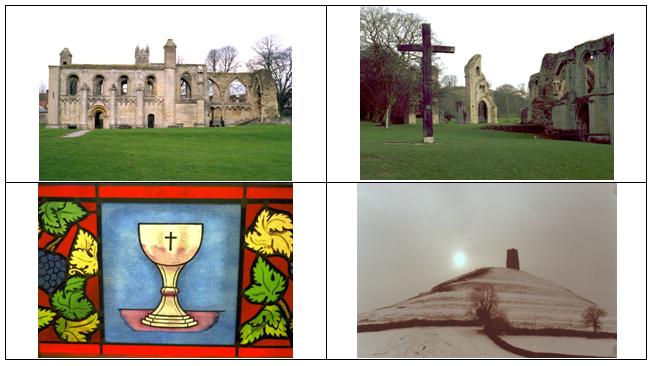
Joseph of Arimathea:

Biblical & Legendary Accounts


Written by Robert Jones

Click here to see other courses that I've written

Click here to go to the Christian History & Theology home page

robertcjones@mindspring.com

Acworth, Georgia

St. Mary's Chapel, Glastonbury Abbey, Somerset, England

Copyright 1997 by Robert C. Jones

This material may be reprinted free of charge for use by non-profit church groups, as long as the author and copyright information is retained. 


Would you like to teach this course? 

$20.00 - You can purchase a Teacher's Pack, containing:


Click here to order via post

OR

(Note: Clicking on the "PayPal Buy Now" button allows you to order via MasterCard or Visa. You do not have to have a PayPal account.)


I'd love to hear about anyone that uses this material in their Sunday School classes!

robertcjones@mindspring.com

"Scripture taken from the HOLY BIBLE, NEW
INTERNATIONAL VERSION. Copyright 1973,
1978, 1984 by International Bible Society. Used by
permission of Zondervan Publishing House."

Table of Contents

Introduction

Canonical Sources

Characteristics of Joseph of Arimathea

Involvement in the burial of Christ

Joseph of Arimathea - coward or saint?

Non-Canonical Sources

The Gospel of Nicodemus

The Narrative of Joseph

The Passing of Mary

Legendary Accounts

Founder of the first Christian Church in England

Joseph and the Holy Grail

And did those feet in ancient times...

Conclusions

Sources

Other Christian History & Theology courses


Introduction

Joseph of Arimathea is one of the more mysterious figures in the New Testament. He is mentioned briefly, by all four of the evangelists, and yet we glean little about him from the Gospel accounts.

"Not one of the twelve, but perhaps one of the seventy". ("Homilies of St. John Chrysostum on the Gospel of John")

Yet, while little is written about Joseph in the Gospels themselves, he was a popular figure in both apocryphal (non-canonical ) accounts ("Gospel of Nicodemus", "The Narrative of Joseph"), and in numerous medieval Arthurian epics, including Mallory's "Le Morte D'Arthur", and Robert de Boron's "Joseph d'Arimathie".

In legend, Joseph is a quite remarkable figure - his exploits (in various accounts) include:

This booklet will examine the life of Joseph from canonical, non-canonical (apocryphal), and legendary sources. No claims are made as to the authenticity of the latter two, but the mere fact of their existence adds to the mystery of Joseph of Arimathea.

Canonical Sources

Joseph of Arimathea is mentioned by all four evangelists, in generally consistent accounts. Bible commentator Dwight Moody notes:

"Read the four accounts given, in the four Gospels, of Joseph of Arimathea. There is very seldom anything mentioned by all four of the Evangelists. If Matthew and Mark refer to an event, it is omitted by Luke and John; and, if it occur in the latter, it may not be contained in the former." ("Bible Characters" by Dwight L. Moody, p. 115)

By drawing on all four accounts, we can at least discern some basic characteristics regarding Joseph. The key passages are listed below:

Mat 27:57/60 "As evening approached, there came a rich man from Arimathea, named Joseph, who had himself become a disciple of Jesus. Going to Pilate, he asked for Jesus' body, and Pilate ordered that it be given to him. Joseph took the body, wrapped it in a clean linen cloth, and placed it in his own new tomb that he had cut out of the rock. He rolled a big stone in front of the entrance to the tomb and went away." (NIV)

Mark 15:43/46 "Joseph of Arimathea, a prominent member of the Council, who was himself waiting for the kingdom of God, went boldly to Pilate and asked for Jesus' body. Pilate was surprised to hear that he was already dead. Summoning the centurion, he asked him if Jesus had already died. When he learned from the centurion that it was so, he gave the body to Joseph. So Joseph bought some linen cloth, took down the body, wrapped it in the linen, and placed it in a tomb cut out of rock. Then he rolled a stone against the entrance of the tomb." (NIV)

Luke 23:50/55 "Now there was a man named Joseph, a member of the Council, a good and upright man, who had not consented to their decision and action. He came from the Judean town of Arimathea and he was waiting for the kingdom of God. Going to Pilate, he asked for Jesus' body. Then he took it down, wrapped it in linen cloth and placed it in a tomb cut in the rock, one in which no one had yet been laid. It was Preparation Day, and the Sabbath was about to begin. The women who had come with Jesus from Galilee followed Joseph and saw the tomb and how his body was laid in it." (NIV)

John 19:38/42 "Later, Joseph of Arimathea asked Pilate for the body of Jesus. Now Joseph was a disciple of Jesus, but secretly because he feared the Jews. With Pilate's permission, he came and took the body away. He was accompanied by Nicodemus, the man who earlier had visited Jesus at night. Nicodemus brought a mixture of myrrh and aloes, about seventy-five pounds. Taking Jesus' body, the two of them wrapped it, with the spices, in strips of linen. This was in accordance with Jewish burial customs. At the place where Jesus was crucified, there was a garden, and in the garden a new tomb, in which no one had ever been laid. Because it was the Jewish day of Preparation and since the tomb was nearby, they laid Jesus there." (NIV)

As can be seen from the canonical texts, little detail is given regarding Joseph of Arimathea, other than details of his involvement in the burial of Christ. No occupation is given (although we are told that he was a "rich man"), nor is his age or personal description revealed (although Joseph of Arimathea is often depicted as an elderly man by the time of the crucifixion). Even his place of origin is obscure - although the Gospels identify that he was from the "Judean town of Arimathea", there was no town of that exact name at the time of Jesus' earthly life. Many scholars identify Arimathea with the town of "Ramathaim", mentioned in 1 Sam 1:1. Other scholars view that the modern city of Rentis (located about 20 miles northwest of Jerusalem) is the ancient Arimathea. However, the reference to "Arimathea" remains obscure.

Characteristics of Joseph of Arimathea

The table below shows the main characteristics regarding Joseph of Arimathea that can be gleaned from the Gospel accounts.

Characteristics of Joseph of Arimathea


Characteristic

Reference

Joseph was a rich man Mat 27:57
He was from the Judean town of Arimathea (see map below) Mat 27:57; Luke 23:51
He was a disciple of Christ Mat 27:57
Joseph was probably a fairly influential man - he (boldly) asked Pilate for the body of Christ, and received it Mat 27:58; Mark 15:43
He was rich enough to own his own tomb Mat 27:60
Joseph was a prominent member of the Jewish Sanhedrin Mark 15:43
He was "waiting for the kingdom of God" Mark 15:43
He was a "a good and upright man" Luke 23:50
He had not agreed to the Sanhedrin actions regarding Jesus Luke 23:51
Joseph feared reprisals from the Jewish elders, so he was a secret disciple of Jesus John 19:38

Involvement in the burial of Christ

The most detailed canonical descriptions regarding Joseph have to do with his involvement in the burial of Christ. The table below captures the highlights of this involvement.

Involvement in the burial of Christ


Characteristic

Reference

He was a disciple of Christ Mat 27:57
Joseph asked Pilate for the body of Christ, and received it Mat 27:58
Joseph and Nicodemus prepared the body for burial by wrapping it in linen, along with 75 pounds of "myrrh and aloes" John 19:40
Jesus was buried according to Jewish burial customs John 19:40
Joseph placed the body in his own new tomb, located in a garden at the place where Jesus was crucified, and rolled a stone in front of it Mat 27:60; John 19:41

Joseph of Arimathea - coward or saint?

Through the ages, a theological debate has raged regarding whether Joseph of Arimathea was a coward, or saint. On the coward side, critics point out that Joseph, while being a disciple of Jesus, was afraid to announce so publicly "because he feared the Jews" (John 19:38). It appears to be just another case of a rich member of a ruling elite who is afraid to proclaim potentially socially unacceptable viewpoints, for fear of disturbing the status quo.

The alternate view of Joseph seems to have a stronger backing. While Joseph may not have revealed his discipleship of Jesus during the earthly ministry of the Savior, two acts would seem to strongly put him in the category of "defender of the faith":

"I consider this was one of the sublimest, grandest acts that any man ever did. In that darkness and gloom — His disciples having all forsaken Him; Judas having sold Him for thirty pieces of silver; the chief apostle Peter having denied him with a curse, swearing that he never knew Him; the chief priests having found Him guilty of blasphemy; the council having condemned Him to death; and when there was a hiss going up to heaven over all Jerusalem — Joseph went right against the current, right against the influence of all his friends, and begged the body of Jesus." ("Bible Characters" by Dwight L. Moody, p. 116)

The Roman Catholic Church eventually made Joseph the Patron Saint of Undertakers. His feast day is March 17.

Non-Canonical Sources

There are at least three non-canonical (apocryphal) references to Joseph of Arimathea which give additional (although not contradictory) information regarding Joseph's actions after the death and resurrection of Christ. Keep in mind that the early church father's did not consider these three sources to be authoritative enough to be included in the New Testament. On the other hand, they were not condemned by the early church fathers, either (they were not Gnostic texts, for example).

The Gospel of Nicodemus

Few scholars today view that this account was really written (or inspired) by Joseph's Sanhedrin colleague Nicodemus - some scholars would date it as late as the third century. (Gregory of Tours, writing in the 6th century, references this gospel). It is the major source of early, non-canonical information regarding Joseph of Arimathea.

A summary of the references to Joseph in the Gospel of Nicodemus follows, with certain key passages printed verbatim.

"And likewise Joseph also stepped out and said to them: Why are you angry against me because I begged the body of Jesus? Behold, I have put him in my new tomb, wrapping him in clean linen; and I have rolled a stone to the door of the tomb. And you have acted not well against the just man, because you have not repented of crucifying him, but also have pierced him with a spear." ("Gospel of Nicodemus", translated by Alexander Walker, Esq.)

"The God whom you have hanged upon the cross, is able to deliver me out of your hands. All your wickedness will return upon you." ("Gospel of Nicodemus", from "The Lost Books of the Bible", p. 75)

"On the day of the Preparation, about the tenth hour, you shut me in, and I remained there the whole Sabbath in full. And when midnight came, as I was standing and praying, the house where you shut me in was hung up by the four corners, and there was a flashing of light in mine eyes. And I fell to the ground trembling. Then some one lifted me up from the place where I had fallen, and poured over me an abundance of water from the head even to the feet, and put round my nostrils the odor of a wonderful ointment, and rubbed my face with the water itself, as if washing me, and kissed me, and said to me, Joseph, fear not; but open thine eyes, and see who it is that speaks to thee. And looking, I saw Jesus; and being terrified, I thought it was a phantom. And with prayer and the commandments I spoke to him, and he spoke with me. And I said to him: Art thou Rabbi Elias? And he said to me: I am not Elias. And I said: Who art thou, my Lord? And he said to me: I am Jesus, whose body thou didst beg from Pilate, and wrap in clean linen; and thou didst lay a napkin on my face, and didst lay me in thy new tomb, and roll a stone to the door of the tomb. Then I said to him that was speaking to me: Show me, Lord, where I laid thee. And he led me, and showed me the place where I laid him, and the linen which I had put on him, and the napkin which I had wrapped upon his face; and I knew that it was Jesus. And he took hold of me with his hand, and put me in the midst of my house though the gates were shut, and put me in my bed, and said to me: Peace to thee! And he kissed me, and said to me: For forty days go not out of thy house; for, lo, I go to my brethren into Galilee." ("Gospel of Nicodemus", translated by Alexander Walker, Esq.)

As mentioned before, the account of Joseph in the Gospel of Nicodemus is certainly not canonical, but it is (at least) plausible.

The Narrative of Joseph

Another apocryphal account of Joseph's interaction in the passion story appears in the "Narrative of Joseph". In basic outline, the story told in "The Narrative of Joseph" coincides with the account in "The Gospel of Nicodemus", with some interesting additions. The account starts with the words:

"I am Joseph of Arimathea, who begged from Pilate the body of the Lord Jesus for burial, and who for this cause was kept close in prison by the murderous and God-fighting Jews..." ("The Narrative of Joseph", translated by Alexander Walker, Esq.)

The narrative then goes on to discuss the fate of the two robbers that were crucified with Jesus on Golgotha. Joseph refers to them as Gestas and Demas. It also gives an alternative version of the betrayal of Jesus by Judas (identified as the son of the brother of Caiaphas), and the trial of Jesus. Also:

The narrative ends with the words:

"And I, having seen these things, have written them down, in order that all may believe in the crucified Jesus Christ our Lord, and may no longer obey the law of Moses, but may believe in the signs and wonders that have happened through Him, and in order that we who have believed may inherit eternal life, and be found in the kingdom of the heavens. For to Him are due glory, strength, praise, and majesty for ever and ever. Amen." ("The Narrative of Joseph", translated by Alexander Walker, Esq.)

The Passing of Mary

A third non-canonical source, entitled "The Passing of Mary" is also attributed to Joseph. Joseph appears as an attendant of Mary, Mother of Jesus, and is present at her ascension (which is described in great detail). Joseph is not identified as the author until the last paragraph:

"I am Joseph who laid the Lord’s body in my sepulcher, and saw Him rising again; and who, before the ascension and after the ascension of the Lord, always kept his most sacred temple the blessed ever-virgin Mary, and who have kept in writing and in my breast the things which came forth from the mouth of God, and how the things mentioned above were done by the judgment of God. And I have made known to all, Jews and Gentiles, those things which I saw with my eyes, and heard with my ears; and as long as I live I shall not cease to declare them." ("The Passing of Mary", translated by Alexander Walker, Esq.)

Legendary Accounts

While Joseph of Arimathea is a fairly minor character in the canonical Gospels (and even in the non-canonical sources), he achieves superstar status in later legendary accounts, most which date to the Middle Ages. In Medieval legend, Joseph is, variously, the founder of the first Christian Church in England, the keeper of the Holy Grail, the uncle of Mary Mother of Jesus, and the ancestor of King Arthur, Sir Lancelot, and Sir Galahad. No Biblical figure (other than Christ) equaled the amount of popular press attention given to Joseph of Arimathea during the Middle Ages. A look at the primary legends follows.

Founder of the first Christian Church in England

The most enduring legend regarding Joseph of Arimathea regards his foundation of the first Christian Church in England at Glastonbury, in the first century (37 A.D. or 63 A.D., depending on the source). The traditional view of the Christianization of England is that it didn't occur until the missionary efforts of St. Augustine late in the 6th century (other legends discuss a missionary journey to England in the 2nd-century, by Faganus and Deruvianus).

The distinction between the Arimathean legend and the traditional Augustine view is a significant one - if Joseph really did bring Christianity to England as early as 37 A.D., it means that Christianity in England predates Christianity in other Western European nations such as Spain and France - and may even pre-date the establishment of Christianity in Rome itself. Thus, the claims of the papacy to be descended from the first apostolic church could be called into question.

There are two basic types of sources concerning the legends connecting Joseph of Arimathea to England in general, and Glastonbury specifically - histories, and Medieval (and later) literature. We'll examine entries from both types of sources in this discussion.

The basic legend regarding Joseph of Arimathea, and the establishment of the first Christian Church in Glastonbury, Somerset, England goes something like this:


"We need not believe that the Glastonbury legends are records of facts; but the existence of those legends is a very great fact." - E.A. Freeman ("Avalonian Quest", p. 131)

So, is there any historical evidence to back up the aforementioned legends? There is, but much of it is disputed.

First, is there any early evidence that Britain was evangelized in the Gospel of Jesus Christ as early as the first century? Various Early Church Fathers are quoted to make this claim, including Irenaeus (c. 125 - 189 A.D.), Eusebius (260 - 340 A.D.), St. Hilary of Pottiers (300 - 367 A.D.), and Origin (185 - 254 A.D.). One reference that seems especially relevant is by Tertullian (155 - 222 A.D.):

"All the limits of the Spains, and the diverse nations of the Gauls, and the haunts of the Britons — inaccessible to the Romans, but subjugated to Christ, and of the Sarmatians, and Dacians, and Germans, and Scythians, and of many remote nations, and of provinces and islands many, to us unknown, and which we can scarce enumerate? In all which places the name of the Christ who is already come reigns, as of Him before whom the gates of all cities have been opened, and to whom none are closed, before whom iron bars have been crumbled, and brazen gates opened." - Tertullian, "An Answer to the Jews" ("The Anti-Nicene Fathers Volume 3", p. 296)

The above passage would seem to clearly indicate that Britain had been "subjugated to Christ" long before the papal mission of St. Augustine in 597 A.D. (one of the traditional dates for the foundation of Christianity in Britain).

An early British reference to the possibility of 1st century Christianization of Britain comes from a 6th century monk/historian named Gildas the Wise (500? - 572? A.D.), who reportedly spent some years at Glastonbury Abbey:

"These islands received the beams of light - that is, the holy precepts of Christ - the true Sun, as we know, at the latter part of the reign of Tiberius Caesar, in whose time this religion was propagated without impediment and death threatened to those who interfered with its professors." - "De Excidio Britanniae" ("The Ruin and Conquest of Britain") (Matthews, p. 87)

As Tiberius Caesar died in 37 A.D., this reference places Christianity in Britain even before the typical 63 A.D. date assigned in the Arimathean legends!

So where does Joseph come into the picture? There may be a reference as early as the 6th century, from a "bard" named Melkin (or, variously, Melchinus or Maelgwn). If a source document of this reference existed, it would provide strong evidence linking Joseph to England. Alas, the first existing reference to the Melkin document is in a 14th century document written by monk John of Glastonbury. Here are the relevant parts of Melkin's "Historia de Rebus Brittannicis". Note that Avalon is traditionally connected with Glastonbury:

"Avalon's island...
Amid there Joseph in marble,
Of Arimathea by name,
Hath found perpetual sleep:
He lies in a two-forked [bifurcated] line
Next the south corner of an oratory
Fashioned of wattles
For the adorning of a mighty virgin
By the aforementioned sphere-betokened
Dwellers in that place, thirteen in all.
For Joseph hath with him
In his sarcophagus
Two cruets, white and silver,
Filled with blood and sweat
Of the prophet Jesus." (Matthews, p. 67/68)

If we can be comfortable that this document actually existed (and wasn't a literary creation of John of Glastonbury), it establishes several key points, from a 6th-century source:

The legend assumes more form by the 12th century writings of historian William of Malmesbury (c. 1095 - 1143 A.D.), who, in two books, wrote much of the history of Glastonbury Abbey. In his "Gesta Regum Anglorum" ("Acts of the Kings of the English"), William comments about the "Old Church" in Glastonbury:

"The church of which we are speaking - from its antiquity called by the Angles, by way of distinction 'Ealde Chiche', that is the 'Old Church' of wattle work at first, savoured somewhat of heavenly sanctity even from its very foundation, and exhaled it over the whole country, claiming superior reverence, though the structure was mean..." (Lewis, p. 68)

While William stops short of linking the "Old Church" with Joseph of Arimathea, or even the first century, he does verify its antiquity, and the fact that the original church was built of wattle. William goes on to suggest that the Old Church was built in the second century by papal envoys Faganus and Deruvianus, but adds the following comment:

"There are documents of no small credit, which have been discovered in certain places to the following effect: 'No other hands than those of the disciples of Christ erected the Church of Glastonbury'. Nor is it dissonant from probability: for if Philip, the Apostle, preached to the Gauls, as Freculfus relates in the fourth chapter of his seventh book, it may be believed that he planted the word on this side of the channel also." ("King Arthur's Avalon", Ashe, p. 42)

In the above passage, the possibility of 1st century erection of the Old Church by the "disciples of Christ" is mentioned, as well as the possibility that the Apostle Philip sent missionaries from Gaul.

William of Malmesbury came to the great Medieval Abbey of Glastonbury early in the 12th century to research his books "The Acts of the Kings of the English", and "The Antiquity of the Church at Glastonbury"

Several years after William wrote "The Acts of the Kings of the English", he wrote a second book which was dedicated to telling the history of Glastonbury Abbey. The book was called "De Antiquitate Glastoniensis Ecclesiae" ("The Antiquity of the Church at Glastonbury"), and here is yet another blazing controversy - the earliest extant copy of this document (written c. 1130) dates to approximately 1240 A.D. The passages below, which give the first detailed history of Joseph and the establishment of the church at Glastonbury, were added as an introductory chapter written in another hand. So, this is either the definitive history of Joseph of Arimathea in the British Isles, written by the prominent and respected historian William of Malmesbury, or a later interpolation by an unknown author!

"St. Philip...coming into the country of the Franks to preach, converted many to the Faith and baptized them. Working to spread Christ's word, he chose twelve from among his disciples, and sent them into Britain. Their leader, it is said, was Philip's dearest friend, Joseph of Arimathea, who buried the Lord.

Coming therefore into Britain 63 years from the Incarnation of the Lord, and 15 from the Assumption of Blessed Mary, they began faithfully to preach the Faith of Christ. But the barbaric king and his people, hearing such novel and unaccustomed things, absolutely refused to consent to their preaching, neither did he wish to change the traditions of his ancestors, yet, because they came from far, and merely required a modest competence for their life, at their request he granted them a certain island, surrounded by woods, thickets and marshes, called by the inhabitants Ynys-witrin...

Thereupon the said twelve saints residing in this desert, were in a very short time warned by a vision of the angel Gabriel to build a church in honour of the Holy Mother of God and Virgin Mary in a place shown to them from heaven, and they, quick to obey the divine precepts, completed a certain chapel according to what had been shown them...

And as it was the first in the kingdom, God's Son distinguished it with greater dignity by dedicating it in honour of his Mother...

The said saints continued to live in the same hermitage for many years, and were at last liberated from the prison of the flesh. The place then began to be a covert for wild beats - the spot which had before been the habitation of saints - until the Blessed Virgin was pleased to recall her house of prayer to the memory of the faithful..." ("Avalonian Quest", Ashe, p. 56)

As can be seen, most of the basic legend of Joseph in the British Isles is contained in this (possibly interpolated) passage from "De Antiquitate Glastoniensis Ecclesiae". Only the legend of the Grail (see next section), and the Glastonbury Holy Thorn is missing.

The next major chronicler of the Joseph legends was 14th century monk John (Seen) of Glastonbury, who seemingly gathered all of the extant sources regarding Joseph of Arimathea's connection to his Abbey, and published them in one book, entitled "Cronica sive Antiquitates Glastoniensis Ecclesie" ("Chronicle of the Antiquities of the Church of Glastonbury"). A sample:

"In the fifteenth year after this he went to St. Philip in Gaul, taking with him Josephes, whom the Lord had consecrated a bishop in the city of Sarath...Then the apostle, desiring that the word of God should be spread abroad, sent twelve of his disciples to preach in Britain, placing at their head his favourite disciple Joseph of Arimathea, together with his son Josephes..." (Matthews, p. 69)

It was John, you'll recall, that published the 6th century Melkin poem that mentions the two cruets filled with the blood and sweat of Christ. The Grail has not yet made its way into the story.

The last part of the basic legend (sans the Grail, which deserves its own section) regards a hawthorn bush which grows in Glastonbury, now called the Holy Thorn. The bush (or tree, really) has the interesting property of blooming twice a year - in May, and at Christmas time! The type of thorn ("crataegus oxyacantha praecox"), seems to be native to Syria. Like many other things in Glastonbury, the tree is an unexplained anomaly.

The Holy Thorn isn't connected to the Joseph legend until the publishing of a 1520 anonymous poem (published by Richard Pynson, the royal printer), entitled "The Lyfe of Joseph of Armathia". While the poem discusses the hawthorn and its properties, the story of it growing from Joseph's staff is missing. (Note: this poem also refers to Joseph bringing two cruets with him, containing the blood of Christ - "Thys blode in two cruettes/Joseph dyd take". No Cup from the Last Supper, yet).

In 1677, a Dr. Plot refers to the thorn, and ascribes its planting to Joseph of Arimathea. Finally, in 1716, the full story of Joseph placing his staff on a hill at Glastonbury ("Wirral Hill", because Joseph and his companions were "Weary-All"), and having the thorn grow on the spot is published.

The original thorn was destroyed by Puritan fanatics during the English Civil War, but cuttings from the original have grown into trees in both Glastonbury, and other parts of England. And they continue to bloom at approximately Christmas each year.

One of the surviving cuttings from the original Holy Thorn - at Glastonbury Abbey

The claim of England as the first Christianized Western country was taken quite seriously in the middle ages. The claim was advanced at four church councils: the Council of Pisa (1409), Constance (1417), Sienna (1424) and Basle (1434). Glastonbury was known as "Roma Secunda" in some circles during the Middle Ages.

Queen Elizabeth II, in 1965, erected a wooden cross at Glastonbury with the following inscription:

"The cross. The symbol of our faith. The gift of Queen Elizabeth II marks a Christian sanctuary so ancient that only legend can record its origin."

The Glastonbury Cross

Joseph and the Holy Grail

Perhaps the most enduring legend regarding Joseph of Arimathea - his connection with the Cup from the Last Supper, or the Holy Grail - is even harder to pin down than the other parts of the Joseph-in-England legends. There is no reference connecting Joseph to the Cup from the Last Supper in either the canonical Gospels, the non-canonical sources ("Gospel of Nicodemus", "The Narrative of Joseph"), or the historical sources (William of Malmesbury, Melkin, John of Glastonbury).

If one accepts the validity of the aforementioned 6th-century document by Melkin entitled "Historia de Rebus Brittannicis", as translated by John of Glastonbury in the 14th century, Joseph is early identified, not with the Cup from the Last Supper, but rather:

For Joseph hath with him
In his sarcophagus
Two cruets, white and silver,
Filled with blood and sweat
Of the prophet Jesus. (Matthews, p. 67/68)

The references connecting Joseph to the Holy Grail (and the later Arthurian-era quests for said Grail) are all from Medieval and later romances and literature. Thus, from a historical standpoint, they are the most difficult to verify.

The Medieval romances in question all have to do with one basic topic - the stories of King Arthur, and his band of chivalrous knights. Joseph of Arimathea comes into the stories as a key character, because of one of the greatest subplots in the Arthurian epics - the quest for the Holy Grail.

There is great argument over exactly what the Holy Grail is - a cup? a chalice? a stone? There are also learned treatises on the possibility that the model for the Holy Grail predates Christianity. However, many of the Medieval romances squarely associate the Holy Grail with the Cup from the Last Supper of Christ, and further identify that it was Joseph of Arimathea that brought the Cup to England in the first place (otherwise, there wouldn't have been anything in England for Arthur and his knights to search for!)

The first major romance that explicitly links Joseph to the Grail is Robert de Boron's (or Borron) "Joseph d'Arimathie" (c. 1190). Robert de Boron seems to start with the account from the Gospel of Nicodemus, and then adds his own slant to the story. Essentially:

Other Medieval romances with similar themes include:

As "Le Morte D'Arthur" is the most well-known of the English versions of the Arthurian romances, I've compiled several quotes that refer to Joseph:

"And here followeth the noble tale of the Sangreal, that called is the holy vessel; and the signification of the blessed blood of our Lord Jesu Christ, blessed mote it be, the which was brought in to this land by Joseph of Aramathie." - Introduction to Book 13 (Mallory, p. 370)

"...it befell after the passion of our Lord Jesu Christ thirty-two year that Joseph of Aramathie the gentle knight, the which took down our Lord off the holy Cross, at that time he departed from Jerusalem with a great party of his kindred with him...And so by fortune they came into this land, that at that time was called Great Britian...And after that all the people were turned to the Christian faith." (Mallory, p. 380)

"...ye have heard much of Joseph of Aramathie, how he was sent by Jesu Christ into this land to teach and preach the holy Christian faith...and ever he was busy to be there as the Sangreal was..." (Mallory, p. 393)

"And therewithal beseemed them that there came a man, and four angels from heaven, clothed in likeness of a bishop, and had a cross in his hand; and these four angels bare him in a chair, and set him down before the table of silver whereupon the Sangreal was; and it seemed that he had in middes of his forehead letters the which said, See ye here Joseph the first bishop of Christendom...Then the nights marvelled, for that Bishop was dead more than three hundred year tofore. O knights, said he, marvel not, for I was sometime an earthly man." (Mallory, p. 442)

Note that Mallory is not at all shy about proclaiming that Joseph is "the first bishop of Christendom"!

Another famous literary reference that links Joseph to the Grail is from Alfred Lord Tennyson's 1859 "Idylls of the King" (idylls means "poems" or "songs"):

...What is it?
The phantom of a cup that comes and goes?

Nay, monk! what phantom? answer'd Percivale.
The cup, the cup itself, from which our Lord
Drank at the last sad supper with his own.
This, from the blessed land of Aromat-
After the day of darkness, when the dead
Went wandering o'er Moriah - the good saint,
Arimathean Joseph, journeying brought
To Glastonbury, where the winter thorn
Blossoms at Christmas, mindful of our Lord,
And there awhile it bode; and if a man
Could touch or see it, he was heal'd at once,
By faith, of all his ills. But then the times
Grew to such evil that the holy cup
Was caught away to Heaven, and disappear'd.

To whom the monk: "From our old books I know
That Joseph came of old to Glastonbury,
And there the heathen Prince, Arviragus,
Gave him an isle of marsh whereon to build;
And there he built with wattles from the marsh
A lonely church in the days of yore...

Notice that by the 19th century, not only was the Cup closely associated with Joseph (and Glastonbury), but also the hawthorn bush that blooms at Christmas time. Also of note in Tennyson' poem is the reference to "From our old books I know..." Most Medieval references to Joseph, whether from histories or literature, claim to have received the basis of the story from old or ancient books. Perhaps the most romantic such assignation comes from the anonymous 1225 A.D. epic "Perlesvaus":

"The Latin from whence this history was drawn into Romance was taken in the Isle of Avalon, in a holy house of religion that standeth at the head of the Moors Adventurous, there where King Arthur and Queen Guenievre lie, according to the witness of the good men religious that are therein, that have the whole history thereof." ("King Arthur's Avalon", p. 201)

There is a well at Glastonbury named "Chalice Well". Some esoteric legends say that Joseph placed the Cup somewhere in the depths of the well. The well is a curious place - 25,000 gallons of red-tinted water pass through the well area per day. The red tint, caused by a high iron content, caused the Well to at one time be called the "Blood Spring", or the "Blood Well", seemingly in reference to the Blood of Christ.

Chalice Well, Glastonbury

The legends associating Joseph with the Grail seem weaker, and harder to grasp hold of, than the legends regarding his establishment of the first Christian church in England, at Glastonbury. The Joseph/Grail connection are not mentioned in any early histories, and first appear in 12th century romances. However, if the 6th-century Melkin account is accepted as legitimate, Joseph is, at least, early-on associated with bringing some kind of container ("two cruets") containing the blood of Christ with him to Glastonbury.

So could Joseph have ended up with the Cup from the Last Supper? Could he have had in his possession drops of the blood of Christ? Certainly, the Gospels identify Joseph as a disciple (although not apostle) of Christ, and he is also identified as having taken down the body of Christ from the cross, and preparing it for burial. Assumedly, Joseph would have come in contact with Christ's blood - remember, Christ was speared on the cross, and bled:

John 19:34 "Instead, one of the soldiers pierced Jesus' side with a spear, bringing a sudden flow of blood and water." (NIV)

Thus, while the idea that Joseph could have had in his possession the Cup and/or a container with Christ's blood is not implausible, there is no early source to verify this legend.

The table below traces the sources of the various legends regarding Joseph and his connection with England. Romances and other literary works are indicated in red.

Tracing the legends

Source

Date

Notes

Tertullian - An Answer to the Jews

193/216 A.D.

Britain was already "subjugated to Christ" in the late 2nd century

Melkin the Bard

6th century?

  • Quoted by John of Glastonbury

  • Joseph & 12 followers in Avalon

  • Wattled oratory

  • Two cruets with blood and sweat of Christ

Gildas Ruin and Conquest of Britain

c. 540

Britain received "the holy precepts of Christ...at the latter part of the reign of Tiberius Caesar" (!)

William of Malmesbury - Acts of the Kings of the English

c. 1125

  • The Old Church, "of wattle work at first, savoured somewhat of heavenly sanctity even from its very foundation"

  • Mentions the possibility of foundation by the disciples of Christ, sent by the Apostle Philip

William of Malmesbury - The Antiquity of the Church at Glastonbury

c. 1130

  • Story of Faganus & Deruvianus, papal envoys, in 170 A.D. as builders of the Old Church

  • Joseph referred to in a preface, written in another hand, dating to c. 1240. Almost the whole Joseph/Glastonbury legend is contained here, except for the Cup, and the hawthorn

Robert de Boron - Joseph d'Arimathie

c. 1190

  • Joseph as keeper of the Cup from the Last Supper (The Holy Grail)

  • The Cup brought to the "Vales of Avaron"

John of Glastonbury - Chronicle of the Antiquities of the Church of Glastonbury

14th century

  • Gathered all extant sources together to produce a book on Joseph

  • Joseph as an ancestor of King Arthur

  • Quotes Melkin manuscript ("two cruets") - no mention of the Grail

  • Joseph is an attendant of Mary, Mother of Jesus, and is present at her ascension

Thomas Mallory - Le Morte D'Arthur

1485

  • Most famous English Arthurian romance

  • Joseph as "first bishop of Christendom"

The Lyfe of Joseph of Armathia

1520

Connects the Holy Thorn with Joseph
Alfred Tennyson - Idylls of the King

1859

Directly states that Joseph brought the Cup to Glastonbury

And did those feet in ancient times...

There is one more legend associated with Joseph of Arimathea that should be briefly explored, if for no other reason than its popularity. This is the legend that Joseph brought the boy Jesus to Cornwall and/or Somerset one or more times. This legend can't be directly traced to early histories or Medieval romances, although it appears that William Blake refers to it in his famous poem "Jerusalem" (see below).

The Bible is, of course, rather mysterious about the events that happened in the life of Jesus between the ages of 12 and 30 (when he began his ministry). As a result, many people have attempted on their own to define what happened in those lost years. India, North America, and England have all been posited as possibilities for where Jesus might have traveled as a youth/young adult. The Biblical references usually quoted to set the stage for theories regarding the travels of Jesus between the ages of 12 and 30 include:

The legends connecting Jesus and Joseph with Cornwall/Somerset go something like this:

As stated earlier, there are no direct early historical, or even literary references to these legends. The earliest reference of any kind may be in William Blake's famous poem, "Jerusalem", which is now a much-loved hymn in England (watch the last 10 minutes of the movie "Chariots of Fire" to hear it sung):

Jerusalem

And did those feet in ancient times
Walk upon England's mountains green?
And was the Holy Lamb of God
On England's pleasant pastures seen?
And did the Countenance Divine
Shine forth upon our clouded hills?
And was Jerusalem builded here
Among those dark Satanic mills?

Bring me my bow of burning gold!
Bring me my arrows of desire!
Bring me my spear! O clouds unfold!
Bring me my Chariot of Fire!
I will not cease from mental fight,
Nor shall my sword sleep in my hand
Till I have built Jerusalem
In England's green and pleasant land.

- William Blake, 1757-1827

There is some background and indirect evidence that just prevent the legend from being totally implausible:

"There is on the confines of western Britain a certain royal island, called in the ancient speech Glastonia...In it the earliest neophytes of the Catholic rule, God guiding them, found a church, not built by the art of man, they say, but prepared by God himself for the salvation of mankind, which church the heavenly Builder himself declared - by many miracles and many mysteries of healing - he had consecrated to himself and to holy Mary, Mother of God." - from "Life of St. Dunstan", c. 1000 ("Avalonian Quest", p. 23)

"...the Son of God was pleased to grace it with particular dignity, dedicating it Himself in honour of His Mother..." - from the possibly interpolated c. 1240 edition of "De Antiquitate Glastoniensis Ecclesiae", by William of Malmesbury (Matthews, p. 97)

"The church of which we are speaking...savoured somewhat of heavenly sanctity even from its very foundation, and exhaled it over the whole country, claiming superior reverence, though the structure was mean..." - "Acts of the Kings of the English", by William of Malmesbury (Lewis, p. 68)

Proponents of the legend also point to the mysterious stone on the south side of the Old Church (St. Mary's Chapel), which says "Jesus Maria".

Conclusions

Joseph of Arimathea remains an enigmatic character. While he appears to be a fairly minor player in the canonical Gospels, he, not Mary, Mother of Jesus, not Mary Magdalen, and not any of the apostles, is entrusted with the act of taking Jesus down from the cross, respectfully preparing him for burial, and donating a tomb for the body. These facts would seem to speak of some special significance accorded to Joseph's role as a disciple of Christ.

That being said, Joseph seems an unlikely character to have become one of the centerpieces of the Medieval literary craze which became the Arthurian legends. Likewise, he seems an unlikely character to create a story around as the founder of the Christian church in England. Why not pick Paul, or Philip, or another better known disciple than Joseph of Arimathea, if one was going to make up the story?

So, are the stories and legends true? In my personal opinion - The idea that Joseph brought a small band of followers to Britain in the 1st century, and started a church at Glastonbury seems reasonably credible (although not absolutely provable). The idea that, as the undertaker of Jesus, he might have saved some drops of blood also seems, at least plausible (but again, not provable). The legends regarding Joseph's connection with the Cup from the Last Supper, the hawthorn bush at Glastonbury, and bringing the boy Jesus to Cornwall/Glastonbury seem (in decreasing order) less credible.

However, I can speak quite personally that Glastonbury is a very eerie place, and if miracles could occur anywhere in the world, I could believe that they could occur there.

Sources

All photos by Robert Jones

Title

Author

Publisher

Year

A Glastonbury Reader Compiled and edited by John Matthews The Aquarian Press

1991

The Arthurian Encyclopedia Norris J. Lacy, Editor

Boydell Press

1986

Avalonian Quest Geoffrey Ashe Fontana Paperbacks

1982

Bible Characters Dwight Moody The Sage Digital Library

1996

Holman Bible Dictionary for Windows   Parsons Technology

1994

Holy Bible - New International Version   Zondervan

1984

Idylls of the King Alfred Tennyson American Book Company

1915

King Arthur's Avalon - The Story of Glastonbury Geoffrey Ashe Barnes & Noble

1992

Le Morte D'Arthur Sir Thomas Mallory Harrison House

1985

St. Joseph of Arimathea at Glastonbury Lionel Smithett Lewis James Clarke & Co., Ltd.

1922

The Traditions of Glastonbury E. Raymond Capt M.A. Artisan Sales

1983

The Lost Books of the Bible   Bell Publishing Co.

1979

The Anti-Nicene Fathers Volumes 3 & 8 Edited by A. Roberts and J Donaldson The Sage Digital Library

1996

The Grail - Quest for the Eternal John Matthews Thames and Hudson

1981

PC Bible Atlas for Windows   Parsons Technology

1994

Other Christian History & Theology courses

The Search for the Pre-Incarnate Christ in the Old Testament Click here to order PowerPoint presentations, teacher's guides, and printed booklets

(Note: To order online through PayPal, click on the desired course on the left, and look for the "Would you like to teach this course" heading.)

 A Brief History of the Celebration of the Lord’s Supper
A Brief History of the Inquisition
A Brief History of Christian Baptism
Joseph of Arimathea: Biblical & Legendary Sources
The Apocrypha and Christianity
Theological Roots of the Protestant Reformation: A Handbook
Angels: In the Bible, the Apocrypha & the Dead Sea Scrolls
The Crusades: A Brief History (1095-1291)
A Brief History of Western Monasticism
Evidence for the Gospel Accounts of Jesus Christ
Heresies and Schisms in the Early Church
Women as Leaders in the Church: From Miriam to Joan of Arc
Hell and the Devil: In the Bible, the Apocrypha and the Dead Sea Scrolls
The Dead Sea Scrolls and Christianity
Angels: A Biblical View
Meet the Apostles - Biblical and Legendary Accounts: Part One - The Twelve
Origins of the Major Protestant Denominations in the United States
Heaven: In the Bible, the Apocrypha and the Dead Sea Scrolls
Revelation: Background and Commentary
Basic Christian Theology
Worship and Cultural Patterns of the Early Church
Jewish Religious Parties at the Time of Christ - Part Two: The Essenes
Origins of the New Testament
Meet the Apostles - Biblical and Legendary Accounts: Part Two - After the Twelve
The Messiah - In the Old Testament, the Apocrypha, and the Dead Sea Scrolls
Jewish Religious Parties at the Time of Christ Part One: Pharisees and Sadducees
The Holy Spirit: In the Bible, the Apocrypha & the Dead Sea Scrolls


Hit Counter