The Origins of the New Testament

Written by Robert C. Jones

jone442@bellsouth.net

Acworth, Georgia

Click here to see other courses that I've written

Click here to go to the Christian History & Theology home page

Copyright 1998 by Robert C. Jones

This material may be reprinted free of charge for use by non-profit church groups, as long as the author and copyright information is retained. 


Would you like to teach this course? 

$20.00 - You can purchase a Teacher's Pack, containing:


Click here to order via post

OR

(Note: Clicking on the "PayPal Buy Now" button allows you to order via MasterCard or Visa. You do not have to have a PayPal account.)


I'd love to hear about anyone that uses this material in their Sunday School classes!

jone442@bellsouth.net


"Scripture taken from the HOLY BIBLE, NEW

INTERNATIONAL VERSION. Copyright Ó 1973,

1978, 1984 by International Bible Society. Used by

permission of Zondervan Publishing House."

Table of Contents

Table of Contents

Introduction

New Testament Quiz

The origins of the New Testament

The Gospels

The letters

The Apocalypse

Writings by Jesus?

Dating of the New Testament

Creation of the New Testament canon

Criteria for inclusion in the canon

The Early Church Fathers

Forming the canon

Marcion - the first attempt at a canon

Muratori Canon (c. A.D. 200)

Eusebius (c. 260 - c. 340 A.D.) and his Ecclesiastical History

Athanasius (c. 296-373 A.D.)

The Councils of Hippo and Carthage

Other voices

Important developments after the creation of the canon

Books that almost made the New Testament

Revelation of Peter

Epistle of Clement to the Corinthians

Epistle of Barnabas

The Shepherd (Pastor) of Hermas

Other books not deemed canonical

Sources

Other Christian History & Theology courses


Introduction

This purpose of this booklet is to examine the origins of the New Testament, including who wrote it and when, as well as the process by which the books that make up our modern day New Testament were deemed "canonical", or authoritative.

"...For it is not to be accounted of no consequence, that, from the first publication of Scripture, so many ages have uniformly concurred in yielding obedience to it, and that, notwithstanding of the many extraordinary attempts which Satan and the whole world have made to oppress and overthrow it, or completely efface it from the memory of men, it has flourished like the palm tree and continued invincible." (John Calvin, "Christian Institutes", p. 113/114)

In my experience as a Christian (first, as a Schwenkfelder, later as a Presbyterian), I have noted with some dismay that the subject of how the 27 books that make up the Protestant and Roman Catholic New Testament became canonical is often vaguely addressed by the Church.  Generally, the hazy answer is that a group of bishops convened a council in the fourth century (usually incorrectly attributed to the Council of Nicea in 325 A.D.), and selected the books that we now have in our New Testament. 

While this hazy outline contains some elements of truth (there were fourth century councils on the topic, at Hippo and Carthage), it can give the false impression that the books of the canon were somewhat arbitrarily selected by an arbitrary group of church leaders 300-400 years after they were written.  One might excuse the skeptic for questioning the validity of such a methodology for such an important (and lasting) decision.

The reality is somewhat different.  The various councils of the fourth century did indeed vote on a New Testament canon, but the process was far from arbitrary.  Rather, the learned bishops merely put their stamp of approval on a corpus of works that had been in constant use in the Christian Church since the first century, and that were quoted from liberally by the earliest church fathers (the "Ante-Nicene", or pre-Council of Nicea church fathers).  While there were some controversies and compromises between the Eastern and Western churches in terms of the final canon (Hebrews was popular in the Eastern Church, the Apocalypse in the Western), no books were chosen that weren't already in common use in either the former or the latter (and the great majority were in use in both).

In addition, I will discuss the mysterious books that "almost made it" into the canon, but were rejected in the final cut. Books such as the Shepherd of Hermas, the Epistle of Clement to the Corinthians, the Epistle of Barnabas, and the Revelation of Peter all appeared on various proposed canonical lists (or were referenced by Early Church Fathers) throughout the first three centuries of the church.  While it was eventually decided that they were not of apostolic origin, and therefore should not be contained in the canon, they were still viewed by the early church fathers as useful to those "who newly join us, and who wish for instruction in the word of godliness".   Even with that recommendation, these books are not only not used in the church today, but have practically disappeared from public view. 

Finally, I will discuss some of the major New Testament events since the creation of the canon in the late fourth century (with an emphasis on the creation of English-language translations).

Hopefully, this booklet will help elucidate how the New Testament became the book we as Christians, cherish today.

New Testament quiz

  1. At least one of the four Gospels lists the author within the text (T/F)

  2. The modern day New Testament canon was decided upon by a group of bishops at the Council of Nicea in 325 A.D. (T/F)

  3. Martin Luther was especially enamoured of the Book of James (T/F)

  4. There was great debate regarding whether there should be more than four Gospels in the canon, at the fourth century councils (T/F)

  5. The Gospel of Thomas was known, and rejected, by the Church Fathers

  6. The oldest extant piece of any part of the New Testament is from the Gospel of John, dating to approximately 125 A.D. (T/F)

  7.  One book of the New Testament that was universally agreed upon for inclusion into the canon was the Book of Hebrews (T/F)

  8. The one-time existence of a Lost Gospel of Q is a proven historical fact (T/F)


Glossary


Bible - from the Greek word biblia, meaning "books"

Canon - from the Semitic word for "reed"; in Greek, it became to mean a standard measure or rule (kanon); as pertaining to the Bible, it is the list of books considered authoritative by the Early Church Fathers

Gospel - from the Greek evangelion, meaning "good news"

Koine - the common Greek used to write most of the New Testament

Vulgate - the common (or "vulgar") Latin used in Jerome's translation of the Bible

The origins of the New Testament

The New Testament, of course, is not a single book, but rather a collection of books (gospels, letters, an apocalypse) written over a period of several decades in the latter part of the first century.  The primary purpose of the books that were later called the "New" Testament (to distinguish them from the "Old" Jewish scriptures) was to record and pass on the gospel ("good news") of Jesus Christ. 

The Gospels

The word "gospel" comes from the Greek word evangelion, meaning "good news".  (Other words in common usage that come from the same root include evangelical and evangelist.)  Gospels are not meant to be histories - they were not written as a "Life and Times of Jesus Christ", but rather to convince people that Christ was both the promised Messiah of the Hebrew scriptures, and, more importantly, the very Son of God.  John 20:31 records:

"But these are written that you may believe that Jesus is the Christ, the Son of God, and that by believing you may have life in his name."  (John 20:31, NIV)

However, John, who wrote the longest of the four Gospels, goes on to point out that no attempt has been made to record everything that Jesus said and did:

"Jesus did many other miraculous signs in the presence of his disciples, which are not recorded in this book." (John 20:30, NIV)

"Jesus did many other things as well. If every one of them were written down, I suppose that even the whole world would not have room for the books that would be written."  (John 21:25, NIV)

Sometimes people question why the Gospels were written so long after the death and resurrection of Christ.  Assuming that Christ died around 30 A.D., even early datings of Mark (before 50 A.D.) would still put the first written Gospel 15 or more years after the death and resurrection of Christ.  Why so long?  Two possible answers follow:

The first three Gospels (Matthew, Mark, and Luke) are referred to as the "synoptic" Gospels, because the have a great deal of common material.  J. Phillip Hyatt in his "Heritage of Biblical Faith" notes:

"Of the 661 verses in Mark, Matthew has about 600 in substance or actual wording, and Luke has about 350.  Altogether, only 31 verses of Mark fail to appear also in Matthew and Luke.  On the other hand, Matthew and Luke have between 200 and 250 verses in common that are not found in Mark, consisting chiefly of sayings of Jesus."

Given the above set of statistics, many modern Biblical scholars assume that Mark is the oldest Gospel, and that it formed the basis for Matthew and Luke.  The additional portions of Matthew and Luke not contained in Mark are viewed to be from yet a fourth source, mysteriously designated as "Q" (German for quelle, or "source".)  Some scholars are so convinced that there must have been a "sayings" source for Matthew and Luke that they sometimes refer to the five Gospels - Matthew, Mark, Luke, John, and "Q".  However, it should be noted that there is not a single scrap of evidence that "Q" ever existed - it is not referred to by any of the Early Church Fathers, nor is there any historical or archaeological evidence of its existence.  It should be noted also, that the Early Church Fathers identified Matthew (and Luke) as the first Gospels to be written (see section on "The Early Church Fathers" below).

"Try to imagine flying to a non-existent island on an airplane that has not yet been invented.  Even if this impossible trip were to take place during the thirteenth month of the year, it would not be as fantastic as the tale, recently christened as scientific certainty by some New Testament scholars, concerning the 'Lost Gospel' of Q".  (Is There a Gospel of Q?, Eta Linnemann, Bible Review, August, 1995)

Who wrote the Gospels?

Unfortunately, the Gospels themselves are silent on the question of authorship.  Our views as to the identities of the four evangelists come from the Early Church Fathers (one, Bishop Papias, from as early as 110 A.D.)!  The Early Church Fathers are clear as to the apostolic origin of the four Gospels - Matthew and John writing first hand accounts, and John Mark (Acts 12:12, Acts 12:25, Acts 15:37, 1 Peter 5:13) and Luke the Physician (Col 4:14, 2 Tim 4:11, Philemon 1:24) recording the words of Peter and Paul (respectively).  The next chapter ("Creation of the New Testament canon") will investigate the views of the Church Fathers on the topic of the Gospels in some detail.


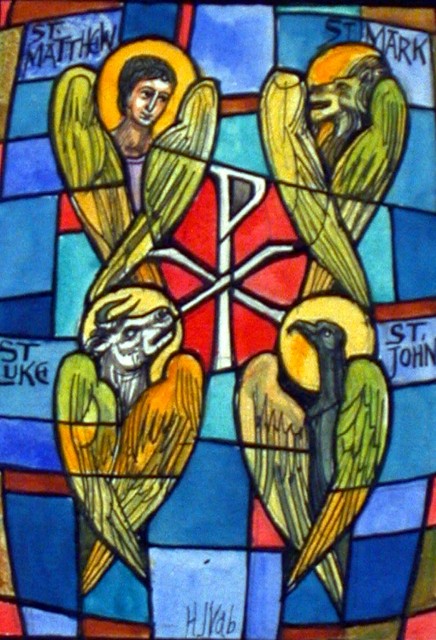
Medieval depictions of the four evangelists often show them with a Bible in their hand - however, the original copies of the Gospels would have been written on papyri.

The letters

The majority of the New Testament is comprised of letters written by various figures that knew Jesus, including Paul (because of the Road to Damascus experience), Peter, John, James, and Jude (the last two, brothers of Jesus).  Most of these letters were written to address specific problems in specific churches.

At least 25% of the New Testament is made up of letters written by Paul of Tarsus, an early persecutor of Christians, but later the greatest of all Christian missionaries, and one of the greatest theologians.  Paul's letters are among the oldest Christian documents still in existence - they were probably all written between 49 - 66 A.D.

Paul's letters are proclaimed authoritative by none other than Peter himself:

"He writes the same way in all his letters, speaking in them of these matters. His letters contain some things that are hard to understand, which ignorant and unstable people distort, as they do the other Scriptures, to their own destruction." (II Pet 3:16, NIV)

In general, there was never any question in the Early Church regarding the authentic Pauline-authorship of the letters attributed to him (except for Hebrews).  As to the non-Pauline (or "catholic") epistles, attributed to James, Jude, John, and Peter, controversies as to their actual authorship and authority would exist almost up to the time that the canon was fixed.  This will be discussed in more detail in the chapter entitled "Creation of the New Testament canon".

The Apocalypse

The final book of the New Testament, Revelation, is written in the style and tradition of Jewish apocalyptic works, such as Daniel, Enoch, or II Esdras.  It is traditionally ascribed to John the Apostle. It was, perhaps, the most controversial of all of the books finally accepted into the canon.

Writings by Jesus?

We are not aware of any extant writings by the focal point of the New Testament - Jesus Christ.  Intriguingly, though, the New Testament does record an instant of Christ writing something - unfortunately, we are not told what it is:

"They were using this question as a trap, in order to have a basis for accusing him. But Jesus bent down and started to write on the ground with his finger.  When they kept on questioning him, he straightened up and said to them, "If any one of you is without sin, let him be the first to throw a stone at her."  Again he stooped down and wrote on the ground."  (John 8:6-8, NIV)

Thus, while the New Testament contains the recorded words of Jesus, it contains no written works by Christ himself.

Dating of the New Testament

When was the New Testament written?  By tradition, it has long been assumed that the New Testament was completed by the end of the first century - in other words, within living memory of people whom actually knew Jesus of Nazareth.  During the late 19th century a form of Biblical "scholarship" arose in Germany which greatly questioned a first century authorship of the New Testament, especially targetting the Gospels.  In this German view, the Gospels were really a product of a much later Christian Church, written perhaps centuries after the lives of the principals involved in the narratives. 

A special target of these German scholars was the Gospel of John, which was assumed to have been written in the late second or even third century.  By the turn of the century, though, (and continuing to this day), archaeological discoveries have unearthed manuscripts much older than deemed possible by the German scholars.  Perhaps the most definitive nail in the coffin of this school of late dating of the New Testament was the discovery in 1920 by Bernard Pyne Grenfell in a shop in Cairo of a fragment (now referred to as the Rylands Papyrus) of the Gospel of John that dates back to approximately 125 A.D.  The fragment contains the famous words "What is truth?" (John 18:38), an appropriate question to ask Biblical "scholars" who impugn the veracity of the New Testament, without evidence.  It should be noted, however, that many modern Biblical scholars still insist on late dating for the books of the New Testament, blithely ignoring the archaeological findings of past 100 years.

"In my opinion, every book of the New Testament was written by a baptized Jew between the forties and the eighties of the first century A.D. (very probably sometime between about A.D. 50 and 75." - Biblical Archaeologist William Foxwell Albright (Christianity Today, 1/18/63)


Book

Author

Date

Possible reason for inclusion in the canon:

Matthew

Matthew the Apostle

< 70 A.D.

Apostolic authorship

Mark

John Mark

55 A.D.

Recorded the teachings of Apostle Peter

Luke

Luke the physician

59 - 63 A.D.

Recorded the teachings of Apostle Paul

John

John the Apostle

85 - 93 A.D

Apostolic authorship

Acts

Luke the physician

63 A.D.

Contemporary of both Peter and Paul

Romans

Paul

57 A.D.

Apostolic authorship

1 Corinthians

Paul

55 A.D.

Apostolic authorship

2 Corinthians

Paul

55 A.D.

Apostolic authorship

Galatians

Paul

50 A.D.

Apostolic authorship

Ephesians

Paul

60 A.D.

Apostolic authorship

Philippians

Paul

61 A.D.

Apostolic authorship

Colossians

Paul

60 A.D.

Apostolic authorship

I Thess.

Paul

51 A.D.

Apostolic authorship

II Thess.

Paul

51-52 A.D.

Apostolic authorship

I Timothy

Paul (some modern scholars question Pauline authorship)

64 A.D.

Apostolic authorship

II Timothy

Paul (some modern scholars question Pauline authorship)

66 A.D.

Apostolic authorship

Titus

Paul

64 A.D.

Apostolic authorship

Philemon

Paul

60 A.D.

Apostolic authorship

Hebrews

unknown (possibly Paul, Apollos, Clement or Barnabas)

< 70 A.D.

Possible apostolic authorship - generally accepted as authoritative by the ECF

James

James, brother of Jesus

48 - 50 A.D.

Apostolic authorship

I Peter

Peter

64 A.D.

Apostolic authorship

II Peter

Peter (some scholars feel this was written by a follower of Peter)

66 A.D.

Apostolic authorship

I John

John the Apostle

90 A.D.

Apostolic authorship

II John

John the Apostle (some scholars feel this was written "John the Elder")

90 A.D.

Apostolic authorship

III John

John the Apostle (see note for II John)

90 A.D

Apostolic authorship

Jude

Jude, brother of Jesus

65 A.D.

Brother of Jesus

Revelation of John

John the Apostle (see note for II John)

95 A.D.

Apostolic authorship

In general, dates are taken from the New International Version

Creation of the New Testament canon

This section will trace the creation of the New Testament canon as it developed throughout the first three centuries after Christ.  Before beginning this tracing, let us first take a look at the possible criteria for inclusion in the New Testament (there is no extant list of criteria).

Criteria for inclusion in the canon

Let's say you are a fourth century Christian bishop.  Within your lifetime, Christianity has gone from being an underground religion, to being the official religion of the Roman Empire.  Amazingly, the emperor of that empire has accepted Christianity.  Things are looking quite rosy indeed, for this upstart religion.

But wait, there are also problems.  Because Christianity has been underground for so many years, branches of The Church in different parts of the world have developed different traditions, and, in some cases, different theologies.  And some people are even promulgating a pseudo-version of Christianity that varies significantly from the traditional teachings of the Church.  How to bring the various traditions together into one, united faith, worthy of an empire?  How to combat the new heresies that seem to be springing up and spreading like wildfire?

An obvious way to deal with both problems would be to refer to the Holy Scriptures, which, after all, contain the revealed word of God.  But wait - what scriptures are considered Holy?  Amazingly, even though it is the fourth century (300 years after the time of Christ), there is no definitive list of authoritative Christian texts.  So, first things first - create a canon (a list of authoritative texts) of books for the New Testament.

But how to choose the books to be included?  By the fourth century, there are literally dozens of gospels, epistles, histories ("acts"), and apocalypses to choose from.  Which ones should be considered for inclusion in the new canon?  How to decide?

Well, one criterion could be ancient authorship - certainly no later than the end of the first century.  So that leaves out writings of the Early Church Fathers, such as Irenaeus, Origen, or Tertullian (although, of course, their writings should still have an exalted place in the interpretative and historical panoply of the church).

However, there were many writings from the first century that were written by people that never met Christ, and that varied wildly in their theological view from the theology of the Early Church Fathers.  There must be some way to weed those (gnostic) writings out from the real writings of the Faith.  So, another criteria for inclusion in this new canon would be apostolic authorship (either directly, or indirectly, through someone recording the words of an apostle).

But even now, there are still difficulties - loose ends that heretical preachers will take advantage of to the detriment of the Church.  For example, how does one define an "apostle"?  Just the original 12 (minus Judas, plus Matthias)?  But gasp, what about Paul, who was not one of the twelve, or James, the brother  Jesus, and head of the original Jerusalem church?  What about Silas and Barnabas, the faithful companions of Paul?  And what about those that were the second generation, flowing like tributaries from the Pauline theological river, such as Clement (an early Bishop of Rome), or Papias? So, another cut is needed - the authors must have known Christ personally (or recorded the words of someone that knew Christ personally).  So, Paul, James, and Jude were in (Paul, because of the Road to Damascus experience), but Silas, Barnabas, Clement, and Papias were out.

Well, you are almost there.  The criteria is almost set, with one small problem - many of the writings that could fit the criteria you've established are unclear as to their authorship.  For example, none of the Gospels identify their author.  And there are gospels that claim to have been written by apostles, but are clearly fraudulent.  So one more criteria must be established - the writings for inclusion in the new canon must have been in general use and acceptance by the Early Church Fathers down to your own day.  So now, our list of criteria is coming into focus:

But even with these criteria, there will still be some controversy. While there is a corpus of books accepted by all of the Church Fathers, in both the Eastern and Western branches of the church (the Four Gospels, most of Paul's letters), there are other works accepted by some, but not all (II John, III John, II Peter, Revelation of John, Revelation of Peter, Acts of Paul, etc.)  Well, since the goal is to solidify the church, perhaps some compromise will be needed.  And your job begins...

The tale of our fictional fourth century bishop actually fits two important churchmen in the fourth century - Eusebius, and Athanasius.  It is because of the work of these two men, and many others, that we have a New Testament canon today.


Date

Event

c. 45-95 A.D.

Books of the New Testament written

2nd century

Codex (modern form factor) of books developed

c. 110 A.D.

Papias refers to the Gospels of Mark & Matthew

c. 125 A.D.

Earliest extant fragment of any part of the New Testament copied (John 18:38)

c. 140 A.D.

Gnostic Marcion attempts first canonical list

144 A.D.

Marcion excommunicated

c. 150 A.D.

Justin Martyr refers to Christians gathering together and "the memoirs of the Apostles or the writings of the prophets are read, as time permits"

c. 160 A.D.

Tatian compiles a "harmony" of the four gospels, called the "Diatessaron"

c. 180 A.D.

Christian prisoners in Scilla, Libya, refer to "the books, and letters of a just man, one Paul" as their defense

c. 180 A.D.

Ireneaus confirms four Gospels: Matthew, Mark, Luke, & John

c. 200 A.D.

Muratori Canon compiled

324 A.D.

Constantine becomes undisputed emperor of the Roman Empire

325 A.D.

Council of Nicea; Eusebius writes his Church History

c. 332 A.D.

Bishop Eusebius of Caesarea is ordered by Constantine to create 50 volumes "on prepared parchment" of the Holy Scriptures

c. 325 - 350 A.D.

Codex Vaticanus created; contains the complete New Testament as we have it today

c. 350 A.D.

Codex Sinaiticus (now in the British Museum) written; contains most of modern day New Testament, plus the Shepherd of Hermas, and the Letter of Barnabas

367 A.D.

Athanasius, Bishop of Alexandria, writes his Paschal letter, listing the modern day New Testament canon

393 A.D.

Council of Hippo affirms modern day canon

397 A.D.

Council of Carthage affirms modern day canon

c. 400 A.D.

Jerome (A.D. 346-420) translates Bible into common Latin (the "Vulgate"), using the list of Athanasius

The Early Church Fathers

While (as we shall see) it was the fourth century church fathers who created the official New Testament canon (Eusebius, Athanasius, Jerome, etc.), it was the Early Church Fathers of the first, second, and third centuries that laid the groundwork for the fourth century canon.  By reading the works of the early (i.e. pre-Nicene Council) fathers, one can get a pretty good picture of which works they considered authoritative by the number of times they quoted from them.  And, conversely, which works they did not consider authoritative, because they either did not reference them, or specifically called them into question (Gospel of Truth, Gospel of Thomas, etc.)

It has been estimated by several Biblical scholars (Bruce Metzger and Sir David Dalrymple among them) that the whole New Testament can be reconstructed from references from the Early Church Fathers in the second and third centuries.  The following astonishing table, from Josh McDowell's "Evidence That Demands a Verdict" (p. 52), shows 36,289 New Testament references from just seven Early Church Fathers:

Writer

Gospels

Acts

Pauline Epistles

General Epistles

Revelation

Total

Justin Martyr

268

10

43

6

3

330

Irenaeus

1,038

194

499

23

65

1,819

Clement Alex.

1,017

44

1,127

207

11

2,406

Origen

9,231