A Brief History of Christian Baptism: From John the Baptist to John Smyth
Written by Robert Jones
Click here to see other courses that I've written
Click here to go to the Christian History & Theology home page
Acworth, Georgia

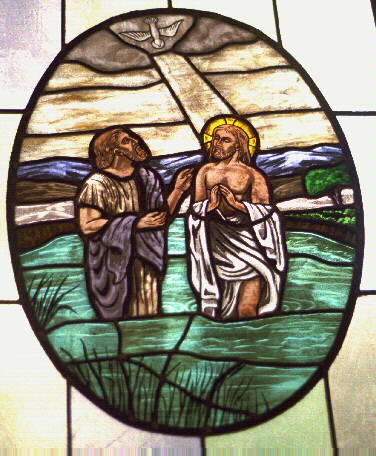
Stained glass from the old Mars Hill sanctuary
Copyright 1998 by Robert C. JonesThis material may be reprinted free of charge for use by non-profit church groups, as long as the author and copyright information is retained.
Would you like to teach this course?
$20.00 - You can purchase a Teacher's Pack, containing:
OR
(Note: Clicking on the "PayPal Buy Now" button allows you to order via MasterCard or Visa. You do not have to have a PayPal account.)
I'd love to hear about anyone that uses this material in their Sunday School classes!
"Scripture taken from the HOLY BIBLE, NEW
INTERNATIONAL VERSION. Copyright Ó 1973,
1978, 1984 by International Bible Society. Used by
permission of Zondervan Publishing House."
Table of Contents Table of Contents
Baptism in the pre-Nicene Early Church
St. Augustine and the Donatist schism
St. Augustine and the Pelagian schism
Other Christian History & Theology courses
Baptism is a manifestation of the Father's prevenient love, a sharing in the Son's Paschal Mystery, and a communication of new life in the Spirit; it brings people into the inheritance of God and joins them to the Body of Christ, the Church. (Instruction On Infant Baptism By the Sacred Congregation for the Doctrine of the Faith; Approved by His Holiness Pope John Paul II, October 20, 1980)
The term "baptism" comes from the Greek word baptizo, which means to immerse, dip, submerge". Few Christians would argue the importance of Baptism - yet few topics have caused such controversy in the history of the Universal Church. Debates such as the following continue even today:How different Christian groups respond to these and other questions can lead to situations, such as schisms (the Donatists and Pelagians with the Catholic Church) and persecution (the Anabaptists in the early days of the Protestant Reformation).
This booklet will attempt to give a brief history of Christian Baptism, using the historical panoply to introduce some of the theological arguments for and against various baptism practices and beliefs. Topics will include baptism in the Bible, baptism in the early church, the Donatist/Pelagian controversies of the 4th and 5th centuries (and the huge impact that St. Augustine of Hippo had on the views of the Catholic Church on baptism), and the Protestant battles regarding infant baptism that were to come a thousand years later.
As I am a Presbyterian Elder, my theological viewpoints tend to be Calvinist-oriented. However, I will attempt to maintain neutrality on the issues discussed herein.
TimelineDate |
Event |
| c. 182/88 A.D. | Irenaeus in Against Heresies may be the first to specifically mention infant baptism |
| c. 215 | Hippolytus in the Apostolic Tradition states First Baptize the children |
| c. 250 | Some Christians commit apostasy under the persecution of Decian |
| c. 251 | Novatian, a presbyter of Rome, breaks away from the Catholic Church after apostate priests are readmitted to the Church |
| c. 254-256 | Cyprian of Carthage argues that baptisms given by schismatics are invalid; Bishop Stephen of Rome holds that the sacraments belong not to the minister but to Christ |
| 303306 | Diocletians persecution |
| 311 & 315 | First Majorinus, and then Donatus set up as rival bishops of Carthage, after a bishop is ordained by a possible apostate. "Donatists" believed a) only Donatist baptisms are valid and b) baptisms performed by the unworthy are invalid |
| c. 312 | Conversion of Constantine to Christianity |
| 314 | Donatism condemned by the Council of Arles |
| 337 | Constantine is baptized shortly before his death |
| c. 380 | British monk Pelagius is shocked by lax morals among Christians in Rome - He eventually rejects the doctrines of Grace and Original Sin, but still believes that infants should be baptized (John 3:5) |
| 387 | St. Augustine baptized by St. Ambrose |
| 393 | Augustine begins his offensive against the Donatists |
| 411 | Arbitration in Carthage rules in favor of Augustine, and against the Donatists |
| 412 421 | Augustine writes thirteen works and letters denouncing the views of Pelagius Augustine believes that we are all tainted by original sin; unbaptized children are condemned to "darkness" |
| 418 | Council of Carthage condemns whoever says that newborn infants should not be baptized |
| 418 | Pelagius excommunicated by Pope Zosimus |
| 431 | Pelagian heresy condemned at the Council of Ephesus |
| 1412 | Council of Florence states that infants should receive baptism as soon as is convenient |
| January 21, 1525 | Several students of Ulrich Zwingli illegally rebaptize themselves in Zurich, starting the Anabaptist movement |
| 1536 | John Calvin publishes Christian Institutes |
| 1528 | Luther states in his Large Catechism we must be baptized or we cannot be saved |
| 1609 | Englishman John Smyth re-baptizes 40 followers in Amsterdam, starting the Baptist movement |
| 1644 | Baptist congregations in London draw up First London Confession, with believers baptism by immersion as a central tenet |
| 1649 | Westminster Confession affirms infant baptism, but views that baptism is not necessary for salvation |
| c. 1900 | Birth of Pentecostalism, with its emphasis on baptism with the Holy Ghost and fire |
| 1980 | Pope John Paul II strongly reaffirms the necessity for infant baptism, in the Instruction On Infant Baptism by the Sacred Congregation for the Doctrine of the Faith |
There is no explicit reference in the Old Testament to baptism, although some commentaries point out that baptism was practiced during the end of the inter-testamental period by Jews initiating Gentile converts into Judaism.
While there is no explicit reference to baptism in the Old Testament as we understand it in the Christian sense, there are references to various elements that will eventually assert themselves in Christian baptism, such as the use of water for ceremonial purification, the pouring out of the Holy Spirit on individuals, and (possibly)...circumcision.
Whether circumcision should be viewed as an Old Testament form of baptism is a theological choice primarily dictated by whether one believes in infant baptism or not. Those in favor of the circumcision/baptism linkage argue that, just as circumcision marked a child in the Old Testament as being part of the convenant of Abraham, so infant baptism in the Christian sense marks a child as being part of the new covenant of Jesus Christ. John Calvin, one of the founders of the Reformed Church, comments:
"We have, therefore, a spiritual promise given to the fathers in circumcision, similar to that which is given to us in baptism, since it figured to them both the forgiveness of sins and the mortification of the flesh The only difference which remains is in the external ceremony, which is the least part of it, the chief part consisting in the promise and the thing signified. Hence we may conclude, that everything applicable to circumcision applies also to baptism, excepting always the difference in the visible ceremony...For just as circumcision, which was a kind of badge to the Jews, assuring them that they were adopted as the people and family of God, was their first entrance into the Church, while they, in their turn, professed their allegiance to God, so now we are initiated by baptism, so as to be enrolled among his people, and at the same time swear unto his name. Hence it is incontrovertible, that baptism has been substituted for circumcision, and performs the same office. (Calvin, "Christian Institutes", p. 1473)
The Roman Catholic Church takes a similar view, believing that baptism is the Christian equivalent of circumcision. The Baptist and Anabaptist (Mennonite, Amish) view is, of course, somewhat different, and will be examined in due course.
Reference |
Comments |
| Gen 17:1-14 | For the generations to come every male among you who is eight days old must be circumcised... |
| Isa 44:3 | "I will pour out my Spirit on your offspring..." |
| Joel 2:28/29 | I will pour out my Spirit in those days. |
| Lev 16:4, Lev 16:24 | Ceremonial washings |
| Ez 36:25 | I will sprinkle clean water on you, and you will be clean... |
| Psalms 51:1-3 | "Wash away all my iniquity and cleanse me from my sin... |

Statue of John the Baptist at Mission Santa Clara
Photo by Robert Jones
We are first introduced to the subject of Baptism in the New Testament through John the Baptist, an (unspecified) relative of Christ. John's baptism, typically practiced by full immersion in the Jordan River, is defined as "a baptism of repentance for the forgiveness of sins." This concept of a baptism of repentance, and for the forgiveness of sins later becomes an important element (although not, of course, the sole element) of Christian baptism.
Reference |
Comments |
| Matt 3:5 - 3:6 | Baptized by him in the Jordan River. |
| Matt 3:11 | Baptism for repentance |
| Mark 1:4 - 1:8; Luke 3:3 | "...a baptism of repentance for the forgiveness of sins." |
| Luke 3:1 - 3:18 | Signs of true repentance |
| Luke 7:29 - 7:30 | Effects of John's baptism |
| John 1:24 - 1:26 | John's authority |
"2. Now some of the Jews thought that the destruction of Herods army came from God, and that very justly, as a punishment of what he did against John, that was called the Baptist: for Herod slew him, who was a good man, and commanded the Jews to exercise virtue, both as to righteousness towards one another, and piety towards God, and so to come to baptism; for that the washing [with water] would be acceptable to him, if they made use of it, not in order to the putting away [or the remission] of some sins [only], but for the purification of the body; supposing still that the soul was thoroughly purified beforehand by righteousness..." (Josephus, "Jewish Antiquities", Book 18, Chapter 5)
John also prepares us (without going into detail) that baptisms practiced by Christ in the future will be different from John's - John's baptism is by water, but Christ will baptize by fire.
Reference |
Comments |
| Matt 3:11 - 3:17 | He will baptize you with the Holy Spirit and with fire. |
| Mark 1:9 - 1:11 | The Spirit descending on him like a dove |
| Luke 3:21 - 3:22 | All persons of the Trinity present at the baptism |
| John 1:29 - 1:34 | The reason for John's baptism |
| John 3:22 - 3:26 | John still baptizing after baptism of Jesus |
"P(3)-
Q(38)-A(1) ...first, it was necessary for Christ to be baptized by John, in order that He might sanctify baptism...Secondly, that Christ might be manifested. Whence John himself says (John 1:31): That He, i.e. Christ, may be made manifest in Israel, therefore am I come baptizing with water. For he announced Christ to the crowds that gathered around him; which was thus done much more easily than if he had gone in search of each individual..." (Aquinas, Summa Theologica)Baptism as practiced by the first Christians
The New Testament gives fascinating clues as to how Christ and the apostles viewed baptism. However, there is no Handbook on Baptism in the New Testament. We can only surmise the proper form and meaning of baptism based on various verses that mention the sacrament. The meaning of many of the verses referenced below would be disputed by numerous groups over the next 2,000 years, and remain in dispute today.
Reference |
Comments |
Christ and Baptism |
|
| Matt 19:14 | Let the little children come to me... - sometimes used to justify infant baptisms |
| Matt 28:18 - 28:20 | The Great Commission Therefore go and make disciples of all nations, baptizing them... |
| Mark 16:15 - 16:18 | Whoever believes and is baptized will be saved... seems to infer that belief precedes baptism. Baptists view that this verse invalidates infant baptism. |
| John 3:1 - 3:8 | ...no one can enter the kingdom of God unless he is born of water and the Spirit. is sometimes used to justify the view that water baptism is necessary for salvation |
| John 4:1 - 4:2 | Jesus did not baptize |
Pentecost |
|
| Luke 24:49 | Jesus talks about the coming Pentacost |
| Acts 1:4 - 1:5 | ...in a few days you will be baptized with the Holy Spirit. are water baptism and baptism by the Holy Spirit two separate things? Does one follow the other? |
| Acts 2:1 - 2:41 | All of them were filled with the Holy Spirit... |
| Acts 2:38 2:39 | The promise is for you and your children... -sometimes used to justify infant baptism |
Baptism and the Apostles |
|
| Acts 8:6 - 8:25 | Baptism of Simon Magus; Acts 8:14/16 seems to indicate that baptism by the Holy Spirit can follow water baptism |
| Acts 8:26 - 8:40 | Philip baptizes the eunuch |
| Acts 9:17 - 9:19 | Saul receives the Holy Spirit from the laying on of hands by Ananias, and is then baptized |
| Acts 10:44 - 10:48 | Gentiles receive Holy Spirit before water baptism |
| Acts 16:14 - 16:15; Acts 16:33; Acts 18:8, 1 Cor 1:16 | Household baptisms sometimes used to establish a scriptural basis for infant baptism |
| Acts 18:23 - Acts 18:28 | Apollo ...he knew only the baptism of John |
| Acts 19:1 - 19:7 | Paul baptizes followers of John the Baptist When Paul placed his hands on them, the Holy Spirit came on them... |
| 1 Cor 1:13 - 1:17 | Paul came not to baptize but to preach |
Meaning of Baptism |
|
| Rom 6:3 - 6:4 | ...all of us who were baptized into Christ Jesus were baptized into his death... |
| 1 Cor 12:13 | ...we were all baptized by one Spirit into one body... |
| Eph 4:4 - 4:6 | ...one Lord, one faith, one baptism... |
| Col 2:11-12 | Paul seems to equate circumcision with baptism sometimes used to establish a scriptural basis for infant baptism |
| Gal 3:26 - 3:28 | "...all of you who were baptized into Christ have clothed yourselves with Christ |
| Titus 3:5 - 3:6 | He saved us through the washing of rebirth and renewal by the Holy Spirit... |
| 1 Pet 3:18 - 3:22 | Noah and family saved by water This water symbolizes baptism that now saves you also... |
Baptism in the pre-Nicene Early Church
Through a number of Early Church sources, we have detailed accounts both of the form of baptisms in the pre-Nicene Church, as well as the meaning and liturgy of baptism. The late 1st-century/early-second century Epistle of Barnabas (possibly written by the Apostle) contains the following description of Christian baptism:"...we indeed descend into the water full of sins and defilement, but come up, bearing fruit in our heart, having the fear [of God] and trust in Jesus in our spirit..." (Epistle of Barnabas)
The Shepherd of Hermas, a popular book in the 2nd and 3rd century Eastern Church, describes the meaning of baptism as follows:
"...before a man bears the name of the Son of God he is dead; but when he receives the seal he lays aside his deadness, and obtains life. The seal, then, is the water: they descend into the water dead, and they arise alive." (Shepherd of Hermas - Similitude IX, Chapter 16)
Justin Martyr, in his c. 150 work "First Apology", describes baptism as follows:
"And for this [rite] we have learned from the apostles this reason. Since at our birth we were born without our own knowledge or choice, by our parents coming together, and were brought up in bad habits and wicked training; in order that we may not remain the children of necessity and of ignorance, but may become the children of choice and knowledge, and may obtain in the water the remission of sins formerly committed, there is pronounced over him who chooses to be born again, and has repented of his sins, the name of God the Father and Lord of the universe; he who leads to the laver the person that is to be washed calling him by this name alone." (Justin Martyr, "First Apology", p 339)
The c. 3rd-century "Constitutions of the Holy Apostles" discusses the seriousness of baptism and the potential consequences if a Christian continues to sin after being initiated into the faith through baptism:
"Beloved, be it known to you that those who are baptized into the death of our Lord Jesus are obliged to go on no longer in sin; for as those who are dead cannot work wickedness any longer, so those who are dead with Christ cannot practice wickedness. We do not therefore believe, brethren, that any one who has received the washing of life continues in the practice of the licentious acts of transgressors. Now he who sins after his baptism, unless he repent and forsake his sins, shall be condemned to hell-fire." ("Constitutions of the Holy Apostles", Book 2, Section 3)
By the fourth century, many people (including, possibly, the Emperor Constantine) put off getting baptized until they were near death, so that they could continue to live a sinful life!
Events prior to a pre-Nicene baptism typically included a two to three year period of instruction into the Christian faith, and a period of fasting prior to the baptism."But before the baptism let the baptizer fast, and the baptized, and whatever others can; but thou shalt order the baptized to fast one or two days before." (Teaching of the Twelve Apostles, Chapt. 7)
Catechumens were expected to lead lives of purity, and to renounce Satan:
"But let him that is to be baptized be free from all iniquity; one that has left off to work sin, the friend of God, the enemy of the devil, the heir of God the Father, the fellow-heir of His Son; one that has renounced Satan, and the demons, and Satans deceits; chaste, pure, holy, beloved of God..." ("Constitutions of the Holy Apostles", Book 3, Section 18)
Baptisms were generally performed by church officials (bishops, presbyters, etc.) often in the period preceding Easter, or the period between Easter and Pentecost. The baptism itself included both an anointing with oil and/or ointment, as well as the dipping or immersion in water:
"Thou therefore, O bishop, according to that type, shalt anoint the head of those that are to be baptized, whether they be men or women, with the holy oil, for a type of the spiritual baptism. After that, either thou, O bishop, or a presbyter that is under thee, shall in the solemn form name over them the Father, and Son, and Holy Spirit, and shall dip them in the water; and let a deacon receive the man, and a deaconess the woman, that so the conferring of this inviolable seal may take place with a becoming decency. And after that, let the bishop anoint those that are baptized with ointment." ("Constitutions of the Holy Apostles", Book 3, Section 16/17)
The meaning of the tri-part baptism (oil, water, ointment) is discussed:
"But thou shalt beforehand anoint the person with the holy oil, and afterward baptize him with the water, and in the conclusion shall seal him with the ointment; that the anointing with oil may be the participation of the Holy Spirit, and the water the symbol of the death of Christ, and the ointment the seal of the covenants." ("Constitutions of the Holy Apostles", Book 7, Chapter 22)
The Constitutions describe the meaning of the immersion and rising up out of the water:
"This baptism, therefore, is given into the death of Jesus: the water is instead of the burial...the descent into the water the dying together with Christ; the ascent out of the water the rising again with Him. ("Constitutions of the Holy Apostles", Book 3, Section 16/17)
In a passage from Hippolytus (c. 215 A.D.), it appears that whole families might have been baptized together, including their children. Hippolytus also seems to infer that full immersion is not a requirement for baptism:
"Where there is no scarcity of water the stream shall flow through the baptismal font or pour into it from above; but if water is scarce, whether on a constant condition or on occasion, then use whatever water is available. Let them remove their clothing. Baptize first the children, and if they can speak for themselves let them do so. Otherwise, let their parents or other relatives speak for them." (Hippolytus, "The Apostolic Tradition", 21:15).
When the person being baptized goes down into the water, he who baptizes him, putting his hand on him, shall say: Do you believe in God, the Father Almighty? And the person being baptized shall say: I believe. Then holding his hand on his head, he shall baptize him once. And then he shall say: Do you believe in Christ Jesus, the Son of God, who was born of the Virgin Mary, and was crucified inder Pontius Pilate, and was dead and buried, and rose again the third day, alive from the dead, and ascended into heaven, and sat at the right hand of the Father, and will come to judge the living and the dead? And when he says: I believe, he is baptized again. And again he shall say: Do you believe in the Holy Spirit, in the holy church, and the resurrection of the body? The person being baptized shall say: I believe, and then he is baptized a third time. (Creeds Of The Church, Ages Software, P. 7
)Some baptismal creeds included, in addition to the affirmation of Christ as savior, the renunciation of Satan:
"I renounce Satan, and his works, and his pomps, and his worships, and his angels, and his inventions, and all things that are under him." (Constitutions of the Holy Apostles, Book 7, Section 3)

"HOW, WHILE HE WAS PRAYING, GOD SENT HIM A VISION OF A CROSS OF LIGHT IN THE HEAVENS AT MID-DAY, WITH AN INSCRIPTION ADMONISHING HIM TO CONQUER BY THAT.
A
CCORDINGLY he called on him with earnest prayer and supplications that he would reveal to him who he was, and stretch forth his right hand to help him in his present difficulties. And while he was thus praying with fervent entreaty, a most marvelous sign appeared to him from heaven, the account of which it might have been hard to believe had it been related by any other person...He said that about noon, when the day was already beginning to decline, he saw with his own eyes the trophy of a cross of light in the heavens, above the sun, and bearing the inscription, CONQUER BY THIS. At this sight he himself was struck with amazement, and his whole army also, which followed him on this expedition, and witnessed the miracle." (Eusebius, The Life of the Blessed Emperor Constantine, p. 665/66)After having a similar vision of Christ in his sleep, Constantine makes the priests of God his counselors, and:
"...deemed it incumbent on him to honor the God who had appeared to him with all devotion. And after this, being fortified by well-grounded hopes in Him, he hastened to quench the threatening fire of tyranny." (Eusebius, p. 668)
Constantine, of course, goes on to defeat Maxentius, to assume total control of the Western Empire.
Constantine becomes a strong supporter and learned student of Christianity. However, he delays being baptized a common practice in the fourth century. While it was well known among the Bishops of Christianity that their enthusiastic emperor was not baptized, he was, to say the least, assigned some slack:
But the severe rules of discipline which the prudence of the bishops had instituted, were relaxed by the same prudence in favor of an Imperial proselyte, whom it was so important to allure, by every gentle condescension, into the pale of the church; and Constantine was permitted, at least by a tacit dispensation, to enjoy most of the privileges, before he had contracted any of the obligations, of a Christian. Instead of retiring from the congregation, when the voice of the deacon dismissed the profane multitude, he prayed with the faithful, disputed with the bishops, preached on the most sublime and intricate subjects of theology, celebrated with sacred rites the vigil of Easter, and publicly declared himself, not only a partaker, but, in some measure, a priest and hierophant of the Christian mysteries. (Gibbon, "Decline and Fall of the Roman Empire", Vol. 2, p. 200)
It is not until near his death that Constantine agrees to be baptized. These deathbed conversions were common in the 4th century. When catechumens were baptized in the early church, they were expected to live pure and chaste lives from that point on. There was a temptation to hold off on Christian baptism with its demands for purity, until one was old, or even nearing death, to avoid a lifetime requirement of right living. Constantine seems to have been one Christian with those views!
Whatever the reason for the delay, Constantine did finally agree to be baptized in 337 A.D, shortly before his death. Surely, this was the most famous and significant baptism since Paul! It is described by Eusebius:
Being at length convinced that his life was drawing to a close, he felt the time was come at which he should seek purification from sins of his past career, firmly believing that whatever errors he had committed as a mortal man, his soul would be purified from them through the efficacy of the mystical words and the salutary waters of baptism...After this he proceeded as far as the suburbs of Nicomedia, and there, having summoned the bishops to meet him, addressed them in the following words:T
HE time is arrived which I have long hoped for, with an earnest desire and prayer that I might obtain the salvation of God. The hour is come in which I too may have the blessing of that seal which confers immortality; the hour in which I may receive the seal of salvation. I had thought to do this in the waters of the river Jordan, wherein our Savior, for our example, is recorded to have been baptized: but God, who knows what is expedient for us, is pleased that I should receive this blessing here... (Eusebius, p. 809/11)
Constantine was then baptized "in the usual manner". Finally, Eusebius reports the profound significance of this baptism (a significance that still resounds to this very day):
Thus was Constantine the first of all sovereigns who was regenerated and perfected in a church dedicated to the martyrs of Christ; thus gifted with the Divine seal of baptism... (Eusebius, p. 809/11)
The long reign of terror and persecution against Christians was over!
St. Augustine and the Donatist schism More events significant to the history of Christian baptism were to occur throughout the end of the 4th century, and into the 5th. They involved two schismatic groups named the Donatists and Pelagians, and one Christian saint and theologian, St. Augustine of Hippo. Out of the battle between these two schismatic groups and the Catholic Church were to arise Augustinian tenets regarding baptism that are still followed by the Roman Catholic Church today:(Matt 10:32/33 NIV) Whoever acknowledges me before men, I will also acknowledge him before my Father in heaven. But whoever disowns me before men, I will disown him before my Father in heaven.
After losing the election to fill the vacant position of Bishop of Rome in 251 A.D., Novatian and his followers split away from the Catholic Church. By 254 A.D., however, when it was clear that Novatian was not receiving support from outside his circle of followers, many of the followers of Novatian had fled, or desired (re)entry into the Catholic Church.
A great debate was waged between Bishop (254-56 A.D.) Stephen of Rome, who argued that those baptized by Novatianists could be accepted into the Catholic Church without being rebaptized, and Cyprian of Carthage (c. 195258 A.D.), who argued that baptisms given by schismatics were not real baptisms at all. The following quote from Cyprian is representative of his views on the subject:
You have written to me, dearest brother, wishing that the impression of my mind should be signified to you, as to what I think concerning the baptism of heretics; who, placed without, and established outside the Church, arrogate to themselves a matter neither within their right nor their power. This baptism we cannot consider as valid or legitimate, since it is manifestly unlawful among them... (Cyprian, "Epistle 72 - To Jubaianus, Concerning The Baptism Of Heretics")
Stephen, whose view ultimately prevailed (and was later strongly seconded by Augustine), noted that baptism belongs to Christ, not the church, and the standing of the baptizer is not the relevant issue.
The cause of Novatian (against apostasy) and Cyprian (against validating baptisms by schismatics) would later be taken up by a group called the Donatists.
The situation in the early fourth century was similar to that of 50 years earlier. Emperor Diocletian had ordered the persecution of Christians throughout the empire (303 306), and many Christians (including some bishops and priests) had committed apostasy. After Constantine came into power, the question of the mid-third century remained what to do about those that had committed apostasy? The situation boiled over at Carthage in 311 A.D. when an archdeacon named Caecilianus was ordained by a bishop that was suspected of having committed apostasy during the Diocletian persecution. In retaliation, the Donatists set up a rival Bishop of Carthage (Majorinus in 311 A.D.; Donatus in 315 A.D.).In time, the Donatists became a schismatic sect, claiming that they were the only true Christians. The Donatists refused to accept baptisms performed in the Catholic Church, claiming they were invalid:
Whenever they [Donatists] acquired a proselyte, even from the distant provinces of the East, they carefully repeated the sacred rites of baptism and ordination; as they rejected the validity of those which he had already received from the hands of heretics or schismatics. Bishops, virgins, and even spotless infants, were subjected to the disgrace of a public penance, before they could be admitted to the communion of the Donatists. If they obtained possession of a church which had been used by their Catholic adversaries, they purified the unhallowed building with the same zealous care which a temple of idols might have required. They washed the pavement, scraped the walls, burnt the altar, which was commonly of wood, melted the consecrated plate, and cast the Holy Eucharist to the dogs, with every circumstance of ignominy which could provoke and perpetuate the animosity of religious factions. (Gibbon, Vol. 2, p. 219)
The Donatists also insisted that a baptism performed by an impure priest was not valid.
While Donatism was condemned at the Council of Arles in 314 A.D., it continued to flourish. Beginning in 393 A.D., St. Augustine, the great theologian of the early Catholic Church, turned his skills of eloquence and logic against the Donatists. Central to the debate was, once again, baptism. It has already been noted that the Donatists forced Catholic proselytes to be rebaptized. However, the Catholic Church did not force reformed Donatists that wished to (re)join the Catholic Church to be rebatized, following the logic of Bishop Stephen of Rome in 254 A.D. baptism is of Christ, not of the baptizer.
It was against this backdrop (and also against the later Pelagian schism) that Augustine of Hippo began promulgating his theological views on baptism, which are still the standards of the Roman Catholic Church today.
One baptism
It is true that Christs baptism is holy; and although it may exist among heretics or schismatics, yet it does not belong to the heresy or schism; and therefore even those who come from thence to the Catholic Church herself ought not to be baptized afresh. (The Seven Books Of Augustin, Bishop Of Hippo, On Baptism, Against The Donatists, p. 780)
And as the baptized person, if he depart from the unity of the Church, does not thereby lose the sacrament of baptism, so also he who is ordained, if he depart from the unity of the Church, does not lose the sacrament of conferring baptism. (Augustine, p. 756)
So those, too, who in the sacrilege of schism depart from the communion of the Church, certainly retain the grace of baptism, which they received before their departure, seeing that, in case of their return, it is not again conferred on them whence it is proved, that what they had received while within the unity of the Church, they could not have lost in their separation. (Augustine, p. 755/56)
...we act rightly who do not dare to repudiate Gods sacraments, even when administered in schism. (Augustine, p. 757)
On Cyprians view of baptism in the third century
St. Augustine and the Pelagian schism
While St. Augustine established for all time some important tenets of baptism in his battle with the Donatists, his theological conclusions that resulted from his battle with the Pelagians were even more significant and far reaching.Pelagius (c. 354 A.D. - after 418) was a British Monk who was horrified by the seeming lack of piety and purity practiced by Christians in Rome c. 380 A.D. He felt that the laxness of Roman Christians grew partly from the prevailing doctrine of Grace, which stated that humans on their own are incapable of purity, and can only be saved by Gods grace.
Pelagius and his followers (one student named Coelestius was especially influential) denied predestination, original sin, and the doctrine of Grace, maintaining the humans are not tainted by the sin of Adam and Eve, and that babies are born pure. As a result, humans have the free will to choose to live sinless lives. (In his somewhat confused theology, though, Pelagius still maintained that babies needed to be baptized.)
Augustines response to the Pelagian heresy was vociferous and voluminous Augustine wrote at least thirteen works and letters against Pelagius, and firmly entrenched in Catholic theology the doctrines of:
It should be noted that tenets three and four above are seemingly inconsistent with the doctrine of predestination, of which Augustine was a proponent. A thousand years later, John Calvin (as we shall see) would argue against the necessity of infant baptism for this very reason.
Original Sin/necessity for infant baptism
Hence men are on the one hand born in the flesh liable to sin and death from the first Adam, and on the other hand are born again in baptism associated with the righteousness and eternal life of the second Adam... (Augustine, p. 160)
"For who would dare to say that Christ is not the Savior and Redeemer of infants? But from what does He save them, if there is no malady of original sin within them? From what does He redeem them, if through their origin from the first man they are not sold under sin? Let there be then no eternal salvation promised to infants out of our own opinion, without Christs baptism; for none is promised in that Holy Scripture which is to be preferred to all human authority and opinion." (Augustine, p. 171)
Necessity of baptism for salvation
Fate of infants that die before being baptized
It may therefore be correctly affirmed, that such infants as quit the body without being baptized will be involved in the mildest condemnation of all. (Augustine, p. 159) (Even Augustine seemed a bit uncomfortable with the idea that infants that die unbaptized are damned to suffer in hell for eternity!)
The basic views on baptism promulgated by St. Augustine in the late fourth and early fifth centuries remained the effective doctrine of the Roman Catholic Church for the next thousand years (with, perhaps, some refinement by Thomas Aquinas in his "Summa Theologica"). Only with the coming of the Protestant Reformation in the 16th century would millennium-old doctrines and theologies begin to be challenged, including:
Baptism is no human trifle, but instituted by God Himself, moreover, that it is most solemnly and strictly commanded that we must be baptized or we cannot be saved, lest any one regard it as a trifling matter, like putting on a new red coat. (Martin Luther, Large Catechism, 1528, p. 100/111)
The more revolutionary views on baptism would come from the Reformed Church, the Anabaptists, and the Baptists.
John Calvin and the Reformed Church
John Calvin, one of the founders of the Reformed Church, and perhaps the greatest theologian since Thomas Aquinas, agreed with the Augustinian (and thus, Roman Catholic) views on baptism in several areas, including the idea that people should only be baptized once, and that the purity of the person conferring the baptism was irrelevant:
"Moreover, if we have rightly determined that a sacrament is not to be estimated by the hand of him by whom it is administered, but is to be received as from the hand of God himself, from whom it undoubtedly proceeded, we may hence infer that its dignity neither gains nor loses by the administrator. And, just as among men, when a letter has been sent, if the hand and seal is recognized, it is not of the least consequence who or what the messenger was; so it ought to be sufficient for us to recognize the hand and seal of our Lord in his sacraments, let the administrator be who he may". (Calvin, p. 1461)
John Calvin also agreed with Early Church Fathers such as Hippolytus that the form of baptism was not of consequence both sprinkling and immersion are acceptable:
"Whether the person baptized is to be wholly immersed, and that whether once or thrice, or whether he is only to be sprinkled with water, is not of the least consequence: churches should be at liberty to adopt either, according to the diversity of climates, although it is evident that the term baptize means to immerse, and that this was the form used by the primitive Church." (Calvin, p. 1465)
However, Calvin did not believe that baptism was either the cause of salvation, nor was it necessary to salvation:
"Peter also says that baptism also doth now save us (1 Peter 3:21). For he did not mean to intimate that our ablution and salvation are perfected by water, or that water possesses in itself the virtue of purifying, regenerating, and renewing; nor does he mean that it is the cause of salvation, but only that the knowledge and certainty of such gifts are perceived in this sacrament." (Calvin, p. 1451)
...we must not deem baptism so necessary as to suppose that everyone who has lost the opportunity of obtaining it has forthwith perished. By assenting to their fiction, we should condemn all, without exception, whom any accident may have prevented from procuring baptism, how much soever they may have been endued with the faith by which Christ himself is possessed. (Calvin, p. 1493)
Calvin viewed that a primary goal of baptism, rather than to confer salvation, was to make a public profession of faith, and to join the Universal Church of believers:
"Baptism serves as our confession before men, inasmuch as it is a mark by which we openly declare that we wish to be ranked among the people of God, by which we testify that we concur with all Christians in the worship of one God, and in one religion; by which, in short, we publicly assert our faith, so that not only do our hearts breathe, but our tongues also, and all the members of our body, in every way they can, proclaim the praise of God". (Calvin, p. 1459)
John Calvin also strongly believed in the practice of infant baptism:
"If, by baptism, Christ intends to attest the ablution by which he cleanses his Church, it would seem not equitable to deny this attestation to infants, who are justly deemed part of the Church, seeing they are called heirs of the heavenly kingdom". (Calvin, p. 1490)
While John Calvin was in favor of the practice of infant baptism, in a significant departure from Roman Catholic doctrine, he stated that unbaptized infants that die prematurely could still be saved. How? - through the doctrine of predestination. If, before the beginning of the world, God had pre-ordained that an infant was to be saved, the lack of baptism in the infants temporal life would not be an inhibitor to salvation. As was noted earlier in this work, Augustine also believed in predestination, but did not apply the doctrine to infant baptism. It could be said that John Calvin took the theology of predestination to its logical conclusion with infant baptism.
Our children, before they are born, God declares that he adopts for his own when he promises that he will be a God to us, and to our seed after us. In this promise their salvation is included. None will dare to offer such an insult to God as to deny that he is able to give effect to his promise. How much evil has been caused by the dogma, in expounded, that baptism is necessary to salvation, few perceive, and therefore think caution the less necessary... that children who happen to depart this life before an opportunity of immersing them in water, are not excluded from the kingdom of heaven. (Calvin, p. 1465, 1467)
"28:1 Baptism is a sacrament of the New Testament, ordained by Jesus Christ (Mat 28:19), not only for the solemn admission of the party baptized into the visible Church (1 Cor 12:13); but also, to be unto him a sign and seal of the covenant of grace (Rom 4:11 with Col 2:11, 12), of his ingrafting into Christ (Rom 6:5; Gal 3:27), of regeneration (Titus 3:5), of remission of sins (Mark 1:4), and of his giving up unto God through Jesus Christ, to walk in newness of life (Rom 6:3, 4). Which sacrament is, by Christs own appointment, to be continued in His Church until the end of the world (Matt 28:19, 20)."
"28:3 Dipping of the person into the water is not necessary: but Baptism is rightly administered by pouring or sprinkling water upon the person (Mark 7:4; Acts 2:41; 16:33; Heb 9:10, 19-22)."
"28:4 Not only those that do actually profess faith in and obedience unto Christ (Mark 16:15, 16; Acts 8:37, 38), but also the infants of one or both believing parents, are to be baptized (Gen 17:7, 9 with Gal 3:9, 14, and Col 2:11, 12, and Acts 2:38, 39, and Rom 4:11, 12; Matt 28:19; Mark 10:13-16; Luke 18:15; 1 Cor 7:14)."
"28:5 Although it be a great sin to contemn or neglect this ordinance (Luke 7:30 with Ex 4:24-26), yet grace and salvation are not so inseparably annexed unto it, as that no person can be regenerated or saved without it (Acts 10:2, 4, 22, 31, 45, 47; Rom 4:11); or, that all that are baptized are undoubtedly regenerated (Acts 8:13, 23)."
"28:7 The sacrament of Baptism is but once to be administered unto any person (Titus 3:5). (Westminster Confession, Chapter XXVIII)
On January 21, 1525, an event occurred in Zurich which still reverberates today, almost 500 years later. Several of Zwinglis students (including Conrad Grebel, Feliz Manz and Georg Blaurock) illegally re-baptized each other, viewing that their baptism as infants was invalid. While the Anabaptist movement had other views that distinguished it from the Reformed Church of Zwingli (separation of church and state, for one), this event (and the theology that it stood for) became so strongly associated with the group that their very name reflects it:
The name Anabaptists which is now applied to them, has but lately come into use, deriving its matter from the matter of holy baptism, concerning which their views differ from those of all, so-called, Christendom.
(Braght, Martyrs Mirror, 1660 , p. 16)The Anabaptist view on infant baptism is summarized in the following passage:
Of Holy Baptism, and why we have preferred it to all other articles, in our history: ...Because it is the only sign and proof of incorporation into the visible Christian church, without which no one, whoever he be, or whatever he may profess, or how separated and pious a life he may lead, can be recognized as a true member of the Christian Church...Because it is, beyond contradiction, the only article on account of which others call us Anabaptists. For, since all other so-called Christians have, yet without true foundation, this in common that they baptize infants; while with us the baptism only which is accompanied by faith and a penitent life, according to the word of God, is administered to adults; it follows, that with us such persons are baptized who have received baptism in their childhood, without faith and repentance; who, when they believe and repent, are again, or at least truly baptized with us; because with us their previous baptism, being without true foundation, and without the word of God, is not considered baptism at all. (Braght, Martyrs Mirror, 1660 , p. 16)
Compared to the Lutheran and Reformed Church successors, the Anabaptists are a comparably small group today, with the Amish, Mennonites, and Hutterites comprising about 600,000 members worldwide. However, while there is no unbroken line of succession between the Anabaptists and the modern day Baptists (over 32,000,000 strong in the U.S.A.), there is certainly great doctrinal similarity. The Anabaptists may be considered the spiritual predecessors of the American Baptist movement.

Amish farmer in Lancaster County, PA (1987)
Photo by Robert Jones
The Baptist movement grew out of the Puritan/Separatist movements in England in the 17th century. The Puritans, generally Calvinists, wanted the Church of England to be more democratic in its governmental structure, and less Catholic in its trappings, liturgy, and rituals. (The Puritans were members of the Church of England, who wished to purify the church from within.) The Separatists were more radical, desiring a complete break from the Church of England. Out of the Separatist movement came both the Pilgrims and the Baptists.
The man often cited as the first Baptist is John Smyth (15701612), a former Anglican priest that became, in succession, a Puritan, a Separatist, and finally, a Baptist. In 1608, John Smyth (with the help of Thomas Helwys (?1616)) took a group of Separatist followers to Amsterdam. During this period, Mennonites, descendents of the 16th century Anabaptists influenced Smyth and his followers.
In 1609, in a scene somewhat reminiscent of the Anabaptist re-baptizing ceremony in Zurich 90 years before, Smyth re-baptized himself and 40 followers, reasoning that their baptism as infants were invalid. What was soon to become the Baptist Church had begun.
In 1644, a group of Calvinist Particular Baptists published their London Confession, affirming believers baptism as a key tenet:
Baptism is an ordinance of the New Testament, given by Christ, to be dispersed only upon persons professing faith. The way and manner of dispensing this Ordinance the Scripture holds to be dipping or plunging the whole body under water. - "The London Confession (1644)" (The Baptists: A People Who Gathered "To Walk in All His Ways. Christian History, Issue 6)
As noted in the bold text above, both believers baptism, and baptism by immersion were central to their beliefs - a final separation from Augustinian views on baptism.
The Great Debate Infant Baptism vs. Believers Baptism
Perhaps the greatest continuing debate regarding baptism in the Universal Church is infant baptism vs. believers baptism. In this section, we examine some of the basic arguments on both sides of the issue.In general, those that believe in believers baptism outline the following arguments in favor of their position:
Infant baptism is not mentioned in the Bible, the sole authority for Christians
Perhaps the strongest argument against infant baptism is that it is nowhere explicitly mentioned in the New Testament:
The word of God, in all its length and breadth, contains not a syllable of authority for infant baptism, in the form of command, of precept, of permission, of example, or in any other form whatever. In that sacred book not one word in relation to it, is anywhere uttered. (R.B.C. Howell, Evils of Infant Baptism, p. 11)
Those in favor of infant baptism typically refer to:
Everyone must now see that paedobaptism, which receives such strong support from Scripture, is by no means of human invention. Nor is there anything plausible in the objection, that we nowhere read of even one infant having been baptized by the hands of the apostles. For although this is not expressly narrated by the Evangelists, yet as they are not expressly excluded when mention is made of any baptized family (Acts 16:15, 32), what man of sense will argue from this that they were not baptized? (Calvin, p. 1476/77)
For we must not lightly overlook the fact, that our Savior, in ordering little children to be brought to him, adds the reason, of such is the kingdom of heaven...If it is right that children should be brought to Christ, why should they not be admitted to baptism, the symbol of our communion and fellowship with Christ? If the kingdom of heaven is theirs, why should they be denied the sign by which access, as it were, is opened to the Church, that being admitted into it they may be enrolled among the heirs of the heavenly kingdom? (Calvin, p. 1475/6)
(Acts 2:38/39 NIV) Peter replied, Repent and be baptized, every one of you, in the name of Jesus Christ for the forgiveness of your sins. And you will receive the gift of the Holy Spirit. The promise is for you and your children and for all who are far off--for all whom the Lord our God will call.
Church Tradition
A standard argument in favor of infant baptism is that the Early Church Fathers, including Origen, Augustine, and Hippolytus almost universally accepted it:
Both in the East and in the West the practice of baptizing infants is considered a rule of immemorial tradition. Origen, and later St. Augustine, considered it a "tradition received from the Apostles." When the first direct evidence of infant Baptism appears in the second century, it is never presented as an innovation. St. Irenaeus, in particular, considers it a matter of course that the baptized should include "infants and small children" as well as adolescents, young adults and older people. The oldest known ritual, describing at the start of the third century the Apostolic Tradition, contains the following rule: "First baptize the children. Those of them who can speak for themselves should do so. The parents or someone of their family should speak for the others." (Instruction On Infant Baptism, By the Sacred Congregation for the Doctrine of the Faith - Approved by His Holiness Pope John Paul II, October 20, 1980)
The argument against this position usually points out that there is no record of infant baptism in the church until a possible reference by Irenaeus late in the second century (c. 182/88), 100+ years after the Synoptic Gospels were written.
Not till so late a period as at least certainly not earlier than Irenaeus appears a trace of infant baptism. That it first became recognized as an apostolic tradition in the course of the third century is evidence rather against, than for the admission of its apostolic origin, especially since, in the spirit of the age when Christianity appeared, there were many elements which must have been favorable to the introduction of infant baptism... (Howell, p. 18)
It should be noted also that the passage from Irenaeus mentioned by the Sacred Congregation for the Doctrine of the Faith above does not actually mention infant baptism by name:
For He came to save all through means of Himself all, I say, who through Him are born again to God infants, and children, and boys, and youths, and old men. He therefore passed through every age, becoming an infant for infants, thus sanctifying infants; a child for children, thus sanctifying those who are of this age, being at the same time made to them an example of piety, righteousness, and submission; a youth for youths, becoming an example to youths, and thus sanctifying them for the Lord... (Irenaeus, Against Heresies, II, Chapt. 22, Section 4)
John Calvin weighs in on the topic of whether there was a long period of time between the writing of the Gospels, and the general acceptance of infant baptism by the Church Fathers:
The assertion which they [the Anabaptists] disseminate among the common people, that a long series of years elapsed after the resurrection of Christ, during which paedobaptism was unknown, is a shameful falsehood, since there is no writer, however ancient, who does not trace its origin to the days of the apostles. (Calvin, p. 1477)
Mark 16:16 belief precedes baptism
A key point in the arsenal of those who believe in believers baptism is the fact that Christ states in Mark 16:16 that Whoever believes and is baptized will be saved, but whoever does not believe will be condemned (NIV). This would seem to set an order of belief first, then baptism:
Those alone, who believe the gospel, they are required to baptize. The persons to be baptized are minutely described. They are believers. Believers therefore, and believers only, are to be baptized. A law to baptize believers is necessarily confined in its administration to believers. It embraces no others. To baptize any others is a violation of the law. It is unlawful. It is prohibited. Infants are not believers. (Howell, p. 21)
John Smyth, perhaps the first Baptist, viewed that baptism of the Spirit is required for a baptism to be valid (a view which would later become a key part of 20th century Pentecostalism):
For baptism is not washing with water: but it is the baptism of the Spirit, the confession of the mouth, and the washing with water: how then can any man without great folly wash with water which is the least and last of baptism, one that is not baptized with the Spirit, and cannot confess with the mouth: or how is it baptism if one be so washed: Now that an infant cannot be baptized with the Spirit is plain, 1 Pet. 3:21. where the Apostle saith that the baptism of the Spirit is the question of a good conscience unto God, and Heb. 10:22. where the baptism which is inward is called the sprinkling of the heart from an evil conscience: seeing therefore infants neither have an evil conscience, nor the question of a good conscience, nor the purging of the heart, for all these are proper to actual sinners: hence it followeth that infants baptism is folly and nothing. - John Smyth, The Character of the Beast (1609) (The Baptists: A People Who Gathered "To Walk in All His Ways.": Christian History, Issue 6)
John Calvin viewed that the Mark 16:16 passage regarding the belief/baptism order was referring specifically to adults, and should not be applied to infants:
Whosoever believeth and is baptized, shall be saved. Is there one syllable about infants in the whole discourse? What, then, is the form of argument with which they assail us? Those who are of adult age are to be instructed and brought to the faith before being baptized, and therefore it is unlawful to make baptism common to infants. They cannot, at the very utmost, prove any other thing out of this passage, than that the gospel must be preached to those who are capable of hearing it before they are baptized; for of such only the passage speaks. (Calvin, p. 1494/95)
The debate, of course, continues to rage to this day.
SourcesTitle |
Author |
Publisher |
Date |
| A Treatise On The Merits And Forgiveness Of Sins And On The Baptism Of Infants - St. Augustine | Trans. by Peter Holmes, D.D., F.R.A.S., & Rev. Robert Ernest Wallis, Ph.D. |
Ages Software | 1997 |
| Against Heresies - Irenaeus | Trans. by A. Cleveland Coxe, D.D. | Ages Software | 1997 |
| Constitutions of the Holy Apostles | Edited, With Notes, By James Donaldson, D.D. | Ages Software | 1997 |
| Creeds Of The Church | Ages Software | 1997 | |
| Decline and Fall of the Roman Empire | Edward Gibbon | Ages Software | 1997 |
| Ecclesiastical History - Eusebius | Trans. by Arthur Cushman McGiffert, Ph.D. | Ages Software | 1997 |
| Epistle 72 - To Jubaianus, Concerning The Baptism Of Heretics - Cyprian | Trans. By The Rev. Ernest Wallis, Ph.D | Ages Software | 1997 |
| Epistle of Barnabas | Trans. by A. Cleveland Coxe, D.D. | Ages Software | 1997 |
| Evils of Infant Baptism | R.B.C. Howell | Ages Software | 1997 |
| First Apology - Justin Martyr | Trans. by A. Cleveland Coxe, D.D. | Ages Software | 1997 |
| First Epistle of Clement to the Corinthians | Trans. by Archbishop Wake | Gramercy Books | 1979 |
| Holy Bible - New International Version | Zondervan Publishing House | 1973 | |
| Institutes of the Christian Religion - John Calvin | Trans. by Henry Beveridge | Ages Software | 1997 |
| Instruction On Infant Baptism | By the Sacred Congregation for the Doctrine of the Faith | Approved by His Holiness Pope John Paul II | 1980 |
| Jewish Antiquities - Josephus | William Whiston, Translator | Ages Software | 1997 |
| Large Catechism - Martin Luther | Trans. by F. Bente and W. H. T. Dau | Ages Software | 1997 |
| Lost Books of the Bible | Gramercy Books | 1979 | |
| Martyrs Mirror | Thielman J. van Braght | Herald Press |
|
| Pastor of Hermas | Trans. by the Rev. F. Crombie, M.A. | Ages Software | 1997 |
| Teaching of the Twelve Apostles | Trans. by Professor Isaac H. Hall & Mr. John T. Napier | Ages Software | 1997 |
| The Baptists: A People Who Gathered "To Walk in All His Way | Christian History | 1997 | |
| The Life of the Blessed Emperor Constantine - Eusebius | Trans. by A. Cleveland Coxe, D.D. | Ages Software | 1997 |
| The Seven Books Of Augustin, Bishop Of Hippo, On Baptism, Against The Donatists | Trans. By Rev. J.R. King, M.A | Ages Software | 1997 |
| Summa Theologica - Thomas Aquinas | English Dominican translation of Aquinas begun in 1911 | Ages Software | 1997 |