A Brief History of the
Inquisition
Written by Robert JonesClick here to see other courses that I've written
Click here to go to the Christian History & Theology home page
Acworth, Georgia

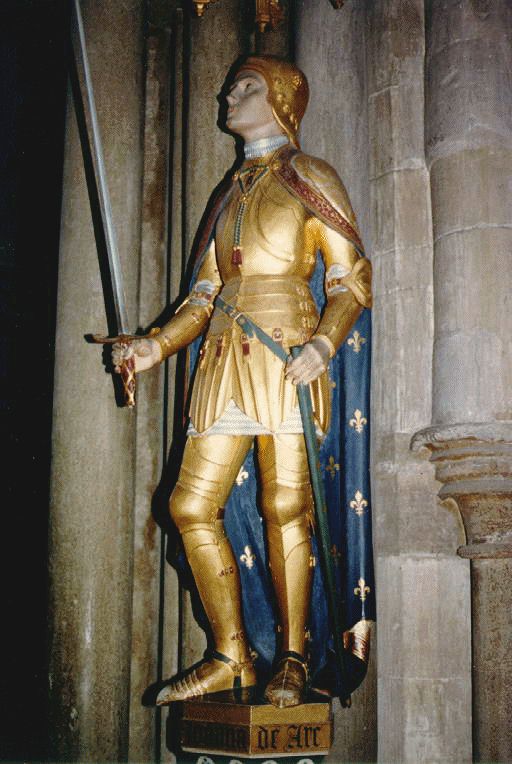
Joan of Arc - a famous victim of the Inquisition
Copyright 1998 by Robert C. JonesThis material may be reprinted free of charge for use by non-profit church groups, as long as the author and copyright information is retained.
Would you like to teach this course?
$25.00 - You can purchase a Teacher's Pack, containing:
OR
(Note: Clicking on the "PayPal Buy Now" button allows you to order via MasterCard or Visa. You do not have to have a PayPal account.)
I'd love to hear about anyone that uses this material in their Sunday School classes!
"Scripture taken from the HOLY BIBLE, NEW
INTERNATIONAL VERSION. Copyright 1973,
1978, 1984 by International Bible Society. Used by
permission of Zondervan Publishing House."
Foundations of the Inquisition
The Medieval (or Papal) Inquisition
Targets of the Medieval Inquisition
The First Grand Inquisitor - Torquemada
Victims of the Spanish Inquisition
Methodologies of the Inquisition
Other Christian History & Theology courses
Making every allowance required of an historian and permitted to a Christian, we must rank the Inquisition, along with the wars and persecutions of our time, as among the darkest blots on the record of mankind, revealing a ferocity unknown in any beast. (Will Durant, The Age of Faith, p. 784)
The Inquisition was one of the great blights in the history of Christianity. No other institution in the history of the Christian Church was so horrible, so unjust, so...un-Christian. When it was finally brought to a halt in 1834, thousands of lives had been lost, and tens of thousands of lives ruined through imprisonment and confiscation of property. Whole populations were driven from their homelands, and the Roman Church had earned a blight against its name that still resonates to this day.
This booklet will present an overview of the Inquisition, including a look at the justification, methodologies, victims, and results of the 600-year reign of this most dreaded institution.
Heresy (Greek hairesis) An opinion or doctrine not in line with the accepted teaching of the church; the opposite of orthodoxy (Holman Bible Dictionary)
In late-20th century America, with its extreme separation of church and state, it is hard to imagine that there was a time when heresy was considered not only an ecclesiastical crime, but a secular one too. However, during the Middle Ages, church and state were often united in the cause of maintaining social order. During Medieval times, it was often difficult to distinguish between the secular and the ecclesiastical Catholic bishops installed emperors and kings; those same emperors and kings provided protection for the church and its ministers. To rebel against the church (either in matters of theology or matters of organizational hierarchy) was to question the legitimacy of the whole social, political, economic, and (of course) religious structure of medieval society. The Inquisition, which lasted for 600 years, was the product of a tight (and very successful) marriage of church and state. The church hunted down and prosecuted heretics, and the state punished them, often by burning at the stake.
The idea that heresy was both an ecclesiastical as well as secular crime has a long pedigree. In Rome, for example, heresy was considered treason, punishable by death, as is witnessed by the early Christian martyrs many of them were murdered for failing to accept that the current emperor was akin to God. A Roman judge could make an inquisitio into the case of a suspected heretic the nomenclature from which Inquisition would come.
Later, the great law code of Justinian (483-565 A.D.) codified (Da haereticis) the equation of heresy with treason, thus punishable by the secular arm to death, if necessary. Justinian, of course, was a Christian, so earlier Roman laws that persecuted Christians for their beliefs were now applied against those that did not hold Christian beliefs.
During the Middle Ages, the burning of heretics was not unusual in the two hundred years leading up to the Inquisition (which officially started in 1227/31 A.D.). Often, the burnings were instigated by secular authorities, or by mob action. One of the first known Medieval burnings of heretics was by Robert the Pious, King of France, in 1022 A.D., who ordered unrepentant heretics to the flames. Mob actions in Milan in c. 1028, in Soissons in 1114, and in Cologne in 1143 resulted in the death of heretics at the stake, when angry mobs pulled unrepentant heretics out of ecclesiastical prisons. Thus, the idea of consigning heretics to burning at the stake was well ingrained by the time of the start of the Inquisition in 1227/31.
In 1184, Pope Lucius III issued a bull against heretics, which would establish many of the principals of jurisprudence later adopted by the Inquisition. Among those principals was the idea that anyone that shielded or succored heretics would be liable to the same punishment as the heretic themselves, that unrepentant heretics should be turned over to secular arm for punishment, and that relapsed heretics should receive steeper sentences (including confiscation of property). Also of interest is the fact that two main targets of the Inquisition of 40 years later were identified by name Catharists, and the Poor of Lyons (a.k.a. Waldensians).
THE DECREE OF POPE LUCIUS III AGAINST HERETICS
To abolish the malignity of diverse heresies which are lately sprung up in most parts of the world, it is but fitting that the power committed to the church should be awakened, that by the concurring assistance of the Imperial strength, both the insolence and mal-pertness of the heretics in their false designs may be crushed, and the truth of Catholic simplicity shining forth in the holy church, may demonstrate her pure and free from the execrableness of their false doctrines....
More particularly, we declare all Catharists, Paterines, and those who call themselves the Poor of Lyons; the Passignes, Josephists, Arnoldists, to lie under a perpetual anathema....
And we likewise declare all entertainers and defenders of the said heretics, and those that have showed any favor or given countenance to them, thereby strengthening them in their heresy, whether they be called comforted, believers, or perfect, or with whatsoever superstitious name they disguise themselves, to be liable to the same sentence....
And as for a layman who shall be found guilty either publicly or privately of any of the aforesaid crimes, unless by abjuring his heresy and making satisfaction he immediately return to the orthodox faith, we decree him to be left to the sentence of the secular judge, to receive condign punishment according to the quality of the offense...
...but those who after having abjured their errors, or cleared themselves upon examination to their bishop, if they be found to have relapsed into their abjured heresyWe decree that without any further hearing they be forthwith delivered up to the secular power, and their goods confiscated to the use of the church. (Jones, p. 23)
Many of the ideas in the aforementioned bull were further codified by the largest Church Council in history (400 bishops, 800 abbots) the Fourth Lateran Council (1215). The council in Rome declared that unrepentant heretics should be excommunicated, and turned over to secular authorities for punishment. Punishment was unspecified, but confiscation of property was explicitly allowed. Thus, one of the areas of greatest abuse in the coming Inquisition the confiscation of property by Church and secular authorities was officially codified by canon law.
The stage was set for the Inquisition.
The proponents of the Inquisition (and, amazingly, apologists since the Inquisition ended in 1834), point to both Biblical and theological sources for its justification. The biblical passages most often quoted by the early Inquisitors were from Mosaic Law, in the Old Testament. This is, of course, somewhat questionable theology, as Mosaic Law regarding, say, dietary restrictions were completely ignored by the Church from the 1st century on, yet suddenly (in the 13th century), Mosaic Law seemed to be a perfectly reasonable justification for burning thousands of people at the stake! Key passages are quoted below (edited for brevity):
(From Deuteronomy 13 NIV) If a prophet, or one who foretells by dreams, appears among you...and he says, "Let us follow other gods"...That prophet or dreamer must be put to death...You must purge the evil from among you.
If your very own brother, or your son or daughter, or the wife you love, or your closest friend secretly entices you, saying, "Let us go and worship other gods...do not yield to him or listen to him. Show him no pity. Do not spare him or shield him...You must certainly put him to death. Your hand must be the first in putting him to death, and then the hands of all the people. Stone him to death...Then all Israel will hear and be afraid, and no one among you will do such an evil thing again.
If you hear it said about one of the towns the LORD your God is giving you to live in that wicked men have arisen among you and have led the people of their town astray...then you must inquire, probe and investigate it thoroughly. And if it is true and it has been proved that this detestable thing has been done among you, you must certainly put to the sword all who live in that town. Destroy it completely, both its people and its livestock.
Gather all the plunder of the town into the middle of the public square and completely burn the town and all its plunder as a whole burnt offering to the LORD your God. It is to remain a ruin forever, never to be rebuilt.
(From Exodus 22:18 NIV) "Do not allow a sorceress to live.
Many of the elements found in the aforementioned extracts from Mosaic Law would later be closely emulated by the Inquisition, including:
It was much more difficult for the proponents of the Inquisition to find New Testament justification for their acts. The most often quoted New Testament verse is from John 15:
(John 15:6 NIV) If anyone does not remain in me, he is like a branch that is thrown away and withers; such branches are picked up, thrown into the fire and burned.
The methods of the Inquisition were also given blessing from the most renowned Catholic theologians of the time, as the following startling passages from Saint Thomas Aquinas (1225? 1274 A.D.) massive theological work Summa Theologica show. Aquinas, a Dominican monk, is generally considered to be the greatest Catholic theologian since Augustine in the 4/5th centuries and Aquinas talks of the extermination of heretics:
P(2b)-
On the part of the Church, however, there is mercy which looks to the conversion of the wanderer, wherefore she condemns not at once, but after the first and second admonition, as the Apostle directs: after that, if he is yet stubborn, the Church no longer hoping for his conversion, looks to the salvation of others, by excommunicating him and separating him from the Church, and furthermore delivers him to the secular tribunal to be exterminated thereby from the world by death...Arius was but one spark in Alexandria, but as that spark was not at once put out, the whole earth was laid waste by its flame. (Summa Theologica - Vol. 3 - The Second Part Of The Second Part (Part I) by Thomas Aquinas, p. 150)
We can say with little doubt that the Inquisitors of the Inquisition proceeded with firm belief in the rightness of their cause, as abhorrent as that cause may be in the eyes of late-20th century Christians.
Historians often divide the study of the Inquisition into two major segments the Medieval (or Papal) Inquisition, which was an arm of the Papacy, and the Spanish Inquisition, which, while closely associated with the Church, is primarily viewed as a tool of the secular government of Spain. For convenience, we will follow this convention.

A group of mendicant friars in the Middle Ages mendicant friars provided both the main source for Inquisitors (Domincans, Franciscans), as well as the main targets for the Inquisition (Cathar pefectis, Waldensians, Fraticelli, etc.) (Engraving from Wylie)
By the 13th century, the dream of a lasting crusader kingdom in the Holy Lands was starting to fade. Pope Innocent III then turned the zeal of the crusaders against fellow Christians. In 1202, the Fourth Crusade was launched which later captured Constantinople. Next, in 1209, Innocent III launched a crusade against the Cathars (see next section) in southern France (Languedoc region). This bloody action, known to history as the Albigensian Crusade, would directly lead to the establishment of the first Inquisition.
The Albigensian Crusade (so named, because the French city of Albi was a Cathar stronghold), lasted for 20 years, from 1209 to 1229. While authorized by the pope, the actual fighting was carried out primarily by secular forces, especially under Simon de Montfort. The suppression of the Cathar heresy established new standards for ferocity for the Roman Church in dealing with its own flock. Perhaps the most famous example was on July 22, 1209, when the city of Beziers was sacked, with over 20,000 men, women and children killed by crusaders. The event will forever be framed in history by the words of papal legate Arnaud, whom, when asked if Catholics should be spared during the assault, answered Kill them all, for God knows His own.
Kill them all, for God knows His own.
- papal legate Arnaud, when asked if Catholics should be spared during the assault on Beziers in 1209Wholesale burnings of Cathars were carried out during the Crusade, including 400 burnt after the fall of Lavaur in 1211, and 94 burnt after the fall of Casses in the same year. It was against this backdrop that Pope Gregory IX instituted the Papal Inquisition in 1227/31. While the Albigensian Crusade had wiped out most of the Cathar strongholds, there were still heretics to be hunted down and burned many of whom had gone into hiding during the years of the Crusade. Examples of post-Crusade slaughter of the Cathars include 183 burned in Montwimer (Marne) in 1239, and the burning of 215 Cathar perfecti at the Castle of Montsegur in 1244 (sometimes referred to as the Massacre at Montsegur.)
And while the Cathars were the initial targets of the Inquisition (so much so that, for many years, the term Cathar was used synonymously with heretic), the scope of the Papal Inquisition would eventually range much wider and further than the Cathars. Ultimately, it would include victims such as the Waldensians, Fraticelli (a splinter group of the Franciscans), the Knights Templar, and (much later) Protestants.
By 1233, the Dominicans (the order founded by St. Dominic in 1217) were given the primary charter to act as Inquisitors, joined shortly after by the Franciscans (founded by St. Francis of Assisi in 1209/10). Curiously, the first 100 years of the Papal Inquisition could be said to have been a battle between ascetic groups. Many of the members of these groups were referred to as mendicant friars, meaning they received sustenance by begging.
By the 12th/13th centuries, many members of the Roman Catholic clergy were known for their rather profligate living styles, including many monastics. A number of groups rose up during this period that believed that the church should return to the example set by the apostles in Acts the church should own no possessions. Further, they believed that clergy should earn the respect of the people by giving up worldly goods, and going out into the world to preach the gospel. (The argument between the ascetics and the status-quo-Church is well laid out in the book (and resulting movie) The Name of the Rose, by Umberto Eco).
Today, it can initially be difficult to understand why some ascetic groups (such as the Dominicans and Franciscans) were openly welcomed by the church (and indeed, were the first Inquisitors), while other ascetic groups (the Waldensians, the Cathars, the Fraticelli) were hunted down and burned at the stake. The answer, though, is rather clear the former groups submitted to the authority of the Church, while the latter groups ultimately rejected the authority of pope and clergy.
It should be noted that prior to the institution of the Papal Inquisition in 1227/31, local bishops had the authority to investigate, and try heretics in local ecclesiastical courts. What made the Inquisition distinctive is that the Inquisitors theoretically answered only to the pope not to the local bishop, nor even to the heads of their Order. This autonomy allowed the Inquisition to act as an independent tribunal, able to go where it wanted, when it wanted, and try whom it wanted with no interference allowed from local secular or ecclesiastical authorities. (Those that tried to interfere with the autonomy of the Inquisition were, of course, branded as heretics themselves).
The runaway train of Inquisitorial power, which lasted in various parts of the world for the next 600 years (!) had started its journey.
The initial target of the Papal Inquisition (and the preceding Albigensian Crusade), was a group of people known as Cathars, which comes from the Greek word katharoi, meaning pure. The Cathars, especially numerous in the region of Southern France known as Languedoc, were also known as Bulgari (from the Balkan province), and Albigensians (from the French town of Albi).
Somewhat unique among most targets of the Inquisition is the fact that the Cathars really were heretics in the sense of having an opinion or doctrine not in line with the accepted teaching of the church. The Cathars were 13th century Gnostics (a 2nd century quasi-Christian group). The Cathars (and Gnostics) were dualists they believed that there were two creator Gods a pure God that created the heavens and things spiritual, and an Evil God that created all things physical and temporal. They generally associated the Evil God with the God of the Old Testament.
They were also docetists they believed that Jesus was a spirit, not a flesh and blood human being. Thus, they rejected the doctrine of the death of Jesus on the cross, and His subsequent resurrection. They also seem to have adopted the views of the 4th century Presbyter of Alexandria Arius which stated that Jesus, while an exalted being, is not on the same level as the Father. (Arianism was rejected at the Council of Nicea in 325 A.D., and condemned at the Council of Constantinople in 381 A.D.) The Cathars seem to have believed in reincarnation, as they viewed that the souls of men are trapped in evil physical bodies, and are released only after multiple iterations.
The major sacrament of the Cathars was the laying on of hands called the consolamentum, or comforting. Once a Cathar had received this sacrament, they were expected to live a life of ascetism and celibacy, rejecting worldly pleasures. Because of these strict requirements, the sacrament was often received on the deathbed. Prior to receiving the consolamentum, Cathar adherents were known as credentes, or believers. Upon receiving the sacrament, they were known as perfecti. The perfecti, the leaders of the Cathar Church, were the primary targets of the early Papal Inquisition.
The Cathars were also rumored to be the keepers of some great secret some people thought that they might be the possessors of the Holy Grail, the Cup from the Last Supper.
The Cathars were, for all intents and purposes, extinct by the beginning of the 14th century (except in Bosnia, where Catharism lasted until the Turkish Conquest in 1463) victims of a merciless crusade, and a relentless Inquisition.
The Waldensians were founded by Peter Waldo (or Valdes), a rich merchant of Lyons. In c. 1173, Waldo sold all he had, and began living the life of a mendicant. His theological foundation for this appears to have been Mark 10:22:
(Mark 10:21 NIV) Jesus looked at him and loved him. "One thing you lack," he said. "Go, sell everything you have and give to the poor, and you will have treasure in heaven. Then come, follow me.

(Engraving from Wylie: A Waldensian barba, or preacher (r))
In time, others were attracted to the ascetic and spiritual lifestyle of Peter Waldo, and the Poor Men of Lyons were created (later to be known as the Waldensians, after their founder). Peter Waldo was also notable for having several books of the Bible translated into the vernacular (langue loc, or French-Provencal). Waldo studied these books carefully, and used them in his preaching.
Initially, Waldo and his followers maintained a fairly orthodox theology, but broke from the Catholic Church when they were refused permission to preach by the Archbishop of Lyons. In 1184, Pope Lucius III excommunicated the Poor Men of Lyons.
In time, followers of Waldo rejected many tenets of Roman Catholicism, including the priesthood, indulgences, purgatory, transubstantiation, and praying to saints. Many Waldensians became followers of Bohemian reformer John Hus (who was burned at the stake in 1415). In 1532, the Waldensians decided to integrate into the Protestant faith. William Farel, an associate of John Calvin, was instrumental in that integration.
Few groups have suffered persecution as long and as terrible as the Waldensians, who were hunted down and slaughtered by both the Inquisition and secular forces for hundreds of years. The most infamous incident of persecution against the Waldensians was the Piedmont Easter, when French forces massacred 1,712 Waldensian men, women, and children. Unlike most Medieval groups that were targets of the Inquisition, the Waldensians still exist today, 800 years after they were excommunicated!
The Knights Templar are, perhaps, the most famous victims of the Papal Inquisition, and an excellent example of how the Inquisition could be manipulated for personal and political gain.
The Knights Templar were founded in 1119 A.D., to protect pilgrim routes to the Holy Lands. Over time, these warrior monks became key figures in the Crusades (one source estimates that over 20,000 Knights Templar were killed in the Crusades). The Templars were notable for the fact that they answered only to the Pope, and not to any local ecclesiastical authority.
In time, the Templars established local offices (called Temples) throughout Western Christendom. Always innovative, they started what is considered by many to be the first European banking system, and it was their involvement as bankers that eventually led to their downfall. By the early 1300s, King Philip IV of France was deeply in debt to the Paris Temple. In 1307, he charged the order with heresy. Charges eventually brought against the Templars included that postulants were required to deny Christ and spit on the cross, and that the Templars worshiped a mysterious head named Baphomet (perhaps a mangling of Mohammed?) These charges were never proved, except in confessions received under torture at the hands of the Inquisition.
The Inquisition of France brought the formal charges against the Templars. This was necessary because, as previously noted, the Templars were immune from local ecclesiastical jurisdiction. The Council of Vienne in 1312 officially dissolved the order, giving most of their property to a similar order, named the Hospitallers. The final part of the saga of the Knights Templar occurred in 1314, when Templar Grand Master Jacques de Molay was burned alive, after recanting of his earlier confession.
After the Templars were dissolved, the French crown received cancellation of all debts owed to the Templars, as well as much of their monetary wealth.
Perhaps the most famous individual victim of the Inquisition was the Maid of Orleans Joan of Arc. Joan was born in Domremy, France in 1412. From age 13 onwards, she had a series of visions from the Archangel Michael, and the Saints Catherine and Margaret. In 1429, believing that she had received instructions to liberate France from the English, she rode 300 miles through enemy territory to see the dauphin, Charles VII. Eventually, Charles, convinced that her powers did indeed come from heaven, put Joan in charge of his army.
In 1429, Joan achieved her greatest military victory when she led 4000 troops to relieve the besieged town of Orleans. After liberating Orleans, Joan defeated the English in several other battles, and liberated several other French towns.
In 1430, during an attack to liberate Paris, Joan was captured by the Burgundians, and sold to the British. She was tried by the French Inquisition for sorcery and heresy, and burned at the stake in 1431. In 1456, the results of the inquisitorial trial were reversed by Pope Calixtus III a rare example of the Inquisition being overridden by a pope. Pope Benedict XV canonized Joan of Arc in 1920.

John Hus was born in Husinec, Bohemia in c. 1369. In 1401, he became an ordained priest, but he soon got in trouble with ecclestiastical authorities for his theological views, many of which would be echoed a 100 years later by the Protestant authorities.
(Engraving from Wylie)The beliefs of Hus included questioning the existence of purgatory, questioning the doctrine of transubstantiation, and rejecting confession. Hus defined the church as the total of the saved in heaven and on earth (similar to Calvin), and believed that Christ, not the pope, was the head of the Church. Like Luther who would follow him, he believed that the Bible was the ultimate spiritual authority
Hus was eventually tried for heresy by the Council of Constance (acting as a court of Inquisition). He was burned at the stake in 1415, in the city of Constance. The Moravian Church, which he founded, survived and exists to this day.
The Fraticelli, also known as the Spirituals, were a splinter group of the Franciscans. They believed that living a life of poverty was the way to Christian perfection. Eventually, they were accused of heresy for asserting that Christ and the Apostles had no possessions. The first Inquisition trials against the Fraticelli occurred in Marseilles in 1318, when four of them were burned at the stake. They were eventually almost totally wiped out in 1426 when the Inquisition, with the help of secular authorities, laid waste to 31 villages known to be sympathetic to them.
It was the mendicant orders, especially the Dominicans and the Franciscans, that administered the courts of the Inquisition. It is a matter of some debate to this day as to whether the respective founders of those orders, Dominic Guzman and Francis of Assisi, should be accorded any responsibility for this fact.
St Dominic was born Domingo de Guzman at Calaruega, Castile, in 1170. He eventually became an Augustinian canon, and adopted a life of poverty. Dominic believed that the way to bring heretics back into the fold of the Roman Church was by zealous preaching, by apostolic humility, by austerity, by holiness.
(Durant, Age of Faith, p. 803) By one of those strange twists of historical fate, Dominic ended up preaching in the Languedoc area of France in 1205 4 years before the beginning of the Albigensian Crusade against the Cathars in the same region.In 1217, Pope Honorius III, impressed by the efforts of Dominic to convert heretics through his zealous preaching, licensed the creation of the Order of Preachers, also known as the Black Friars (because they wore white robes with black capes), and the dogs of the Lord (Domini canes). Later, they would be known primarily as Dominicans. At the time of Dominics death in 1221, there were 60 Dominican monasteries. By 1237, there were over 300.
In 1233, the Dominicans were given the task of running the courts of the Inquisition, a task which they took to with great ferocity and effectiveness for the next several hundred years.

(Engraving from Wylie: Dominican Inquisitors)
So should St. Dominic (so canonized in 1233) be considered the first Inquisitor? Could the man about whom the bouncy hit song Dominique was written in the 1960s have been the founder of the Inquisition? Dominic was dead more than a decade before the Pope appointed the Dominicans as inquisitors. And there is no known record of Dominic being involved in the burning of any heretics. However, his followers later referred to him as Persecutor haereticorum. Either way, Dominic is certainly responsible for founding the order which would later form the foundation of both the Papal and Spanish Inquisitions.

Statue of St. Francis of Assis at Mission Santa Clara in California
The second group of mendicant friars that made up the backbone of the inquisitorial courts was the Franciscans. The Franciscans were founded by St. Francis of Assisi (1181 1226), the son of a wealthy merchant. In 1206, Francis gave up his wealth and embraced a life of poverty and service to the poor. He founded the Franciscan order in 1209/10.
The story of Francis sounds eerily similar to that of Peter Waldo, so why was one canonized (Francis, in 1228), and the other excommunicated (Waldo, in 1184)? Francis, while embracing the life of a mendicant friar, always accepted the authority of the Church. Francis died in 1226, several years before Gregory IX pressed his order into service as inquisitors.
By end of the 15th century, the original Papal Inquisition (created, remember, to eradicate the Cathars) had pretty much run its course (no one left to burn!). However, the flames of the Inquisition would receive new life in the mid-16th century, as the Papal Inquisition was reconstituted to fight a new perceived enemy of the Roman Church the Protestants.
By the 1540s, the Roman Catholic Church was reeling from the affects of Protestantism all through Europe. While once the pope reigned supreme over all of Western Christendom, by 1540, whole countries had been lost to Protestant usurpers, including England (Henry VIII), Germany (Luther) and Switzerland (Calvin). France, too, was starting to look shaky, as a growing community of Calvinists were asserting their rights there. And (unthinkably!) Protestantism was even making inroads into Italy itself! The Roman Church viewed that something must be done to stem the tide of defections. The set of methodologies employed to do so is collectively known as the Counter-Reformation.
The Counter Reformation used several methods to attempt to save the church. One was to call a great church council - the Council of Trent met from 15451563, and enacted many church reforms, and restated basic Catholic beliefs. Other methods included the creation of a new militant religious order (the Jesuits), and open warfare against Protestant strongholds (The 30 Years War, in Germany). And one more tool was used with ruthless efficiency the Inquisition.
On June 21, 1542, Pope Paul III reconstituted the Papal Inquisition (in the Licet ab initio Bull) as the Congregation of the Inquisition, or the Holy Office (Sanctum Officium). The Pope appointed a commission to administer the Inquisition, and made Cardinal Giovanni Caraffa the Grand Inquisitor. Caraffa made his intentions clear with statements such as the following:
No man must debase himself by showing toleration toward heretics of any kind, above all toward Calvinists Cardinal Caraffa (later Paul IV), 1542 (Durant, The Reformation, p. 925)
In 1555, the Grand Inquisitor became Pope Paul IV. Paul IV increased the power of the Inquisition in both Italy and Spain. In 1559, he published the first Index of Forbidden Books (Index auctoreum et librorum prohibitorum). Eventually, the works of all of the major Reformers would appear on the list Calvin, Zwingli, Luther, etc. Paul IV was also noted for charming sentiments such as the following Even if my own father was a heretic, I would gather the wood to burn him.
After the death of Paul IV in 1559, Europe received a respite from the Inquisition for several years. However, in 1566, Grand Inquisitor Michele Ghislieri (so appointed by Paul IV) became Pope Pius V (1566-1572) the second time in little over a decade that a Grand Inquisitor became Pope (in 1585, a former inquisitor again became pope as Sixtus V). Under Pius V, torture again became a common weapon in the Papal Inquisition. On June 23, 1566, Pius V organized the first of what were to be many public auto-da-fés (acts of faith) in Rome itself - beheadings and burnings became common occurrences.
The reconstituted Papal Inquisition was especially successful in Italy almost all vestiges of incipient Protestantism were wiped out by the end of the 16th century.
The most famous victim of the reconstituted Papal Inquisition, though, would come in the 17th century. Galileo Galilei was brought up on charges before the court of Inquisition in February of 1633, for publishing The Great Systems of the Universe, which backed the Copernican/Kepler views of the movement of the planets (i.e. that the Earth revolved around the Sun). Unfortunately, Galileo had been warned in 1616 by Cardinal Bellarmine to stay out of the debate regarding whether the earth orbited the sun. Thus, when brought before the Inquisition in 1633, he was determined to be a recidivist, and was sentenced to life imprisonment. The sentence was later softened by the pope to be house arrest. Like Joan of Arc before him, the Inquisitorial charge and sentence against Galileo was eventually overturned when it was too late to help in October 1992, by Pope John Paul II.
So when did the Papal Inquisition officially end? The Congregation of the Holy Office was officially supplanted by the Congregation for the Doctrine of Faith during Vatican II in 1962/65!
Date |
Event |
| 385 | Spanish heretic Priscillian executed by Emperor Maximus |
| 529 | Justinian code against heretics |
| 1022 | King of France condemns unrepentent heretics to burning at the stake |
| 1028 | Mob in Milan burn unrepentant heretics, over objections of local bishop |
| 1143 | In Cologne, Cathars are burned at the stake by the populace |
| 1170 | Dominic Guzman born |
| c. 1173 | Peter Waldo founds the Waldensians |
| 1184 | Bull of Pope Lucius III against heretics; followers of Peter Waldo and the Cathars excommunicated |
| 1199 | Bull of Innocent III specifies that lands of convicted heretics could be confiscated |
| 1209 | Innocent III launches the Albigensian Crusade in Languedoc against the Cathars; Beziers is destroyed by crusaders 20,000 men, women and children massacred |
| 1209/10 | Franciscan order founded |
| 1215 | Fourth Lateran Council in Rome declares that unrepentant heretics should be excommunicated, and turned over to secular authorities for punishment. Property could be confiscated |
| 1217 | Honorius III licenses Order of Preachers, later known as the Dominicans |
| 1220 | Frederick II, Holy Roman Emperor, makes canon laws against heresy the law of Europe heretics to be burnt, or have their tongues cut out |
| 1227/31 | Gregory IX launches Papal Inquisition |
| 1229 | Albigensian Crusade ends |
| 1229 | Council of Toulouse declares that no lay people should possess scripture except for the Psalms and Hours and those must be in Latin! |
| 1233 | Dominic Guzman canonized |
| mid-1200s | Domicans (1233) and Fransciscans given task of running the courts of the Inquisition |
| 1252 | Bull of Innocent IV (Ad Extirpanda) authorizing torture |
| 1244 | Cathar stronghold at Montsegur falls to secular forces 215 Cathar perfecti burned |
| 1262 | Urban V appoints Cardinal Orsini as the Grand Inquisitor |
| 1307 | Knights Templar accused of heresy; charged by the Inquisition |
| c. 1323 | Inquisitor Bernard Gui publishes handbook for inquisitors |
| 1398 | Theology faculty of the University of Paris decides that sorcery is heresy witchcraft comes under the jurisdiction of the Inquisition |
| 1415 | John Hus burned at the stake in Constance |
| 1426 | The Inquisition, led by Franciscans (along with secular authorities) lay waste to 31 villages, to root out heretical group known as the Fraticelli |
| 1431 | Joan of Arc condemned by the French Inquisition and burned at the stake in Rouen |
| 1498 | Savonarola burned at the stake |
| 1516 | Fifth Council of Lateran orders that no books should be printed without Church approval |
| 1532 | The Waldensians, long victims of the Inquisition, merge with the Protestants |
| 1542 | Pope Paul III reconstitutes the Papal Inquisition as the Congregation of the Inquisition, or the Holy Office |
| 1550 | Inquisition orders trial of any Catholic cleric who doesnt preach against the Protestants |
| 1559 | First papal Index auctoreum et librorum prohibitorum published by Paul IV |
| 1566 | Michele Ghislieri, former Grand Inquisitor, becomes Pope Pius V |
| 1585 | Former inquisitor Felice Peretti becomes Pope Sixtus V |
| 1633 | Galileo Galilei brought before the court of the Inquisition |
| 1655 | During Easter week, 1,712 Waldensians are massacred by French troops |
| 1962/65 | Congregation of the Holy Office supplanted by the Congregation for the Doctrine of Faith (Vatican II) |
| October, 1992 | Galileo pardoned by Pope John Paul II |
As horrible as the Papal Inquisition was (in both of its manifestations), in modern times, the Spanish Inquisition has became almost synonymous with the excesses, violence, and cruelty of the Inquisition. In 1478 Pope Sixtus IV issued a bull authorizing King Ferdinand and Queen Isabella to appoint an inquisitorial board (which occurred in 1480). The express purpose of the Spanish Inquisition was to root out false Christians in Spain especially Jews and Moslems who claimed to convert to Christianity, but were still secretly practicing their faith.
While the members of this board needed to be approved by the Pope, the fact that the sovereigns of Spain appointed them was a significant departure from the practices of the Papal Inquisition. During the Papal Inquisition, the heads of the mendicant orders typically chose inquisitors (grand inquisitors were chosen by the pope). Another difference between the Papal Inquisition and the Spanish Inquisition was that the Spanish government paid the expenses, and received the net income, of the Inquisition.
Amazingly, the Spanish Inquisition remained intact for 354 years! It wasnt deactivated until 1834, when the Queen Mother Cristina announced It is declared that the Tribunal of the Inquisition is definitely suppressed.
(Roth, p. 267) The last recorded death attributed to the Inquisition was in 1826 (!) when a poor schoolmaster, Cayetano Ripoll was garroted to death for allegedly teaching Deist principles.In 1483, the most infamous inquisitor of all was appointed Inquisitor General for all of Spain by Ferdinand and Isabella - Tomas Torquemada. Torquemada, a Dominican friar, was born at Valladolid in 1420. He at one time served as confessor Queen Isabella. As Grand Inquisitor, it is estimated that over 100,000 people were sentenced as heretics under his jurisdiction.
(Hroch, p. 47.) Torqeumada died in 1498, but not before he had achieved his lifes goal the ejection of all un-baptized Jews from Spain on March 30, 1492.There was a long history in Spain of persecution of Jews before the Inquisition. During 1391 for example, over 50,000 Jews were murdered by mobs. In 1492, the Jews in Spain were given the option of becoming baptized Christians, or leaving Spain. It is estimated that about 50,000 accepted conversion, and 100,000-200,000 left Spain. Forced Jewish converts were known as Marranos (meaning swine), conversos, or New Christians. While the Inquisition had no authority over practicing Jews (who could not be branded as Christian heretics), the Inquisition had great authority over the conversos, many of whom continued to worship as Jews in secret.
The Inquisition drew up an elaborate list of signs by which a Judaizer (a relapsed Jew) could be discovered, some of which are included in the following Edict of Faith issued in Valencia in 1519:
...changing into clean personal linen on Saturdays and wearing better clothes than on other days; preparing on Fridays the food for Saturdays, in stewing pans on a small fire; who do not work on Friday evenings and Saturdays as on other days; who kindle lights in clean lamps with new wicks, on Friday evenings; place clean linene on the beds and clean napkins on the table; celebrate the festival of the unleavened bread, eat unleavened bread and celery and bitter herbs...who do not wish to eat salt pork, hares, rabbits, snails, or fish that have not scales; who bathe the bodies of their dead...if any know that in any house, people congregate for the purpose of carrying on religious services, or read out of bibles in the vernacular or perform other Judaic ceremonies... - Edict of Faith issued in Valencia in 1519 by Inquisitor Andres de Palacio (Roth, p. 77/79)
Moslems in Spain suffered a similar fate to the Jews convert, or be exiled. Converted Moslems were known as Moriscos, and were viewed with great suspicion by the Inquisition. Moslems that did not convert were exiled from Spain by some estimates, up to 3,000,000 Moslems left Spain between 1502 and 1615!
Protestants were also frequent targets of the Spanish Inquisition. Among the victims were native Protestants (Lutherans and Calvinists), such as Francisco de San Roman, who was the first Protestant burned at the stake in Spain, in 1540. More controversial were Protestants that served on merchant vessels visiting Spanish ports. In 1565, for example, 26 English subjects were burned at the stake, and 10 times that number were sentenced to Inquisitorial prisons.
Needless to say, this situation became a major bone of contention between Spain and its trading partners! In 1604, the Treaty of London was signed, which forbade subjects of the King of England from being persecuted for matters of conscience within the realm of the King of Spain. However, a caveat existed in the treaty English subjects in Spain were only safe provided they did not cause public scandal a matter open to subjective judgement!
Like the Papal Inquisition in Italy in the 16th century, the Spanish Inquisition was very successful at preventing Protestantism from gaining a foothold in Spain.
Date |
Event |
| 1391 | Mobs murder up to 50,000 Jews throughout the Spanish kingdom |
| 1478 | Sixtus IV issues bull authorizing Ferdinand and Isabella to appoint an inquisitorial board |
| 1480 | Ferdinand and Isabella appoint first two Inquisitors for district of Seville |
| 1481 | First auto-da-fé occurs 6 people burned alive in Seville. 298 were burned by the end of the year. (Durant, Reformation, p. 213) |
| 1482 | Seven additional Inquisitors named, including Tomas Torquemada |
| 1483 | Inquisition put under control of government agency named the Suprema; Tomas Torquemada appointed Inquisitor General for all of Spain |
| March 30, 1492 | All unbaptized Jews ejected from Spain 50,000 accepted conversion, 100,000-200,000 left |
| 1502 | Edict of Expulsion for Moslems baptism or exile |
| 1519 | First Spanish Inquisitors appointed for the American colonies |
| 1528 | First Act of Faith in the New World (Mexico City) |
| 1531 | Inquisition established in Portugal |
| 1540 | First Protestant victim of the Spanish Inquisition, Francisco de San Roman, burned at stake |
| Sept. 24, 1559 | 14 Lutherans burned at the stake in Seville |
| 1560 | First English subjects brought before the Inquisition |
| June 17, 1565 | 22 Lutherans burned in Toledo 11 alive |
| 1604 | Treaty of London forbids subjects of the King of England from being persecuted for matters of conscience within the realm of the King of Spain, provided they did not cause public scandal |
| 1615 | Deportation of Moslems completed estimated at between 300,000 3,000,000 |
| 1660 | Auto-da-fé held in Seville lasted 3 days, attended by 100,000 people |
| June 30, 1680 | Auto-da-fé held in Madrid lasted for 14 hours; 50,000 spectators; 51 were relaxed, either in person or effigy |
| 1721 | 96-year old woman, Maria Barbara Carillo burned alive in Madrid |
| c. 1815 | Famous painter Goya (first of the moderns) called before the Inquisition to explain his portrait The Naked Maja |
| 1821 | Inquisition officially ends in Portugal |
| 1826 | A schoolmaster, Cayetano Ripoll garroted to death for allegedly teaching Deist principles the last victim of the Inquisition in Spain |
| July 15, 1834 | Holy Office officially abolished in Spain by the Queen Mother Cristina: It is declared that the Tribunal of the Inquisition is definitely suppressed. (Roth, p. 267) |
| 1860 | Distinction between New and Old Christians officially abolished in Spain |
| 1869 | Principle of religious toleration incorporated into the Spanish constitution |
Their form of proceeding is an infallible way to destroy whomsoever the inquisitors wish. The prisoners are not confronted with the accuser or informer. Nor is there any informer or witness who is not listened to. A public convict, a notorious malefactor, an infamous person, a common prostitute, a child, are in the holy office, though no where else, credible accusers and witnesses. Even the son may depose against his father, the wife against her husband. - Voltaire (Jones, p. 88)
To late-20th century Americans, the methodologies of the Inquisition are understandably horrifying. The Inquisition created an atmosphere where the denouncing of real or imagined sins of neighbors, business partners, even family members was encouraged. The accused had almost no rights no right to a lawyer, no right to know who their accusers were, and no right to know the nature of the charges leveled against them. Torture was used in many cases to extract confessions. The methodologies and the ferocity of the Inquisition stood as unique in the history of Western civilization until the Nazis and Communists of the 20th century.
In this section well examine how the Inquisitor went about his job, and what the experience of the accused might have been.
Listen to me, citizen! I am no heretic: I have a wife, and sleep with her, and she has born me sons. I eat meat, I tell lies and swear [activities forbidden to Cathar perfecti], and I am a good Christian. Jean Tisseyre, Toulouse (Oldenbourg, p. 288)
Typically, the cycle of the Inquisition would start with the Inquisitor and his entourage (Tomas Torquemada traveled with 50 mounted bodyguards, and 200 foot soldiers) visiting a particular town or parrish. The Inquisitor would often preach to the population in the town square or church about the sin of heresy. An Edict of Faith was often published by the Inquisitor, giving detailed instructions as to how to spot a heretic (either in other people, or in yourself!)
Typically, a 1-4 week Term of Grace followed in which voluntary confessions were sought. Those that stepped forward voluntarily and admitted to their heresy were often given limited punishment. Also during this period the Inquisitor would start accumulating information from denouncers those that were reporting heresy in others. This was, of course, a covenient way to do away with a business or personal rival (although there was one safeguard, which will be described later). Sometimes the Inquisitor would call upon a whole parish or city to testify. In 1245/6 inquisitors in the Toulouse area called on 8,000-10,000 people to testify!
(Hamilton, p. 42)After the period of grace, everyone in the parish or city that had not voluntarily confessed was at risk of being denounced. The Inquisition only required evidence of two witnesses for prosecution. And, as pointed out by Voltaire in the preamble of this section, the inquisitors were not very choosy about who could bring the denunciation. Wives and husbands could testify against each other. Convicted heretics and convicted criminals could denounce others.
Once a person had been accused, he or she was politely summoned to appear before the Inquisition. Such an appearance was not a requirement, but failure to appear was taken as evidence of guilt. During the Inquisiton, several inquisitors wrote handbooks for budding inquisitors. The excerpt below gives advice to the inquisitor on how to handle an early interrogation of a suspect:
The inquisitor should behave in a friendly manner and act as though he already knows the whole story. He should glance at his papers and say: Its quite clear you are not telling the truth or should pick up a document and look surprised, saying: How can you lie to me like this when what Ive got written down here contradicts everything youve told me? He should then continue: Just confess you can see that I know the whole story already. - Nicholas Eymeric, Directorium inquisitorium (Hroch, p. 145)
Inquisition trials were held in secret. Suspects were not told the names of their accusers; however, they would be asked for a list of people that might bear them ill will. If the names of the denouncers were on the list, the accused was often set free (clever suspects would often present very long lists!)
The accused were not able to call witnesses in their own defense, nor (during most of the Inquisition) were they allowed to have counsel present. (In some areas, lawyers for the accused were allowed, but if the accused were found guilty of heresy, the lawyer could also be so charged, for having defended them!)
The accused were often put into Inquisitorial prisons during the time between arrest and sentence. In Spain, this period would often last for 3-4 years. During imprisonment, the accused usually had to pay their own expenses. This fact, and the fact that suspects found guilt of heresy often had to forfeit their property, meant that the Inquisition was often targeted against the wealthy rather than the poor. During the period of imprisonment, the accused was not allowed to talk to anyone other than the inquisitors.
Since the primary stated goal of the Inquisition was to save souls, suspects were continually encouraged to confess to their heresy. Those that admitted their guilt, and were willing to give the Inquisition names of other potential heretics, were often let off with penances. Penances could include:
The harshest sentences (such as complete confiscation of property or burning at the stake) were reserved for two types of offenders - those that refused to recant of their heresy (often the case, for example, with Cathar perfecti), and relapsed heretics. Relapsed heretics could be those that had been charged by the Inquisition at an earlier time, and had recanted of their heresy, or, in Spain, baptized Jews or Moslems that continued to secretly practice their faith might automatically be considered relapsed heretics.
Once a relapsed or unrepentant heretic was found guilty, they were handed over (or relaxed) to the secular authorities for punishment. This was not just an jurisdictional issue. The Church had a motto - the Church shrinks from blood (ecclesia abhorret a sanguine). Based on this motto, the Church itself would not administer the death sentence. Rather, this was left to local secular authorities. The chosen method for administering capital punishment burning at the stake, was partially chosen because it did not shed blood!
The families of heretics that were burned typically had their property confiscated by the secular authorities. In Spain, descendents of heretics could not serve in public office, couldnt enter holy orders, and couldnt become physicians, tutors of the young, or advocates (lawyers).
The use of torture was authorized in 1252 by Pope Innocent IV. In Spain, it is estimated that torture was used in about 1/3 of all cases.
(Hroch, p. 146) The purpose of torture was to exact confessions. Since some people questioned whether confessions received under torture were valid, the accused would be asked to verify what they had admitted under torture several hours later. If they refused to validate their confession, they would be subject to more torture!Popular methods of torture included flogging, burning, the rack, and the roasting of feet over burning coals. In Spain and Italy, the garrucha was popular the victims hands would be tied behind their back, and theyd be lifted off the ground by a rope tied around the wrists.
In Spain, another method of torture was oft employed - the water torture (tortura delagua). In this scenario, the victim would be bound to the rack, with his head lower than rest of his body. The mouth would then be forced open (sometimes with cloth), and water would be forced into the mouth. The victim would risk suffocation if he did not confess.
The final scene of the Inquisitorial process was the Act of Faith (an auto-da-fé in Spain and 16th-century Italy, sermo generalis in the early days of the Papal Inquisition). Often, the accused did not hear their sentence until the day of the auto (those that were sentenced to death would be told the night before).
The Act of Faith was held in public, typically in a town square or (in Italy), inside a local church. They were often huge public spectacles. In 1660, an auto-da-fé held in Seville lasted for three days, and was attended by 100,000 people. On June 30, 1680, an auto-da-fé held in Madrid lasted for 14 hours, and had 50,000 spectators. The longest part of the auto-da-fé was the reading of sentences. With often hundreds of convicted heretics, the sentencing could take many hours.
Once the sentences had been read, those sentenced to death were led to the place of burning (quemadero in Spanish). Those that repented after being sentenced to death would be offered the courtesy of being garroted to death before being burned. Those that refused to recant (often Cathar perfecti, Lutherans and Calvinists in Italy and Spain, etc.) were burned alive.
Those burned at the stake would often have ghoulish company. It was common practice to sentence the dead to burning. The dead would dutifully be disinterred and placed next to the still living victims. As horrifying as this spectacle might seem, there was a pragmatic reason for charging, sentencing, disinterring, and burning the dead the goods of their families could be confiscated.

Once the victims were taken to the place of burning, they were attached to posts, and then burned in a great conflagration. Often, the only remnants were a few bones.
As pointed out in other parts of this book, the Inquisition was extremely effective in achieving its specific goals. Catharism was almost totally destroyed by the 14th century; non-Christians were driven out of Spain by the 17th century; Protestantism was never able to gain a foothold in either Italy or Spain. However, from a broader point of view, the Inquisition was less successful - the resentments caused by the Inquisition helped spur the growth of Protestantism in areas not under strict Roman Church dominance.
How should we judge the Inquisition morally? Apologists will quickly point out that the Inquisition was not the only societal structure that burned heretics during the Middle Ages. Secular rulers in England, France, Germany and others regularly burned heretics on their own without any Inquisitorial help. Protestant sovereigns in England ordered capital punishment for Catholics. And in Calvins Geneva, that great bastion of Protestantism, Catholicism, adultery, blasphemy, idolatry and witchcraft were all punishable by death (and 58 people were executed during Calvins reign on such charges).
However, as an institution, the Inquisition stands alone in terms of the length of time it existed (600 years), the number of its victims, the ruthlessness of its methodologies, and the intolerance that it fostered.
Title |
Author |
Publisher |
Date |
| Ecclesia Militans: The Inquisition | Miroslav Hroch, Anna Skybova | Dorset Press | 1988 |
| Holman Bible Dictionary | Parsons Technology | 1995 | |
| Holy Bible - New International Version | Zondervan Publishing House | 1973 | |
| Massacre at Montsegur | Zoe Oldenbourg | Dorset press | 1959 |
| Summa Theologica - Thomas Aquinas | English Dominican Translation of Aquinas begun in 1911 |
Ages Software | 1997 |
| The Age of Faith | Will Durant | MJF Books | 1950 |
| The History Of The Christian Church | William Jones | Ages Software | 1997 |
| The Medieval Inquisition | Bernard Hamilton | Holmes & Meier | 1981 |
| The Reformation | Will Durant | MJF Books | 1957 |
| The Spanish Inquisition | Cecil Roth | W.W. Norton & Co. |
1964 |
| The Waldensians | Christian History, Issue 22 | 1989 |
Photo credits: